
Quantum Industry Searches for Its Missing Connective Tissue


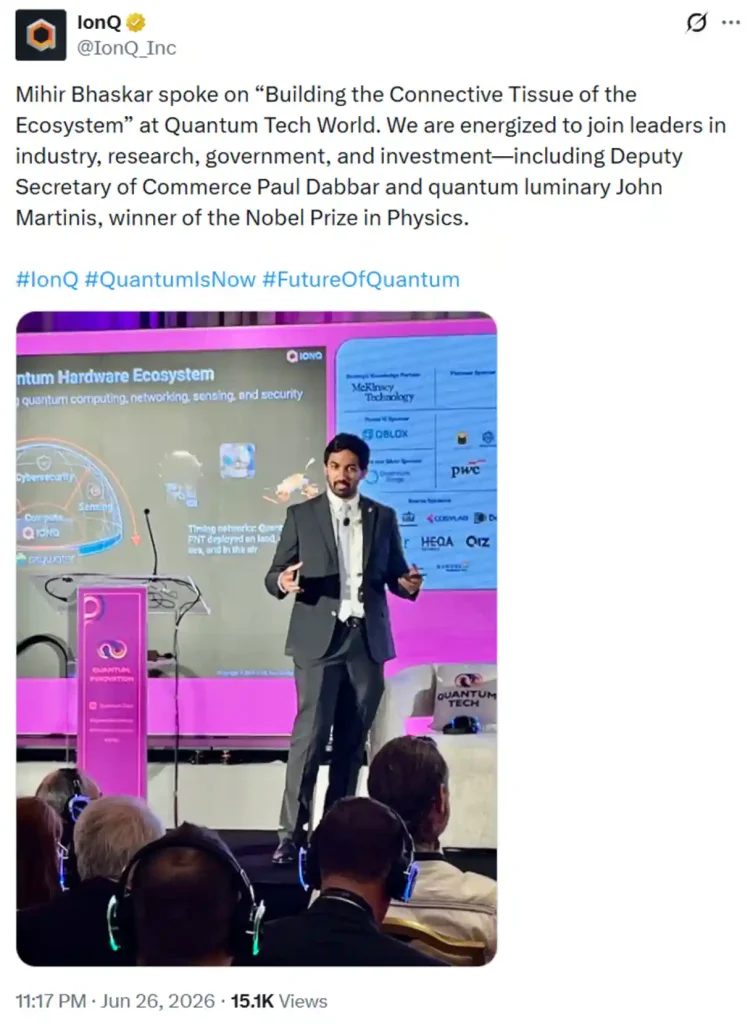
The quantum computing field has plenty of hardware breakthroughs and research papers, but the pieces don’t always talk to each other. At Quantum Tech World, IonQ’s Mihir Bhaskar tackled that issue directly in a talk called “Building the Connective Tissue of the Ecosystem.” His argument was revolved around a thesis that without better links between the people building this technology, progress stays slower than it should be.
Why the ecosystem feels fragmented
Quantum computing pulls from a lot of different worlds. You’ve got academic labs chasing fundamental physics, startups racing to ship products, government agencies funding the work, and investors deciding where the money goes. Each group speaks its own language.
That separation breeds problems. A breakthrough in a university lab can sit unused for years because nobody translated it into something a company could build on. Bhaskar’s point centered on closing those distances so ideas move faster from theory to working machines.
The talk landed as the field is maturing fast. Companies like IonQ, IBM, and Google have moved past pure research into commercial products, which means the questions have shifted. The hard part now is coordination across groups that historically kept to themselves.
Who showed up and what it signals
The lineup at the event tells you where quantum sits today. Deputy Secretary of Commerce Paul Dabbar attended, a sign that the federal government treats this as a priority worth high-level attention. The National Quantum Initiative Act, signed in 2018, committed more than $1.2 billion to quantum research over five years, and the investment keeps the government deeply involved.
John Martinis was also there. He led the Google team that claimed quantum supremacy in 2019, when its Sycamore processor performed a calculation that would take a classical supercomputer thousands of years. His presence put one of the field’s most recognized researchers in the same room as policymakers and investors.
That mix is the whole idea. When a Commerce Department official and a leading physicist share a stage, the conversation can cover funding, science, commercial reality, and more, all at once. These rooms used to stay separate, and the people in them rarely crossed paths.
The meaning of “connective tissue”
Moving away from focusing on a single product or platform, Bhaskar’s describing the relationships, standards, and shared infrastructure that let separate players build on each other’s work instead of starting from scratch.
Quantum lacks much of what the classical computing had during its development, including standards like USB, TCP/IP, and common programming languages that let companies build components that snapped together. In the quantum field, different machines use different qubit technologies, from trapped ions to superconducting circuits, and software written for one often won’t run on another.
IonQ uses trapped-ion technology, which holds individual atoms in place with electromagnetic fields and manipulates them with lasers. Other companies bet on completely different approaches. Bridging those differences requires agreement on interfaces and benchmarks, and that agreement only happens when the right people stay in regular contact.
The road ahead for quantum collaboration
None of this gets solved at one conference, as building shared standards takes years and demands cooperation between competitors who often prefer to guard their advantages. The history of technology shows that the companies who help set standards tend to benefit, even when they give up some short-term edge.
There’s also the fact that financial stakes keep climbing. Global quantum technology investment passed $42 billion in government commitments as of 2023, according to McKinsey, and private money continues to flow in. That capital wants returns, which pushes the field toward practical applications and away from endless research.
IonQ’s positioning as a connector serves a clear purpose. A company that helps define how the ecosystem works gains influence over its direction. Bhaskar’s talk reads as both a genuine call for cooperation and a strategic move.
The takeaway
Quantum computing won’t reach its potential through hardware alone. The machines matter, but so do the connections between everyone building them, funding them, and turning them into something useful. Bhaskar’s message at Quantum Tech World was a reminder that the field’s next phase depends as much on coordination as on physics.
If you follow this space, watch for the standards bodies and partnerships that form over the next few years. Those will tell you more about quantum’s commercial future than any single processor announcement. The connective tissue is where the real work happens now.