
What IonQ’s Radar Contract Says About Its Quantum Story

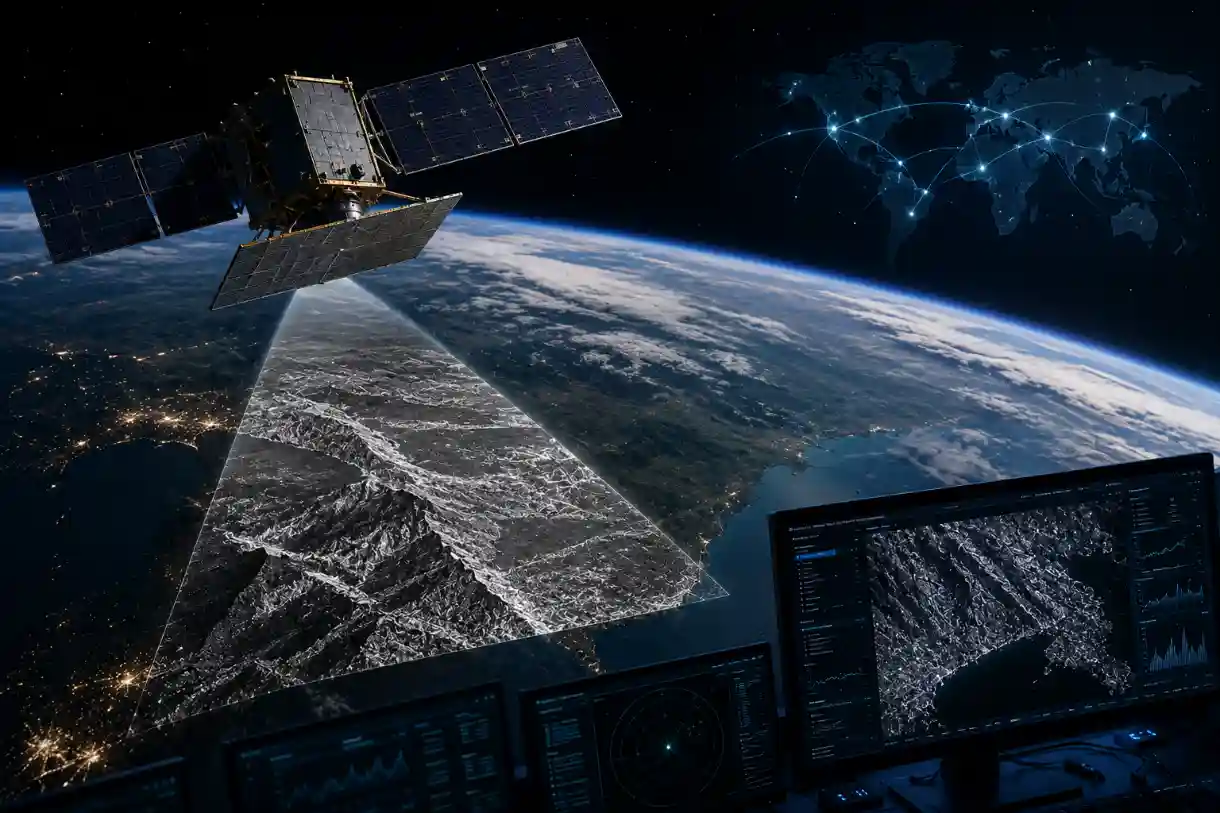
Read IonQ’s latest press release and count the qubits. There aren’t any. The company that bills itself as “the world’s leading quantum platform company” has announced that its subsidiary Capella won a contract from the National Reconnaissance Office (NRO) to supply synthetic aperture radar imagery, the all-weather satellite pictures governments use for surveillance and mapping. It’s a national-security win. It has nothing to do with quantum computing, and that’s the story.
Start with why IonQ owns a radar-satellite company at all. When it closed the $318 million Capella acquisition in July 2025, the pitch was quantum: Capella’s satellites would become the backbone of a space-based quantum key distribution network, beaming un-hackable encryption keys between orbit and the ground.
That’s a great idea, but it’s also years away. In the meantime, Capella has a business that already earns money, selling radar imagery to governments, and this NRO award is that business, the day job, not the quantum future IonQ described when it made the purchase. Niccolo de Masi, IonQ’s chairman and CEO, described the framing in the company’s August 6 press release:
“Our SAR capabilities are built for the mission demands of government customers who need reliable, timely intelligence in complex operating environments. This award reflects the continued trust in our commercial SAR platform, and our commitment to delivering advanced technologies that support U.S. national security.”
Reliability and government trust are at the center, with national security as the throughline. Quantum never comes up.
The acquisition machine
Capella is one piece of a buying spree. Over the past few years IonQ has acquired the quantum-networking firms Lightsynq and ID Quantique, the trapped-ion rival Oxford Ionics, and, this summer, the semiconductor foundry SkyWater for $1.8 billion, handing it an in-house chip fab.
Some of these are quantum companies and several are not. What they share is a direction. IonQ is assembling a vertically integrated national-security technology company, with a quantum computer at the center and a widening ring of conventional hardware around it, satellites and chip fabs among them.
Revenue now, quantum later
IonQ is doing what a patient hardware company should. Quantum computing won’t throw off large profits for years, a reality even the field’s advocates concede when they argue about how to measure its business value.
Buying companies with genuine revenue and government relationships funds the long R&D runway and builds the industrial base a quantum future will need anyway. De Masi has taken this national-security pitch to Washington, and it lands. The government wants domestic, trusted suppliers, and IonQ is positioning to be one across several technologies at once.
On the other hand, a company valued as a quantum pure-play is booking a growing share of its revenue from things that aren’t quantum, and every radar contract or chip order makes “quantum platform company” a looser description of what IonQ actually does.
The quantum work continues, the quantum-memory lab it’s funding in Chattanooga among it, but it’s now one line item in a conglomerate. Investors buying IONQ for exposure to qubits are also buying a spy-satellite operator.
Both readings can hold at once. Which one deserves more weight depends on the question you’re asking. If it’s whether IonQ will build a useful quantum computer, this radar deal is noise. If it’s what kind of company IonQ is becoming, the deal is a data point that keeps recurring, and the picture looks less like a quantum lab each quarter and more like a defense-technology holding company that owns one. The NRO didn’t buy qubits. It bought radar imagery, from a company the market still prices as quantum.