
A Secret That Can’t Be Copied, Even After the Key Is Out

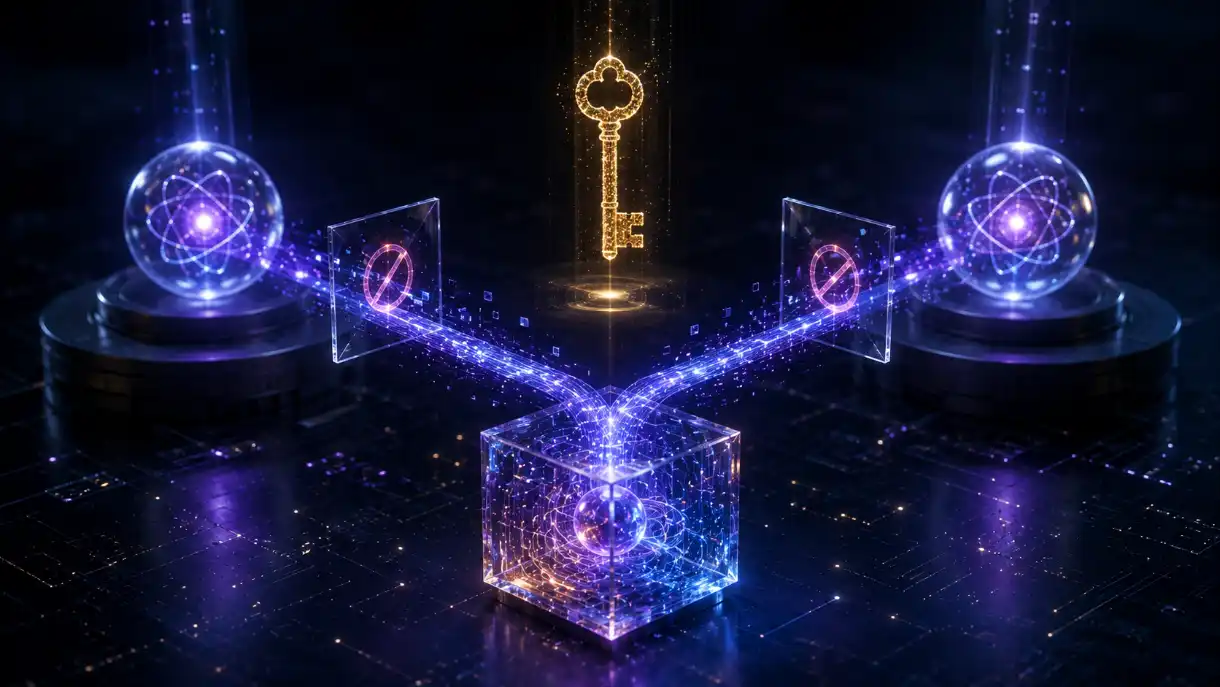
Copy an encrypted file and you’ll have two encrypted files, both openable with the same key. That’s how digital information works, and cryptography builds around it. A new theoretical result flips that assumption. Two researchers describe a way to encrypt a message so it’s impossible to duplicate it into two independently usable copies, even if an attacker later learns the decryption key. The trick is quantum, and there’s a twist in how the proof got written.
Turning no-cloning into a lock
The physics behind it is the no-cloning theorem, one of the stranger rules of quantum mechanics. You can’t make a perfect copy of an unknown quantum state. Measure it or try to clone it and you disturb it, the same principle that makes quantum key distribution hard to eavesdrop on.
Unclonable encryption takes that limitation and turns it into a feature. The message is encoded into a quantum state, the kind of fragile quantum information that’s hard to move and copy in the first place, built so no attacker can split it into two pieces that both decode correctly later.
The attack it defends against is specific and clever. An adversary gets one quantum ciphertext, before the key exists, and has to divide it between two collaborators who can’t talk afterward. Once each gets the key, both try to recover the message, and if both succeed, the attack wins. Two collaborators can always agree to guess the same answer and be right half the time, so the question is whether any strategy beats that coin flip.
The researchers, Prabhanjan Ananth of UC Santa Barbara and Amit Sahai of UCLA, prove that no strategy beats it by more than an exponentially tiny margin. The security is also information-theoretic, resting on the laws of physics and not on an attacker’s limited computing power.
Where it could count is anywhere copying is the threat, secure communication and digital rights management among them, the settings where stopping duplication is as important as stopping unauthorized reading.
A proof written by a machine
Two things make the result stand out. The construction is simple to run, using only single-qubit Clifford gates to encrypt and local measurements to decrypt, a real advance over earlier schemes that needed quantum keys or impractical algorithms. The construction itself wasn’t new, coming from earlier work by Pierre Botteron and colleagues, but proving it actually delivers the strong security guarantee is the contribution here.
The other standout is a disclosure the authors have put right in the paper:
“The construction and main ideas of the proof were generated entirely by Codex using GPT 5.6 Sol Ultra… The human authors take full responsibility for the claims and proofs contained in this paper, and have carefully refined and verified them.”
That’s a candid admission, and a careful one. An AI wrote the core of the argument, and the humans are staking their names on having checked it. It fits a fast-growing pattern of AI-assisted theory work, and it carries the same limitations: a machine-generated proof needs the same slow, skeptical verification any proof gets, and this one hasn’t cleared peer review yet.
A one-bit proof of concept
This is a preprint, and a narrow one. The scheme encrypts a single bit of information, one time, with a key good for one use. Stretching it to longer messages or reusable keys remains as open work. So it’s a foundational proof that a hard thing is possible in a clean setting, closer to a promising design that lives on paper than a tool anyone will deploy. Quantum cryptography has a long history of elegant results that take years to turn practical, and even the flagship QKD networks running today stay limited and short-range.
What makes it worth attention is the direction. Unclonable encryption is one of the genuinely new things quantum information can do that classical bits can’t, a capability rather than a faster version of an old one, and it sits in the same quantum-security push preparing for the day large quantum computers arrive. The physics is settled. Whether an AI-written proof of it holds up, and whether the one-bit demonstration ever grows into something usable, are the questions the field will chew on next.