
Scientists Designed a Promising New Qubit. It Only Exists in Simulation


Imagine ordering a custom part from a factory, except the factory is a supercomputer and the part is a single flaw placed inside a crystal on purpose. That’s basically what a team led by Sungkyunkwan University, working with Wisconsin-Madison and the University of Washington, just did. They designed a defect, atom by atom, that their calculations say would make an excellent qubit. The catch is that nobody has made it yet.
Start with the problem they’re chasing. Some of the best solid-state qubits are tiny defects sitting inside a crystal, where a trapped electron spin can hold quantum information at room temperature for a surprisingly long time. The famous one is the nitrogen-vacancy center in diamond, a missing carbon atom paired with a nitrogen substitute. It works beautifully. Diamond, less so. It’s hard to grow as big, clean crystals, and it doesn’t slot into the machinery the chip industry already uses. That’s a real obstacle if you ever want to mass-produce quantum devices.
Why researchers chose zinc oxide
So, according to the July 24 press release and a paper published in PRX Quantum, the team went looking for the same trick in a friendlier material. They landed on zinc oxide, a semiconductor the industry already knows how to grow and shape. It has one especially nice feature for this job. It’s magnetically quiet. Almost none of its atomic nuclei carry spin, and nuclear spin is one of the main things that jostles a qubit out of its quantum state. Fewer noisy neighbors, longer-lived information.
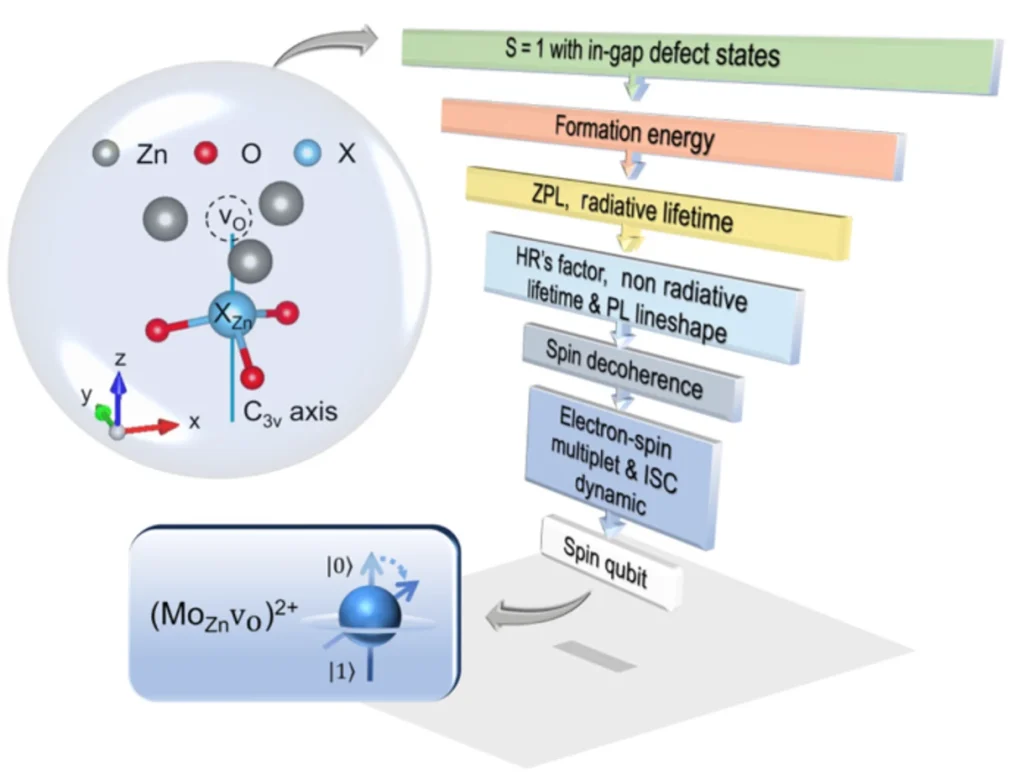
The researchers then used first-principles simulations on supercomputers to screen candidate defects across much of the periodic table, hunting for one with the right behavior. Their winner has a mouthful of a name, the molybdenum-oxygen-vacancy complex. In plain terms, take a zinc oxide crystal, swap one zinc atom for a molybdenum atom, and knock out the oxygen atom sitting next to it. That specific arrangement, on paper, does what you want a qubit to do.
What the simulated qubit actually promises
The predicted numbers are the exciting part, so hold onto the word “predicted.”
Under light, the defect glows bright and sharp in the visible range, which makes it a strong candidate for a quantum light source. The technical measure here is the Huang-Rhys factor, a gauge of how much emission energy bleeds off into crystal vibrations instead of clean light, and this defect’s is far lower than other known zinc oxide defects. Its electron spin should hold quantum information for about 4 milliseconds even with magnetic noise around it. The model also says you could read the spin’s state accurately in a single measurement, a capability called single-shot readout that error correction and quantum networks both need.
Every one of those figures comes from the simulation rather than a lab.
However…
This qubit doesn’t exist yet. What the team built is a very detailed argument that it should, run through the kind of physics modeling that gets published in PRX Quantum, one of the field’s serious journals. The researchers say as much, framing the result as promising “if experimentally realized.” Someone still has to grow the crystal and measure whether the defect behaves the way the math insists it will.
So why care about a qubit made of equations? Because the payoff, if it survives contact with a real lab, is manufacturability. Zinc oxide fits existing crystal-growth and fabrication methods, which is the same reason silicon keeps pulling quantum researchers in. A qubit you can actually build at scale beats a better one you can’t. As it stands, this is a blueprint with good numbers and an empty workbench next to it.