
A Paperclip-Sized Quantum Sensor Can Find Radio Signals in 3D

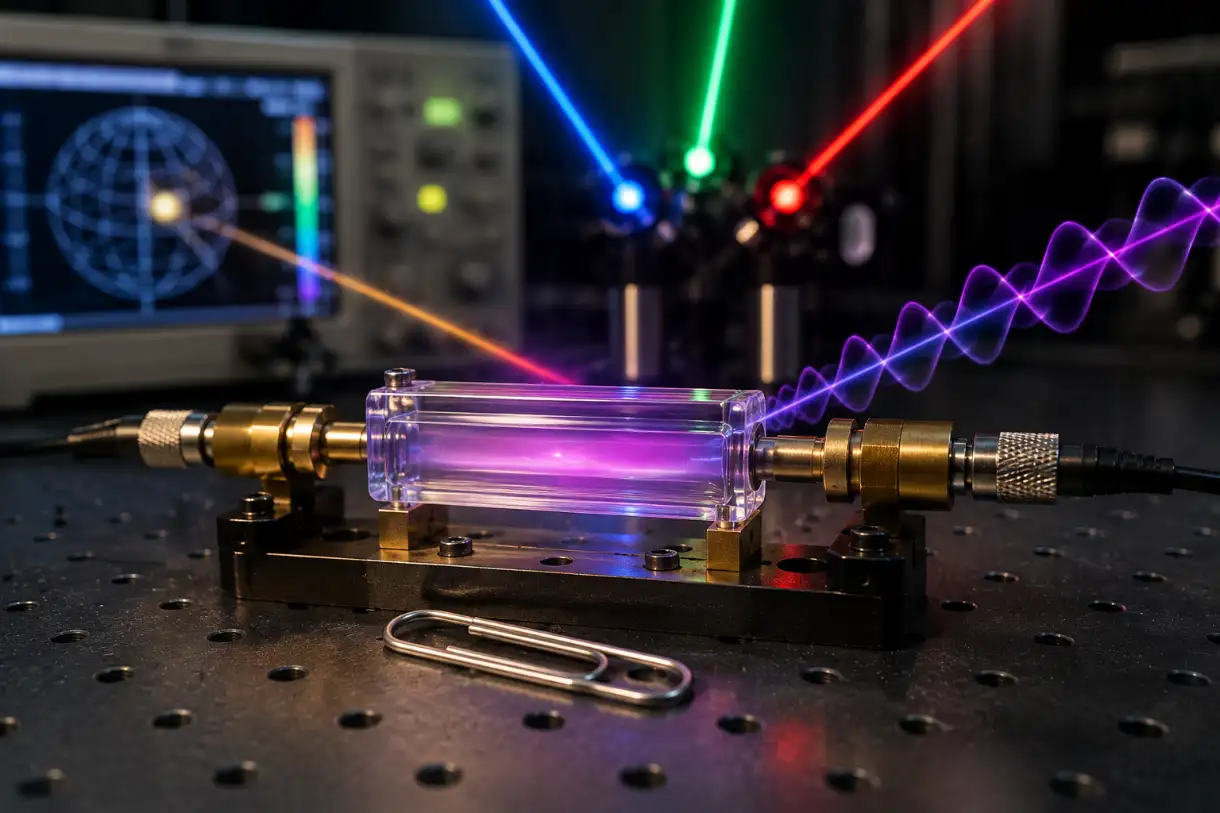
U.S. Army researchers have built a quantum sensor the size of a paperclip that can work out the 3D direction of a radio signal, a job that normally takes several bulky antennas. The device uses a 2.5-centimeter glass cell of excited atoms to cover a wide range of frequencies and locate incoming waves to within two degrees. The work, reported by IEEE Spectrum, was published in Physical Review Applied.
How it works
The sensor relies on Rydberg atoms, atoms with one electron kicked into a very high energy state so it orbits far from the nucleus. Out there, passing electric fields easily disturb the electron, which shifts the atom’s energy levels in a way a laser shining through the cell can read. Indeed, that gives the device its sensitivity across a wide span of frequencies.
Direction is the harder part. Instead of spacing antennas apart to triangulate, the sensor measures a signal’s polarization, the way its waves twist as they travel. The team beams in three reference signals along the X, Y, and Z axes, and an incoming wave nudges the field on each axis differently depending on where it came from. The atoms pick up that interaction, which maps the signal’s orientation and points back toward its source.
Why it’s not ready yet
The appeal is size. Conventional antennas have to roughly match the wavelength they track, and covering many bands means many antennas that interfere if placed too close. A single small cell sidesteps that.
The catch is that this is still a lab result on an optical table, and the lasers that probe the atoms are finicky and dislike heat and humidity. The Army’s research lab is now working with the Colorado company Infleqtion on a field-ready version, borrowing stabilization tricks from atomic-clock technology. As ARL physicist David Meyer told IEEE Spectrum, the path to a tiny deployable unit is real but “a very long path with a lot of dollar signs associated with it.”