
A Ribbon Nine Atoms Wide That Snitches on Radiation

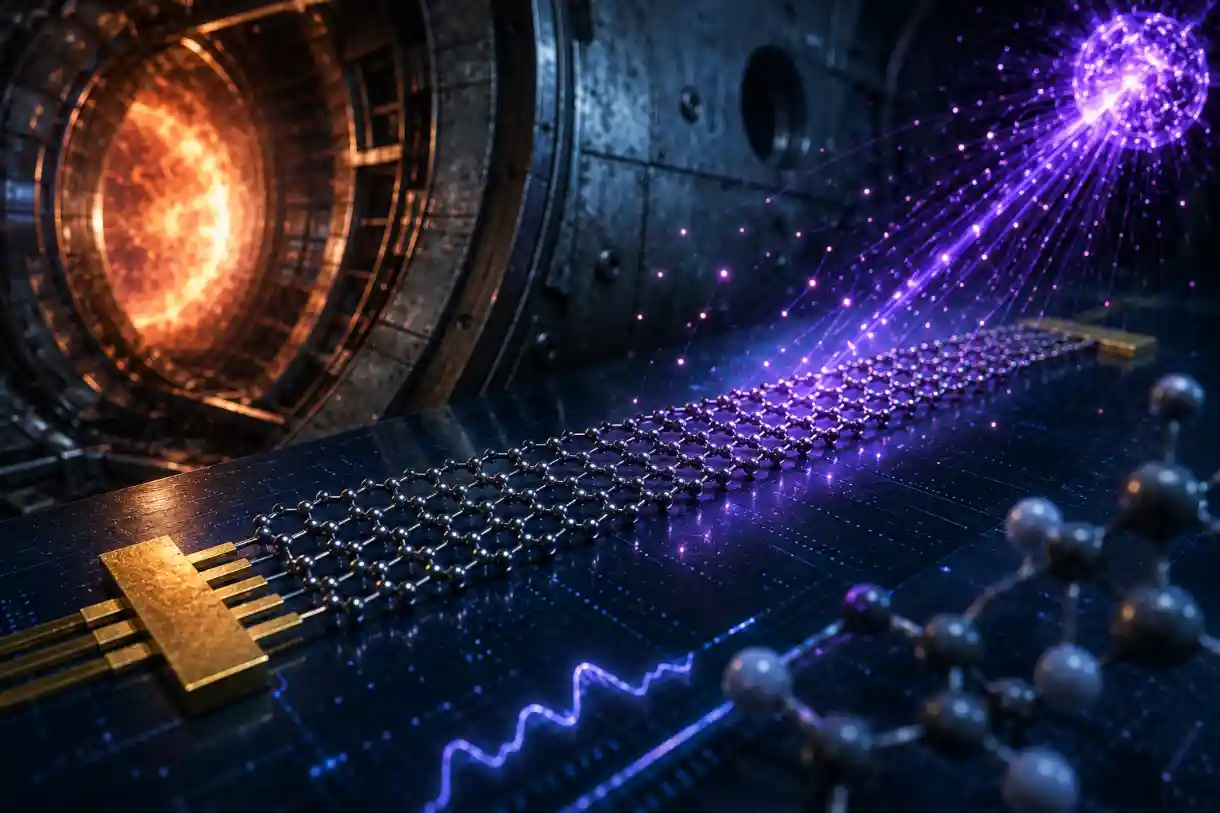
Here’s a design problem that sounds impossible. You need a sensor that sits in one of the most hostile places humans have ever engineered, the inside of a fusion reactor, and you need it to react to radiation without radiation destroying it. Change, but don’t break. Most electronics pick one.
The spot in question is the first wall, the innermost barrier standing between the superheated fuel and the rest of the reactor. It degrades under constant bombardment, so it has to be inspected and replaced. Silicon sensors can’t survive in there, so engineers park them outside the barrier, settle for indirect readings while the reactor runs, then shut everything down to physically inspect the damage. Shutdowns are expensive. Live data would be better.
According to the July 16 report, researchers at the University of Arizona think a strange material might get closer to the fire. In a proof-of-concept study in ACS Applied Materials & Interfaces, they built devices from graphene nanoribbons, strips of carbon exactly nine atoms wide, one atom thick, and roughly 45 nanometers long. Tens of thousands of times thinner than a hair. Then they hit them with gamma radiation.
The ribbons survived. Their atomic framework came through intact. But their electrical behavior shifted sharply, which as principal investigator Zafer Mutlu points out is exactly the combination you want: “The devices survive the exposure and still respond, but their electrical performance changes dramatically. That’s exactly the behavior we want from a sensor.”
Why graphene nanoribbons respond to radiation
At that scale you have left classical physics behind. The team’s measurements suggest the gamma rays create reactive molecules in the surrounding air that nibble at the ribbon’s edges while leaving the overall structure alone. In an ordinary chunk of material that would amount to nothing. In a ribbon nine atoms across, quantum effects magnify it. Their proposed explanation is Anderson localization, which pins the charge-carrying electrons in place and chokes off the current. That collapse in current is the reading.
The tantalizing part is that it looks tunable. Because the ribbons are assembled molecule by molecule, Mutlu says it’s possible to dial in the response: “You can make it less sensitive, more sensitive, non-sensitive.” That’s important for satellites and deep-space probes too, where catching radiation wear early beats discovering it after a failure.
Why the technology could matter for fusion reactors
Now the honest bit. Nobody has built a sensor yet. This is a first study, Anderson localization is the team’s proposed mechanism rather than a confirmed one, and the next steps are unglamorous: different doses, different ribbon sizes. Fusion’s own engineering problems don’t get solved by better instrumentation either.
Still, a material that takes the hit and then tells you it took the hit is a quietly elegant trick.