
Can Quantum Save Democracy? Count the Voters First

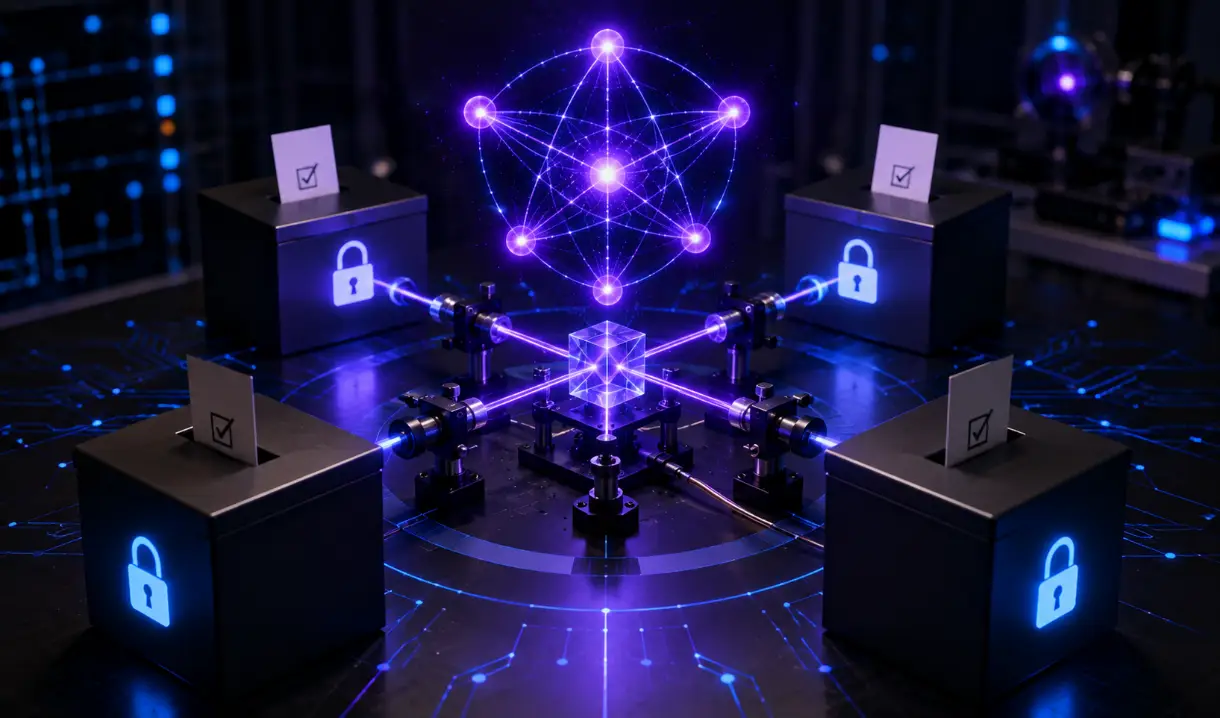
“Can quantum save democracy” is the kind of headline that should trip an alarm. The claim behind it is concrete, though. Three new experiments, two published in Physical Review Letters and one in npj Quantum Information, demonstrate quantum voting: using entangled photons to keep ballots secret and let voters verify the count.
They’re peer-reviewed and genuinely clever. They also involve four voters, eight voters, and two voters, respectively. The plain answer to the headline is “no,” and the reasons are worth understanding, because they show exactly what quantum can and can’t do for an election.
What quantum voting is
Start by clearing up the biggest misconception. No quantum computer counts the votes, and none is required. The quantum part distributes correlated random bits among voters, using entangled Greenberger-Horne-Zeilinger states, so the machinery sits much closer to quantum communication than to quantum computing.
Those shared correlations do two jobs. They let voters coordinate a ballot anonymously, and they let voters check whether the system cheated. The reward for doing it with physics is information-theoretic security, protection that holds even against an attacker with unlimited computing power, as long as the protocol’s assumptions do. It’s the same guarantee behind other quantum tricks that classical bits can’t reproduce.
The clever part is removing the trusted authority
The genuine advance in these protocols is who you no longer have to trust. Every electronic voting system has to distribute ballots somehow, and normally you trust the machine that does it. In the University of Geneva’s four-voter experiment, built on four-photon entangled states at about 89% fidelity, the participants instead sacrifice some rounds to test the quantum correlations directly, catching a distributor that tries to cheat.
A second team, at Sorbonne University and ICFO, pushed a related idea to eight voters choosing among sixteen candidates, with no election authority required at all. A third group, at Shanghai Jiao Tong University, took a different tack, running a two-voter scheme over 50 kilometers of standard telecom fiber using continuous-variable optics, the kind of entanglement-over-fiber work that could ride existing networks. Swapping trust in an official for a test against physics is a real idea, and these are clean demonstrations of it.
Four voters is not a nation
But then comes the leap. Generating a pristine four-photon entangled state on a laboratory bench is a different universe from distributing quantum resources to millions of people scattered across a country. Photons get lost in fiber, and noise and imperfect detectors corrupt the correlations the protocols rely on.
Scale is the obvious issue, the same one that keeps most quantum-network applications from working outside a lab today. The experiments’ own numbers make the point: success rates in the high 80s, voting throughput measured in a few hundred operations per second. That is a proof of principle and not a polling place.
Physics can’t fix a political problem
The deeper limit isn’t technical. The hardest requirement of a real-life election is one physics doesn’t touch: coercion resistance. A ballot can be perfectly anonymous in the math even as a voter is pressured, by an employer or across the kitchen table, to prove how they voted.
No entangled state prevents that. Nor does quantum handle voter eligibility, duplicate voting, malfunctioning equipment, disputes, recounts, or a phone compromised by malware. Elections are hard because of those problems, and ballot secrecy, the part that quantum addresses, was never the piece most likely to fail.
Where it truly lands
Set the democracy framing aside and a sober picture remains, one the researchers and a recent Kennesaw State analysis by Nitin Jha and Abhishek Parakh broadly share. Quantum voting won’t replace elections; it might supply a few security functions inside one. The believable near-term use is small: a corporate board, a small organization, a setting where anonymity carries real personal stakes and the headcount stays in the dozens.
And the realistic design is hybrid, pairing quantum mechanisms for anonymity and tamper-detection with ordinary end-to-end verifiable voting and post-quantum cryptography for authentication and records. It’s quantum as a component and not a replacement.
So, can quantum save democracy? No. The threats to a modern election are mostly human, and physics doesn’t legislate. What these experiments show is smaller and still notable: a handful of the guarantees we currently ask voters to take on trust could instead rest on the laws of nature. Carrying that from four voters to four million is the decade of work that starts now.