
ESA Installs Its First Quantum Computer for Earth Observation

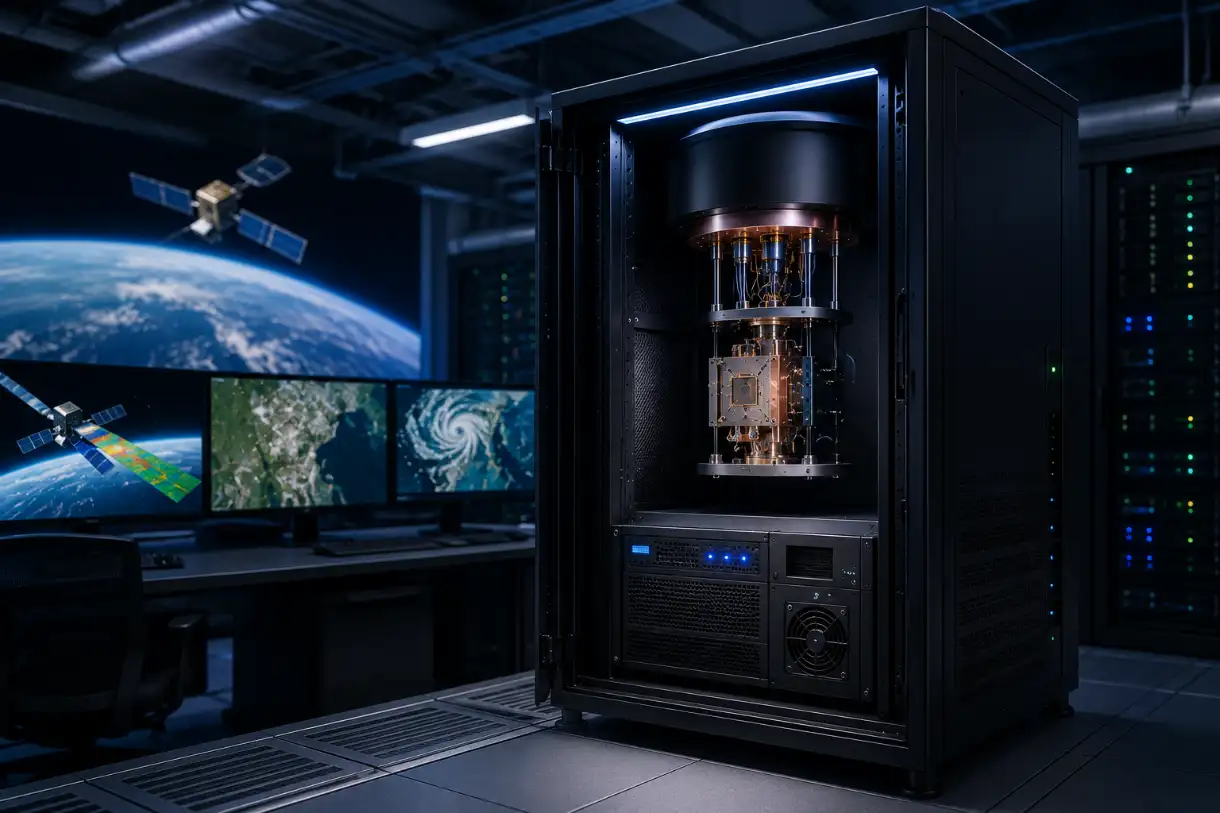
The European Space Agency (ESA) has installed its first quantum computer at ESRIN, its Earth-observation center near Rome. The machine, Equal1’s six-qubit Bell-1, will pair with ESA’s high-performance computers to test whether hybrid quantum-classical methods can help with the flood of satellite data. It is a small testbed, not a computing leap.
Why ESA chose Equal1’s Bell-1
The more notable detail is the hardware. According to the July 15 report, Bell-1 uses silicon spin qubits built on the same CMOS process that makes ordinary smartphone and laptop chips, and it runs at about 0.3 kelvin. That is still extremely cold, but far warmer than the near-absolute-zero many quantum computers need, and it changes the logistics entirely.
The entire system fits in a rack-mounted chassis, cools itself with a closed-cycle cooler instead of external coolant tanks, and draws around 1.6 kilowatts, about what a single high-end server uses. That is why ESA could slot it into an existing data center rather than build a specialized facility.
What ESA hopes to learn from the system
Bell-1 will be available for internal ESA research for a year after commissioning, and ESA’s Φ-lab plans a pilot demonstration by the end of 2026. Early use cases include hybrid quantum neural networks for land-cover classification and satellite mission planning, with results due to be shared at a joint workshop with Equal1.
Six qubits is very small, and the release is candid that today’s machines face limitations through errors and that proving a real advantage for Earth observation remains unsolved. So this is a place to prototype and benchmark hybrid algorithms, not a system that beats classical computing. Giuseppe Borghi, who heads ESA’s Φ-lab, put it in the right register, describing quantum as a way to complement high-performance computing rather than replace it, and the project as a test of where it delivers value.