
Google’s Quantum Computer Learns From Its Mistakes Without Clocking Out

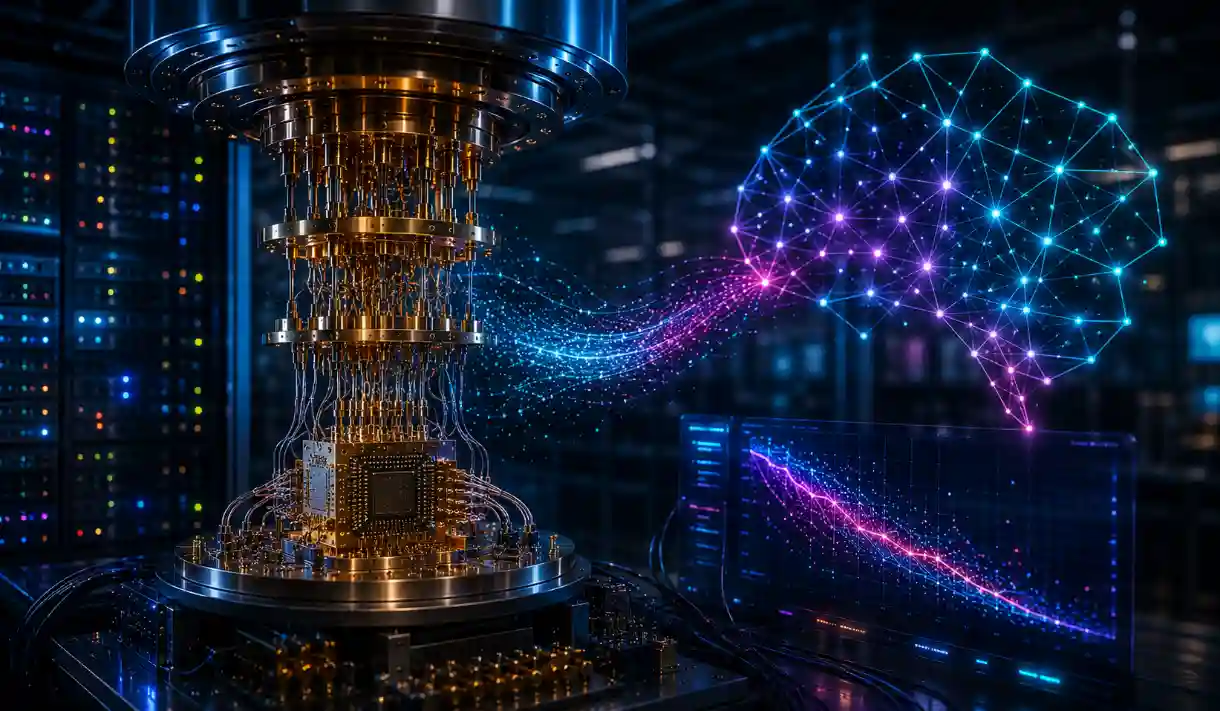
Say there was a race car that retunes its own engine mid-lap, using the exact skid marks it just left in the corners as the instructions for how to steer better. No pit stop. It just gets faster as it’s still driving. That, more or less, is what a Google-led team just pulled off with a quantum computer, and it published it in Nature.
The idea in one breath is this. Quantum computers drift, since the microwave pulses that steer the qubits wobble as the electronics warm up, materials shift, and the environment does its thing, and that drift quietly cranks up the error rate. The usual fix is to stop the computation to recalibrate, and then start again. That’s fine when your program runs for a second, but a disaster when it’s supposed to run for days.
Every mistake is a flashcard
So, per the July 8 paper, the team stopped treating calibration as a separate chore. Quantum error correction already spits out a constant stream of little error-detection signals, normally used only to catch and fix mistakes in the encoded data. Google pointed a reinforcement learning agent at that same stream and told it to learn.
Reinforcement learning is the trial-and-feedback style of AI, the same branch that powers recommendation feeds and robot-walking algorithms. Here the agent watches the error signals, nudges more than 1,000 control knobs (pulse amplitudes, frequencies, coupling strengths), and keeps whatever makes the errors drop. Every detected error becomes a flashcard. The error correction is now doing two jobs at once: protecting the information, and teaching the machine how to protect it better.
The researchers are careful to call this a limited form of self-improvement, and this is important. The processor is not inventing algorithms or redesigning itself. It’s tuning its own controls, live, with no human in the loop.
The numbers, and where they get interesting
On Google’s Willow chip, after the team had already calibrated the thing to death with expert tuning, the AI still shaved logical error rates by about 20%. That’s the part that should raise an eyebrow. It found improvements the experts, with their careful physics-based models, had missed.
Then they got mean on purpose. They injected artificial drift to see if the system could chase a moving target, and it did: a 31% cut in error rate and 3.5 times steadier performance once it was allowed to adapt the decoder too. Why does this hold up at scale?
Because a given knob mostly affects the errors near it, not the whole chip, so the problem stays local even as it grows. In simulation they pushed it to roughly 40,000 parameters and the tuning speed barely flinched.
The part where I stay honest
This doesn’t make errors disappear, and it’s not a fault-tolerant computer solving anything useful. It is one enabling piece. The learning also works by deliberately poking the hardware, which is fine now but gets delicate during a real computation you cannot afford to jostle. Some drift still happens faster than the agent can react. And the whole thing runs on Google’s proprietary software, though the team published the math so others can rebuild it.
Still. A machine that reads its own mistakes and quietly gets better at not making them, while it is still working, is a strange and good trick. Nobody has to stand over it with a wrench the entire time. For now, that is the whole point.