
IBM, University of Sydney Advance Quantum Error Correction

Researchers from the University of Sydney and IBM have demonstrated a new approach to improving quantum error correction that significantly increases the reliability of quantum computations. Specifically, using an IBM 156-qubit Heron processor, the team identified mid-circuit measurements as a major source of errors and showed that redesigning error-correction circuits can substantially improve logical qubit performance.
Researchers reduce quantum errors by redesigning measurements
According to a June 23 report, quantum computers remain highly sensitive to environmental noise, which makes error correction essential for scaling them into practical machines. However, the measurements used to detect errors can themselves introduce additional instability.
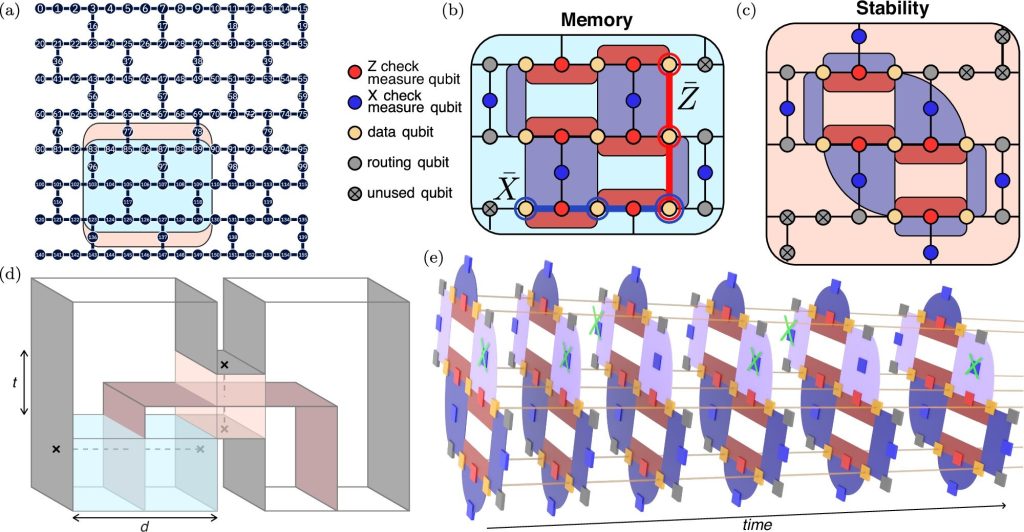
To better understand this problem, the researchers analyzed mid-circuit measurements, which repeatedly measure selected qubits amid running calculations. During these measurements, the remaining qubits must temporarily idle, allowing additional noise to accumulate.
Using IBM’s 156-qubit Heron r2 superconducting quantum processor, the team redesigned the error-correction circuitry to shorten these idle periods.

According to the study, the improvement increased logical qubit survival rates from below 90% to more than 96% during each error-correction cycle, and also identified measurement noise as one of the dominant factors limiting today’s quantum logic operations.
Project lead Professor Stephen Bartlett said the work provides quantitative benchmarks that show where engineering improvements will have the greatest impact on future quantum hardware. As he explained:
“Quantum computers will become even more useful if we can reliably detect and correct errors while calculations are taking place. (…) This joint project with IBM helps us understand which parts of today’s quantum hardware are introducing the most problems and where engineering improvements will have the greatest impact.”
Results support roadmap toward fault-tolerant quantum computing
Lead author Dr. Robin Harper said the project focused on identifying why error-corrected quantum operations fail on current hardware and not simply demonstrating higher performance. In his words:
“Quantum error correction is essential for building large-scale quantum computers, but it introduces a very complex set of engineering challenges.”
The research was conducted as part of the University of Sydney’s collaboration with IBM, launched in 2024 and funded by the U.S. Intelligence Advanced Research Projects Activity (IARPA), to benchmark fault-tolerant quantum computing techniques.
The project also involved researchers from Freie Universität Berlin, the University of Edinburgh, Johannes Gutenberg University Mainz, and University College London.
The findings, published in Nature Communications, provide practical guidance for improving quantum hardware as the industry works toward scalable fault-tolerant quantum computers capable of solving problems in chemistry, materials science, drug discovery, and other computationally demanding fields.