
Neutral-Atom Researchers Just Raised the Bar on What Counts as a Quantum Win

For years, every quantum company published its own roadmap. This one’s different, because it belongs to the whole field, and because it redraws the finish line.
Dozens of neutral-atom groups, from MIT and Harvard to QuEra, PASQAL, Infleqtion, planqc, and NanoQT, have posted a shared strategic plan for moving their machines from lab curiosities to computers that solve problems worth solving and which grew out of an NSF town hall at MIT in early 2025. It’s a preprint that hasn’t been through peer review, and it reads less like a discovery than a treaty.
The centerpiece of the document is a definition.
How the roadmap redefines quantum advantage
The paper argues a quantum computation should count as practically advantageous only if it clears four things at once. It has to return a correct answer. It has to beat the classical hardware you can actually buy rather than a convenient baseline, and it has to scale better than classical methods as the problem grows. Also, it has to solve something a person outside the group that built the machine actually wants solved.
Give the old demonstrations their due. Random-circuit sampling and similar tests did prove that quantum processors can strain the best classical machines. That was genuine. It also wasn’t useful, and it was often chosen precisely because it’s hard to simulate rather than because anyone needed the answer. The roadmap says so plainly, which is unusual candor from a field that has leaned on those headlines.
So the bar moves from “can it beat a classical computer on a rigged task” to “does it do work someone would pay for.” A harder claim to make, and a more honest one.
Where the field actually stands
The numbers are further along than outsiders assume. Neutral-atom arrays now hold thousands of atoms. Leading experiments have pushed two-qubit gate fidelity past 99.5%. Teams have run logical algorithms using as many as 48 logical qubits encoded in 280 physical ones, which means the platform has already stepped into error-corrected territory.
The trend lines are steep, too. The paper estimates physical qubit counts have grown by a factor of about 1.8 every year for a decade, and gate errors have dropped by a factor of about 0.6 a year. Fit those curves forward and neutral atoms could reach genuine utility within ten years.
Read the conditions, though. That projection holds only if the field scales into the range of 100,000 to 1 million physical qubits with reliable control, and the authors caution their own trend fit is loose. The biggest arrays don’t have the best gates, and the experiments they averaged used different architectures. Directionally right, precisely uncertain.
What still stands between neutral atoms and useful quantum computers
Here’s the sharper admission. Hardware may outrun the algorithms.
The roadmap is candid that only a small number of known quantum algorithms offer a clear exponential advantage, and many of those demand enormous fault-tolerant machines. Shor’s algorithm, the famous one, needs thousands of logical qubits to factor a 2,048-bit number. Newer qLDPC error-correcting codes might shrink that to somewhere between 10,000 and 100,000 physical qubits, though that’s a theoretical resource estimate rather than a machine anyone has drawn up.
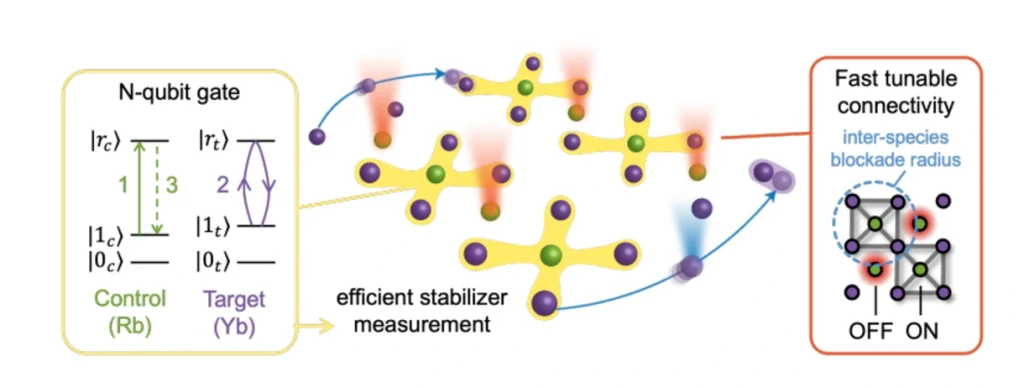
So the field could build a computer with no clearly useful job to run on day one. The authors’ response is co-design. Stop treating hardware, error correction, software, and algorithms as separate problems, and match them to each other. An algorithm that looks too expensive on a generic machine might become practical on a processor and code tuned to its most common operations.
They also want the equivalent of a bake-off. They borrow from how NIST ran its post-quantum cryptography contest and propose shared benchmark problems, things like the two-dimensional Fermi-Hubbard model, where quantum and classical teams attack the same task at the same accuracy. It’s a good instinct, because classical algorithms keep improving, and a task that looks quantum-only today can fall to a better classical method tomorrow. Advantage is a moving target rather than a permanent trophy.
What it will take
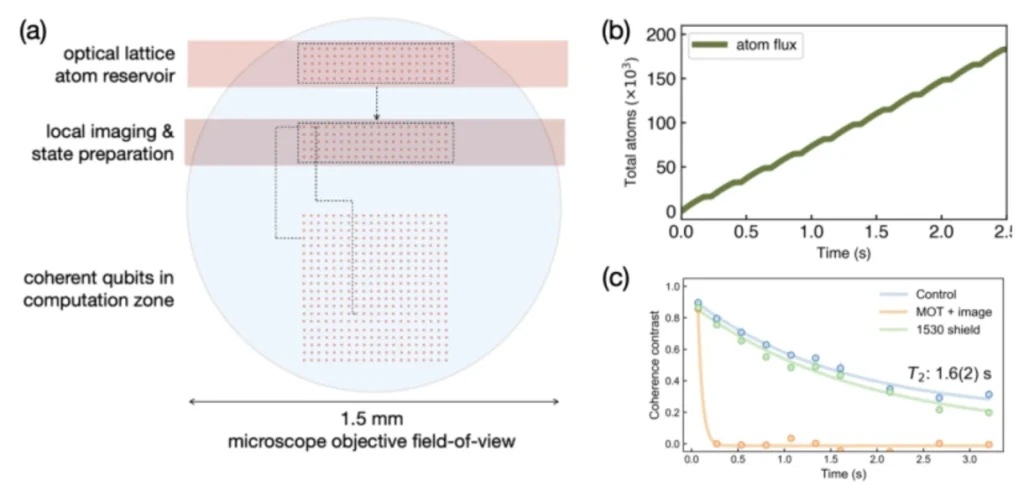
The engineering list is long and unglamorous. Today’s machines steer atoms with lasers, spatial light modulators, deflectors, and imaging systems, and that approach turns into an impractical maze at 100,000 qubits. The paper points to integrated photonics, which guides light through fabricated chips instead of free-space optics, as the likeliest way out. Atoms also get lost mid-calculation, so continuous reloading becomes mandatory once an algorithm runs for millions of operations. Readout has to get faster and gentler. Controllers have to react in real time. And at some point single processors give way to networked ones, linked by photons or by physically shuttling atoms between zones.
None of that has been shown together in one machine. The core of the document sits right there. It combines what’s been demonstrated with what’s only been estimated, and its timelines lean on advances that remain separate today.
Still, the contribution is worth taking seriously. At the very least, a field that defines a strict, shared standard for its own success, and admits the machines may arrive before the problems, is a field that has stopped believing its own press. A healthier place to build from than another company timeline.