
Pasqal Put the Lasers That Trap Its Atoms Onto a Chip

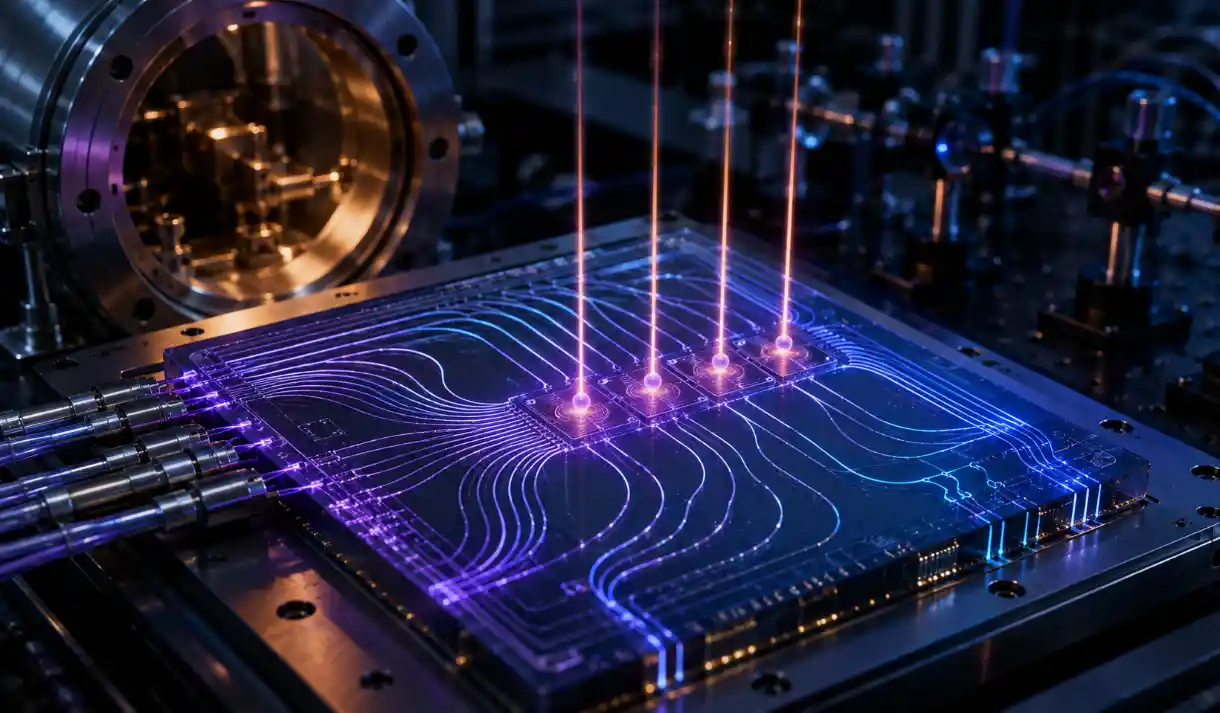
A neutral-atom quantum computer holds each of its qubits in a cage made of light. Focused laser beams called optical tweezers grip single atoms and keep them still, and every atom needs its own precisely aimed beam. Today those beams are shaped by a room-sized bench of mirrors, lenses, and modulators, which is manageable for tens of atoms and a nightmare for the thousands a useful machine will need.
Pasqal, working with a company it bought called Aeponyx, has now moved that beam-making onto a photonic chip and used it to trap four rubidium atoms. The company calls it a world-first, a claim it hedges twice in its own announcement.
Why the optical bench is the wall
The appeal of neutral atoms is that the atoms themselves are identical and cheap, since nature makes them perfectly. The hard part is the control system around them. To scale to more qubits you have to make and stabilize ever more beams of light, and a free-space optical setup grows in size and fragility with every atom you add.
That bulk is one of the main obstacles between today’s few-hundred-atom machines and the large fault-tolerant processors the whole neutral-atom field is aiming at. According to the August 10 press release, Pasqal’s own target is more than 10,000 atoms and 100 logical qubits, and it won’t get there on an optical table.
Putting the light on silicon
The fix Pasqal and Aeponyx demonstrated is to generate the trapping light inside a photonic integrated circuit, a chip that routes laser light through tiny waveguides the way a microchip routes electrons. Built on Aeponyx’s silicon-nitride photonics, the chip produced four optical traps and held four rubidium atoms inside a real quantum processor.
The number that counts is the atom lifetime: about 27.5 seconds, in line with Pasqal’s existing bulk-optics systems. That is the whole point of the exercise, showing that shrinking the optics onto a chip doesn’t cost you the quality of the trap. Wasiq Bokhari, Pasqal’s chief executive, framed the significance:
“By moving qubit control onto a photonic chip, we removed what we believe to be one of the biggest barriers to scale, and we did it within 18 months of acquiring Aeponyx.”
It’s the same move that made classical photonics practical, trading a bench of hand-aligned optics for a programmable chip, and it echoes a wider push to control atoms and photons with integrated hardware rather than room-sized apparatus.
Four atoms is not ten thousand
Keep the result in proportion: this is four atoms in four traps from one chip, a proof of principle, and Pasqal’s destination is more than 10,000 atoms feeding 100 logical qubits. The demonstration shows the photonic approach can trap atoms at all, and do it without degrading quality, which is a genuine step.
It doesn’t show that the approach scales, and the headline promise of an optical footprint as much as fifty times smaller is a design projection rather than a measured result. This is also a company announcement, not a peer-reviewed paper, and the “world-first” label is Pasqal’s own, carefully qualified. Still, the direction fits the field’s slow escape from the artisanal, hand-tuned hardware that keeps quantum machines small.
What the milestone really shows
The clearer signal here is strategy. Pasqal bought Aeponyx so it could possess the photonics layer of its stack. Turning that acquisition into a working atom trap in 18 months is a vertical-integration bet that the company is doing as part of its push toward commercial machines. If integrated photonics scales for atom control the way it did for classical light, the optical bench stops being the ceiling. Four atoms in, that is still a promise, but a credible one.