
Physicist Borrows a Quantum Computer to Watch Matter Build Itself

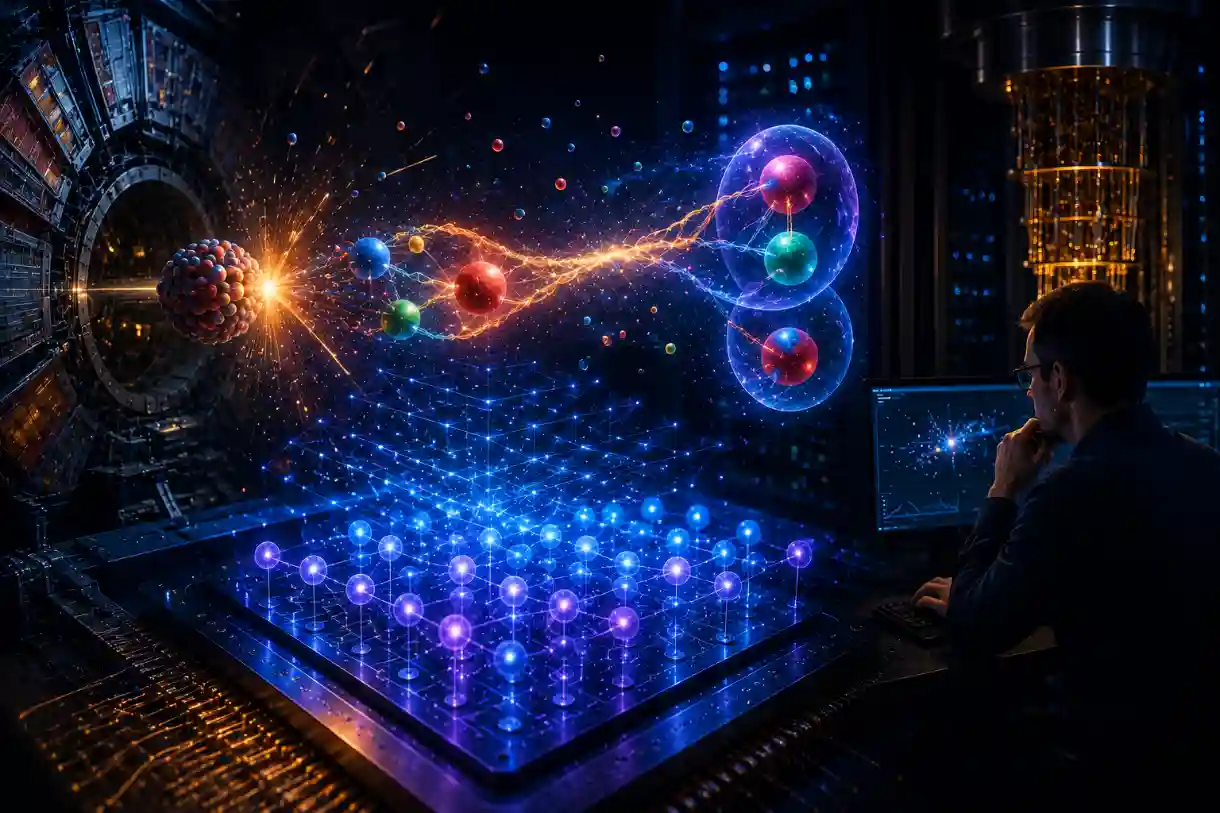
Almost everything you can touch is made of protons and neutrons. The process that assembles them has never been watched all the way through, not in any experiment on Earth.
Anthony Ciavarella got closer than most. He’s a research scientist at Lawrence Berkeley National Laboratory, and he logged into an IBM quantum computer from the other side of the country to simulate hadronization. That’s the instant when quarks lock together under the strong nuclear force and turn into the particles packed inside every atomic nucleus. His results ran in Physical Review D.
Here’s why that’s a big deal.
The step colliders can’t see
Quarks are the subatomic pieces that build up matter. When two or more of them bind through the strong force, they form composite particles called hadrons. Protons and neutrons are the hadrons you already know. Understand how they come together and you understand a little more about the structure of matter itself.
Physicists have a decent view of the collisions but a terrible view of what happens next. At the Large Hadron Collider at CERN, protons get accelerated to nearly the speed of light and smashed together, shattering into a spray of quarks and antiquarks. Those fragments hadronize almost the instant they appear. By the time any detector registers them, the interesting part is already over, so the measurement is always indirect.
Simulations are supposed to fill in the blanks. The trouble is the theory that describes hadronization, quantum chromodynamics, is brutal to compute.
“In principle, we know the theory that describes hadronization, but we are unable to make predictions using it because the calculations have been too difficult for a classical computer,” Ciavarella said. “However, on a quantum computer, we should be able to directly make predictions for the details of how hadronization occurs, which will help with the searches for new physics performed at colliders such as the LHC.”
Why classical machines choke on this
The strong force binds quarks and gluons and tangles them into a mess of quantum correlations. A regular computer has to track every possible state of every particle separately, and the memory it needs doubles with each new particle or time step. Add a few more and you’ve blown past the biggest supercomputers alive, including exascale machines like Frontier.
Quantum computers sidestep the problem because their qubits already behave like the particles under study. A classical bit is a one or a zero. A qubit holds a superposition of both at once, and its power climbs exponentially as you add more of them.
“One of the original motivations for building quantum computers was that they naturally have this quantum phenomenology built into how they’re constructed,” Ciavarella said. “And in these simulations of subatomic systems, we’ve got large amounts of entanglement and quantum correlations that you just can’t efficiently represent on a regular computer.”
How he ran it
Access came through the Quantum Computing User Program, run out of the Oak Ridge Leadership Computing Facility at Oak Ridge National Laboratory. The program hands scientists cloud time on commercial quantum hardware. Ciavarella pointed his at an IBM Heron processor and put 104 of its 156 qubits to work.
Then he simplified, hard. Today’s quantum computers are small and noisy, so the whole exercise was about seeing how far the current hardware could be pushed.
He started with a heavy quark limit and simulated string breaking, the core mechanism inside hadronization. Picture the quarks tied together by strings of gluons. As the quarks fly apart the string stretches and loads up with energy until it snaps, and a fresh quark-antiquark pair forms a new hadron. Heavy quarks are easier to model because they stay put on the simulation grid instead of smearing out. You run the heavy case and extrapolate down to how the light quarks would behave.
To get the qubits into a quantum vacuum, the lowest and most stable energy state, he used a scalable circuit concurrent variational quantum solver, a method he co-developed as a graduate student at the University of Washington.
“The idea is to optimize these vacuum preparation circuits on a small system size. Then you do it slightly bigger and slightly bigger and slightly bigger,” he said. “You can optimize this on up to 10-12 qubits and then extrapolate that out to hundreds if you choose to do so.”
He also flattened the whole thing to one dimension, with particles moving only left and right. An extra dimension is on the list for the next round, once better hardware and algorithms are available.
The part that got him excited
The one-dimensional run reproduced results from earlier classical supercomputer work, which is exactly what you want from a first attempt. One detail stood out.
“One of the findings that we reproduced here is that, in the middle of the gluon string, it starts to look like it’s gasifying at a finite temperature before it separates,” Ciavarella said. “This is exciting because, if we see this reproduced across a wide range of different simplified models, then it should be more likely it’s an actual feature of QCD that describes the world we live in.”
A gluon string turning to gas before it snaps. If that keeps showing up in model after model, it’s probably built into the strong force itself.
Nobody’s claiming this replaces the LHC yet. The qubit counts are small and the error rates are high. The physics got trimmed down to fit. What Ciavarella built is a template. When the hardware grows up, the recipe for simulating the strong force on a quantum machine will already be sitting there, tested, waiting to scale.