
Physicists Built a Waffle, and It Might Be Important for Quantum Computing

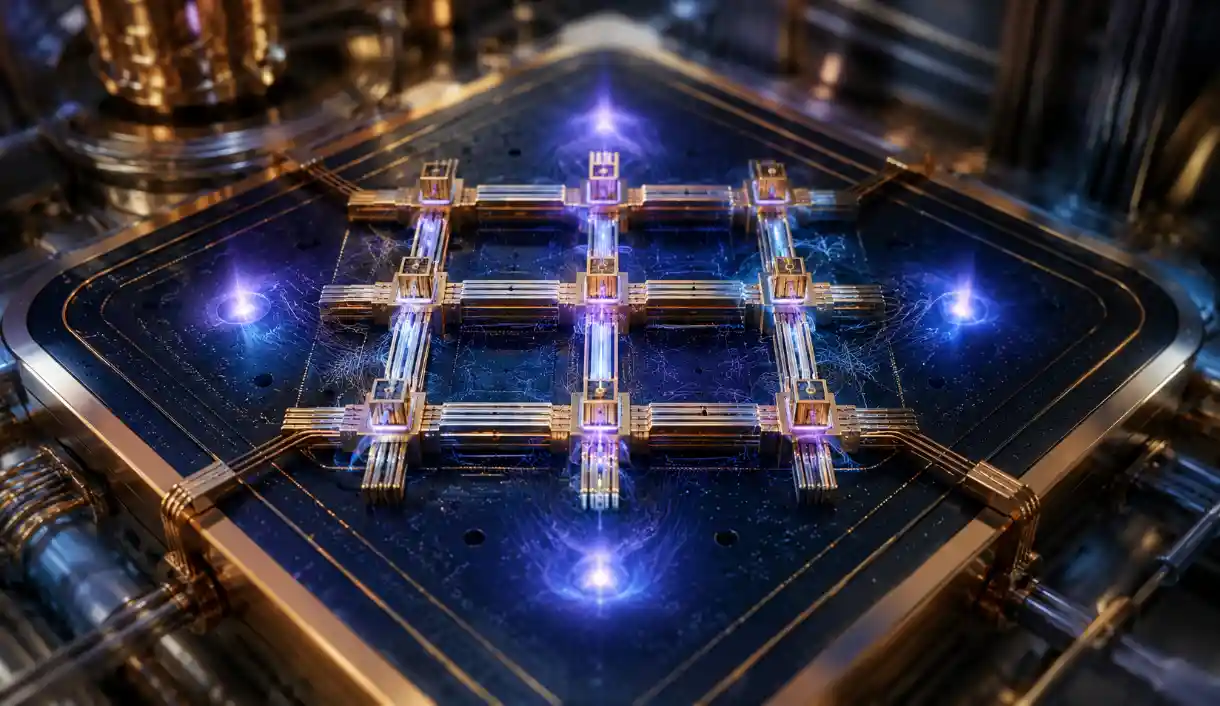
Almost every superconducting quantum computer you have heard of is flat. IBM’s, Google’s, the lot. Josephson junctions sit on a chip and talk to their immediate neighbours, like houses on a street. It works, and the entire industry has been refining that layout for years.
A team led by University of Chicago physicists decided to weave instead. They laid three superconducting wires horizontally, three vertically, and crossed them, creating nine Josephson junctions in a grid where connections reach past the nearest neighbour. They call it a waffle. I appreciate a research group that names things honestly.
Why the waffle-shaped circuit is different
Going non-planar is not an aesthetic choice. That crossed geometry lets the circuit hold an exact mathematical symmetry, labelled Z₃, that theorists have argued for years is a prerequisite for building topological phases of matter.
Here’s why anyone cares about topological phases. Ordinary qubits store information in one fragile device, so any stray disturbance corrupts it and you spend enormous resources on error correction. Topological approaches spread information across many interacting elements, so no single poke ruins it. The protection comes from the structure itself. Building that into the hardware, instead of patching errors afterwards, is the dream.
According to the July 21 report, the test worked. Tuned to a specific magnetic field, the waffle settled into six equally valid low-energy states rather than one, precisely as the theory said it should, and the measured energy spectrum matched simulations closely enough that the team could tell ordinary oscillations apart from genuine quantum tunneling.
Why this isn’t a topological quantum computer yet
This isn’t a topological qubit. It isn’t a qubit doing anything useful at all yet.
The researchers tested one waffle, in what physicists call the semiclassical regime, where the quantum tunneling is most important is still weak. A true system would need many waffles tiled into a honeycomb lattice, and only after that could anyone start asking whether the thing actually protects quantum information. The team’s own framing is a transistor demonstrated long before anybody builds a chip out of millions of them.
It is also an arXiv preprint, so no peer review yet, and the confirmation rests partly on neural-network simulations agreeing with the measurements, which is a model matching a result as opposed to being an independent verdict.
Still, there is something appealing about the underlying move. Most of the field is making flat circuits incrementally better. This group asked whether a different shape could make the physics do the protective work for you, and got a first answer that says maybe. A waffle is a long way from a computer, but it’s still a nice place to start.