
A Warm Atom Cloud and a Cold Quantum Dot, Emitting Identical Photons

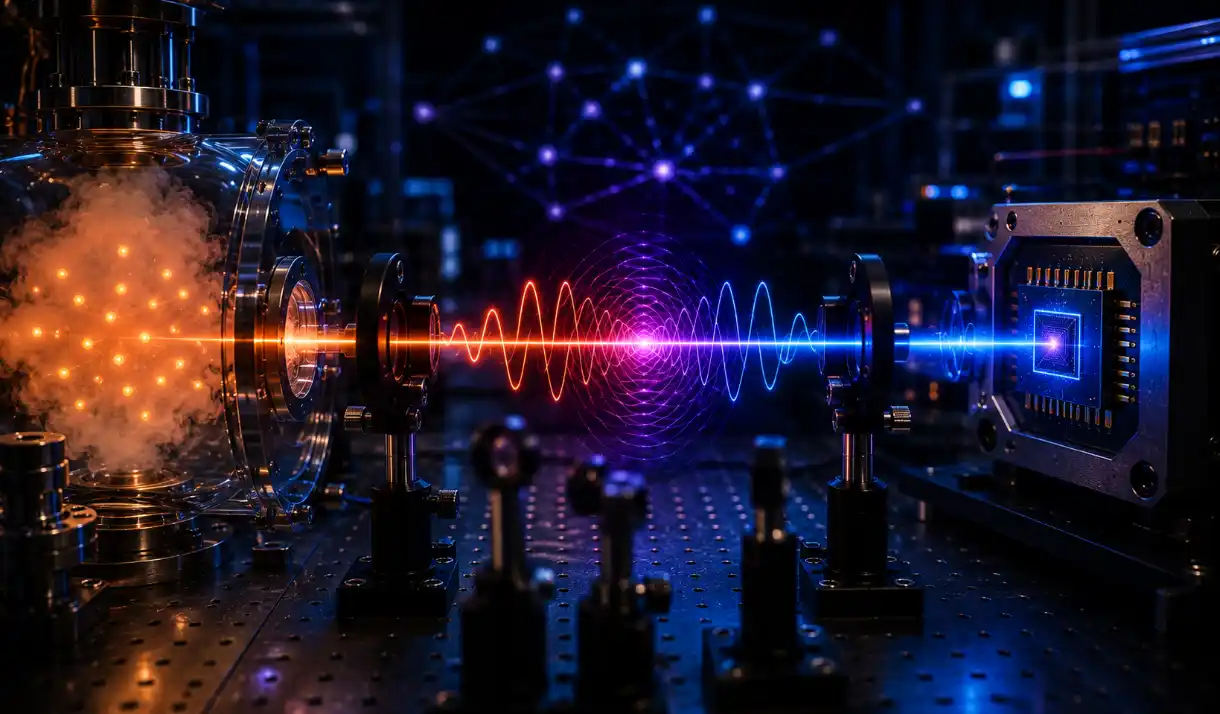
A quantum network is a mix-and-match problem. You want bright, fast photon sources for sending information, and you want atomic systems that can store it and keep everything on the same frequency. The trouble is that photons from two different kinds of source rarely look alike, and if they don’t look alike, they won’t interfere, which is the physical trick most quantum networking runs on. Researchers in Korea just showed a way around that. They made a warm cloud of cesium atoms and a chilled semiconductor quantum dot emit photons identical enough to interfere, straight out of the two sources.
Why matching photons is hard
The appeal of a hybrid network is that no single source does everything well. Quantum dots are bright and fast, good at pumping out single photons on demand, but poor at holding onto them. Atomic systems are the opposite, slower emitters that make excellent memories and steady frequency references.
Pair them and you’d get the strengths of each. But there’s a catch: the handoff. A photon from a quantum dot and a photon from an atomic ensemble come out mismatched in wavelength and in timing, and getting them to behave as one usually means bolting on filters and delay stages that waste photons and add complexity.
The test of whether two photons truly match is a phenomenon called Hong-Ou-Mandel interference. Send two photons into a beam splitter from opposite sides, and if they’re genuinely indistinguishable, they leave together through the same port rather than going their separate ways. How often they pair up, a number called the visibility, tells you how alike they really are. A visibility above 0.5 means you’re seeing true quantum interference and not a classical coincidence.
What the team did
According to the July 30 press release, the group, led by Han Seb Moon at Pusan National University and Je-Hyung Kim at UNIST, used a warm cesium vapor cell to generate heralded photon pairs, with the signal photon landing at 917 nanometers.
Then they cooled an indium-arsenide quantum dot to 12.5 kelvin until its emission lined up at 917.48 nanometers, close enough that the two sources overlapped well. Sent into a beam splitter, the atomic and quantum-dot photons interfered, with a visibility of 0.65 after accounting for the detectors’ timing resolution. Moon framed the milestone:
“For the first time, we experimentally demonstrated direct two-photon interference between single photons from two completely independent, physically dissimilar quantum light sources: a warm cesium atomic ensemble and a semiconductor quantum dot.”
The work was published in Light: Science & Applications, so it’s been through peer review.
How much it settles
The numbers are key here. The visibility was 0.65, give or take 0.14, which sits above the 0.5 threshold for genuine quantum interference but well below the near-perfect matching a working network would want. This is a proof of concept, and a fairly noisy one, as opposed to being a polished result. The team’s point that they needed no spectral or temporal correction is real, though it comes with a footnote. They still tuned the quantum dot by cooling it to match the atoms’ wavelength, so the sources were matched by design even if the photons weren’t massaged afterward.
The “first” is the researchers’ own claim, and the grand applications Moon names, distributed networks and a working quantum internet among them, are where he hopes this leads rather than what a bench demonstration delivers. The building block is objectively real: two unlike quantum sources, one warm and one near absolute zero, produced photons that interfered without heavy post-processing, which represents a genuine step toward stitching mismatched components into one system.
That’s the direction quantum networking keeps reaching for, pairing photon generation with storage that runs warm while staying honest about how few networked applications work today. It builds on a body of photonic-networking work, like sending entanglement through busy fiber and an entangled state that shrugs off the noise that usually wrecks these signals, all of it pointed at the repeaters and links a quantum internet needs.