
Quantum Computers Tackle Fusion’s Fuel Problem in New Study


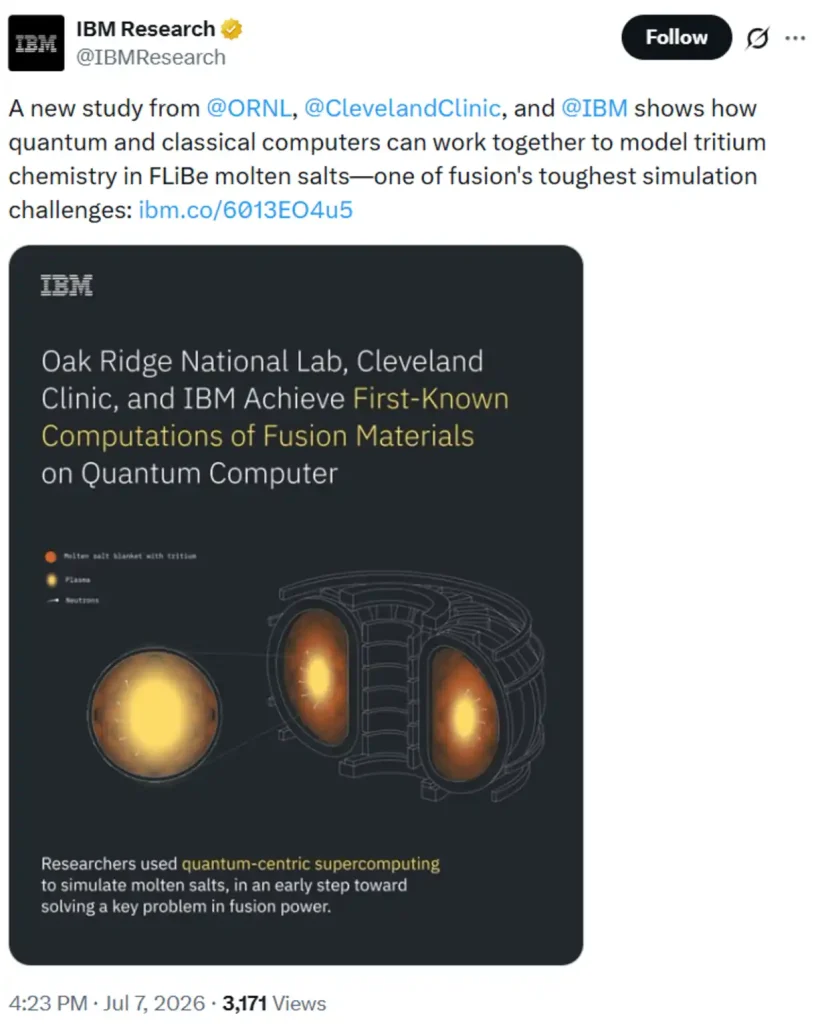
Three research teams have shown that quantum and classical computers can work side by side to model one of the hardest chemistry problems standing between us and fusion power. Oak Ridge National Laboratory, Cleveland Clinic, and IBM released the work on arXiv on June 29, 2026. Their target was tritium chemistry inside molten salt, the rare fuel a fusion plant needs to keep itself running.
Why tritium is so hard to model
A fusion reactor fuses tritium and deuterium into helium, and that reaction gives off enormous energy. Deuterium comes from the ocean. Tritium doesn’t. The whole world produces only a few pounds of it a year, and a single one-gigawatt fusion plant would burn through about a pound a day. That gap means a working plant has to breed its own tritium as it operates.
The solution is a thick blanket of molten lithium salt called FLiBe, wrapped around the plasma. Neutrons from the fusion reaction strike lithium-6 atoms in the salt and split them into helium and fresh tritium. Getting that tritium back out is the tricky part. If it bonds with fluorine, it forms tritium fluoride, which is corrosive and hard to remove. If it stays loose as a gas, it bubbles free on its own.
Predicting which path the tritium takes demands extreme precision. The standard classical tool, density functional theory, can miss the salt’s free energy by as much as 10 percent, according to earlier work from the Oak Ridge group. That’s too coarse to answer the question.
How the quantum workflow fits in
The team split the problem into pieces. Classical computers handled the simpler fragments. A quantum computer took on the clusters with heavy entanglement between atoms, using a method called sample-based quantum diagonalization. The approach builds on Cleveland Clinic’s earlier project with RIKEN and IBM, which modeled a 12,635-atom protein the same way.
Per the July 6 report, researchers pulled nine configurations of FLiBe from their simulations, each a cluster of 21 ions, and computed their energies with and without tritium. The quantum-centric results matched leading classical methods for solving fragments. Kenneth Merz of Cleveland Clinic, a co-author, led the protein work that made the salt clusters small enough to fit on today’s hardware.
“When we started this work maybe five months ago, I did not expect to be at this place this soon,” said Tom Beck, a section head at Oak Ridge.
The result is early. The full problem involves a churning blanket on the order of a trillion-trillion particles, still far beyond any computer. The team now plans to grow the clusters well past 21 ions and run hundreds of configurations instead of nine.