
Quantum Materials Engineering: The Atoms Behind Every Qubit

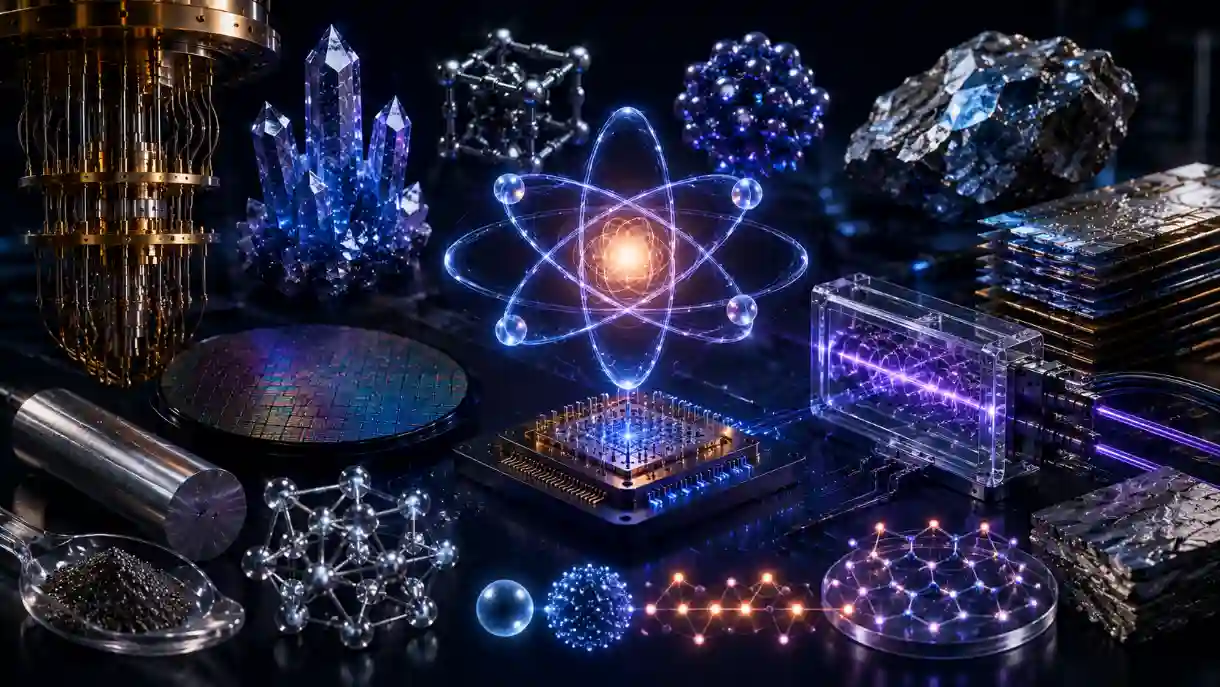
Quantum computing gets described as a race to build better qubits. That framing hides the harder problem. Under every qubit is a search for a material that can hold quantum behavior long enough to be useful, and that search has become one of the field’s central engineering challenges.
The discipline has a name: quantum materials engineering. Its goal is to find, purify, and manufacture the substances that let qubits keep their quantum states. Get the material wrong and no clever control scheme will save the computation. Get it right and a platform has a path to scale.
What makes a material suitable for qubits
As Quantum Insider writes, quantum information is fragile in a way classical data never is. A qubit holds properties like superposition and entanglement, and those states collapse at the smallest disturbance. Stray atoms, surface flaws, microscopic crystal defects, and unwanted electromagnetic coupling all push a qubit toward decoherence, the loss of its quantum information.
That’s why material choice shapes a quantum computer’s viability more than almost any other decision. A purer, more uniform material means quieter qubits, longer coherence, and a better shot at finishing a real algorithm before the information decays.
What makes a good qubit material
Researchers have a working wishlist, even if nothing meets all of it yet.
The material has to isolate qubits from their surroundings so they hold coherence, and it has to let those qubits be manipulated quickly and accurately. It needs to shrug off thermal and electromagnetic noise. It should be ultra-pure and atomically uniform, since impurities and structural flaws generate the noise that kills quantum states. For any real machine, it also has to fit existing manufacturing so that millions of qubits can be built and wired together. No single material checks every box, though several are in contention.
How today’s leading qubit materials compare
Every hardware platform is a different answer to one question: where in nature can quantum information best survive? Here’s how the main candidates line up.
Superconducting metals
The materials are aluminum and niobium, with tantalum a newer favorite for longer-lived qubits. Superconductors carry current with no resistance and no energy loss, which keeps decoherence low and lets quantum behavior persist long enough to compute. The catch is temperature. These qubits need dilution refrigerators that cool them to a hair above absolute zero, which makes the systems large and expensive.
Semiconductors
Silicon leads here, specifically silicon-28. Most of its nuclei have zero spin, so the material is magnetically quiet and unusually gentle on the electron spins that store information. Germanium and silicon-germanium structures are also in play. The big draw is manufacturing, because spin qubits can ride the same fabrication base that already produces the world’s chips. The cost is precision. The silicon has to be isotopically purified, cooled carefully, and made uniform enough that thousands of qubits behave alike.
Trapped ions
Here the qubits are actual atoms, ytterbium, calcium, barium, and strontium, held in place by electromagnetic fields. Trapped ions post some of the highest gate fidelities and longest coherence times of any platform, which makes them among the most accurate. Scaling is the hard part. Control gets tougher as the ion count climbs, since entangling many ions at once demands ever more intricate laser and optical hardware.
Neutral atoms
Rubidium and cesium are the common choices. Excite these atoms into Rydberg states, where an electron orbits far from the nucleus, and neighboring atoms begin to interact strongly, which is how the qubits entangle. Coherence times are long. The open work is control, since researchers are still pushing gate fidelities up to match the more mature platforms.
Photonic materials
Here the qubits are particles of light, guided through silicon photonics, lithium niobate, indium phosphide, or silicon nitride. Photonic qubits can run at or near room temperature, and they’re the natural fit for quantum communication over distance. The difficulty is at the single-photon level. Individual photons are hard to produce and detect efficiently, and large computations need a lot of hardware.
Topological materials
This is the furthest-out bet. The idea is to engineer materials, topological superconductors and semiconductor-superconductor hybrids, that host exotic quasiparticles called Majorana zero modes. Qubits built from them could be inherently protected from noise, because the information lives in states that resist local disturbance. The problem is that they remain largely unproven. The experimental evidence for usable topological qubits isn’t settled, and controlling these materials is still a major scientific challenge.
The common thread
Read across the platforms and one tension shows up everywhere: coherence versus manufacturability. The materials that isolate qubits best are often the hardest to build at scale, and the ones that slot into existing factories can be noisier. Every platform picks a different point on that trade.
There’s a clean way to see the whole field. Superconductors engineer artificial quantum systems. Semiconductors borrow single electrons from silicon. Trapped ions lean on nature’s identical atoms. Neutral atoms build programmable arrays, photons carry information in light, and topological materials try to make matter that protects itself.
Progress from here depends as much on materials as on algorithms. The hunt for the ideal quantum computer has turned into a hunt for the ideal quantum material. Whether that ends up being a superconducting film, a purified silicon crystal, a trapped ytterbium ion, or a phase of matter nobody has made yet, no one can say. The atoms will decide.