
Scientists Made a New State of Matter Inside a Quantum Computer, Then Braided It

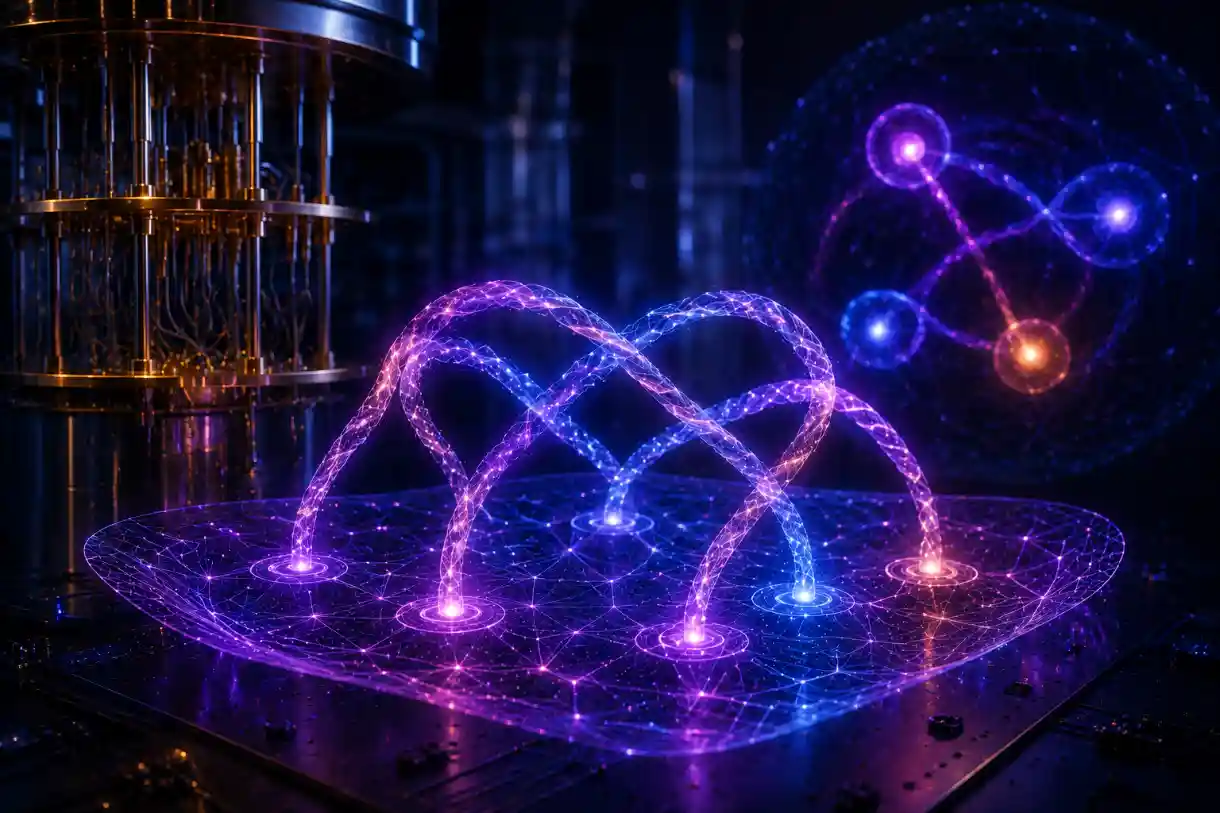
Here’s a sentence that shouldn’t be possible: a team of physicists took the qubits inside a quantum computer, coaxed them into a rare state of matter that barely exists in nature, and then computed by tying that matter into knots. The work, from Quantinuum with collaborators at Caltech, the University of Chicago, and Harvard, ran on Quantinuum’s H2 machine and came out in Nature. Let me try to make it make sense.
How the team created a new state of matter
Start with the state of matter. Normally your qubits are individual things, each holding its own scrap of quantum information. The team pushed them into a so-called topologically ordered state, where the qubits stop behaving as separate particles and start acting as one connected whole. Think of hydrogen and oxygen drifting around as two gases, then combining into water, a completely different substance with properties neither gas had alone. Same ingredients, new creature.
Why bother? Because in that connected state, the quantum information stops living on any single qubit and spreads across the entire system. That turns out to be a kind of armor. A stray bit of noise can’t corrupt information that isn’t in any one place, the way a net holds together better than a pile of loose, unknotted rope.
Now the genuinely strange part. A topologically ordered system throws off exotic particles called non-Abelian anyons, and you can compute with them by moving them around one another, a maneuver physicists call braiding. Picture cat’s cradle: you loop the string into one shape, then another, and each rearrangement is a step in a calculation. The anyons don’t mind being jostled, because the answer depends on the pattern of the braid, not the exact path, so small errors wash out.
Why braiding anyons could simplify quantum computing
Here’s why anyone would go to this trouble, beyond the sheer fun of it. One of the hardest problems in fault-tolerant quantum computing is a resource called magic states. Error correction protects information, but it also handcuffs you: not every operation can be done directly on protected qubits, and the usual workaround, distilling magic states, is brutally expensive. In many blueprints for future quantum computers, making those states eats up most of the qubits and most of the runtime before any useful work even begins.
The topological approach may let you sidestep that. Because braiding anyons naturally gives you a universal set of protected operations, the researchers showed a route to preparing magic states topologically, without the costly distillation step. If that holds up, a quantum computer could need far fewer physical qubits and waste far less time manufacturing resources before it gets to the actual problem.
Now the part where I temper the excitement. This is Quantinuum reporting its own result, though peer review in Nature is a real credibility check. It’s also a demonstration, and the team says plainly there’s serious work left on whether the idea scales into a practical machine. Braiding a handful of anyons on H2 is a long way from a full topological quantum computer.
Still. They made a new phase of matter out of qubits and played cat’s cradle with it to do math, on purpose, and it worked. Even as one approach among several the field is chasing, that is a genuinely wild thing to be able to report.