
Scientists Made Entangled Photons With Sunlight, No Laser Needed

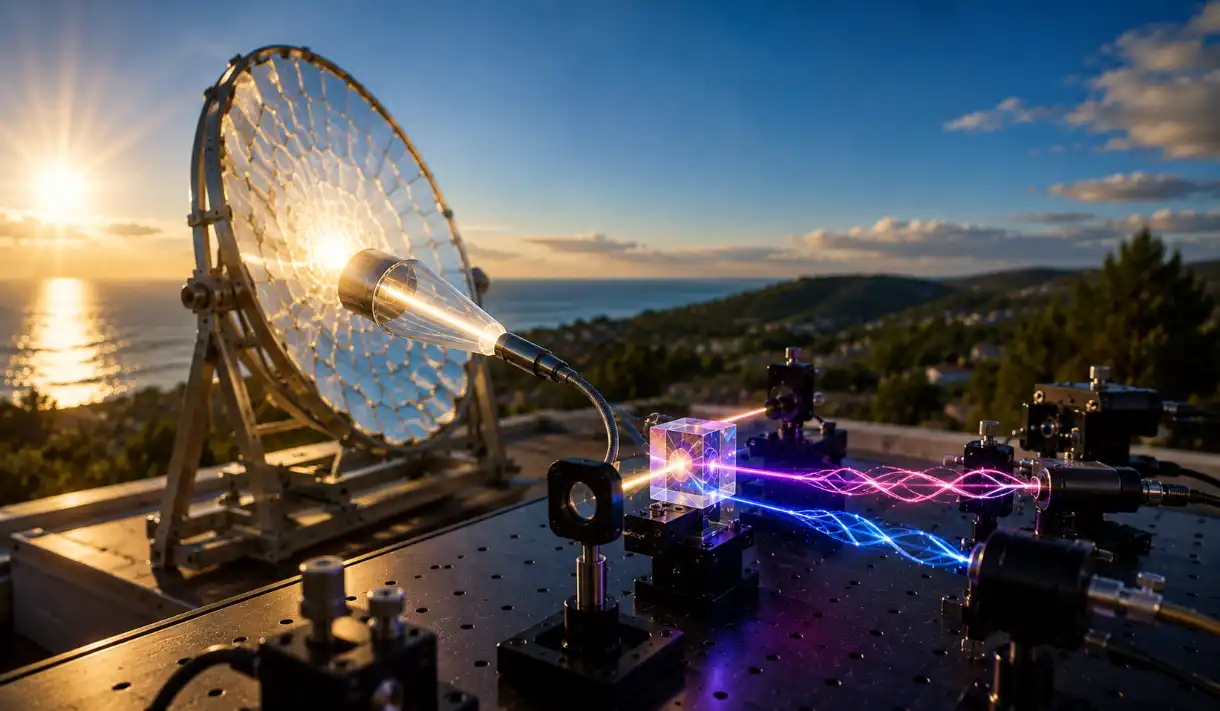
For as long as anyone has built quantum light, the rule was simple: to make a pair of entangled photons, you need a laser. A team from the Max Planck Institute for the Science of Light and the University of Ottawa has now broken that rule with the least exotic light source imaginable.
Specifically, they funneled ordinary sunlight into a crystal and got entangled photons out the other side, at a quality close to what a laser delivers. The work, published in Optica, undoes an assumption the field had carried for decades.
The photons come from a standard trick called spontaneous parametric down-conversion, or SPDC, where a pump beam hits a nonlinear crystal and, once in a while, a single photon splits into an entangled pair, the workhorse process behind most entangled-light experiments.
The old belief that lasers existed for two reasons: they’re coherent, their light waves marching in lockstep, and they’re intense, packing enough power into a small spot to drive the conversion. Sunlight is neither. It’s a jumble of wavelengths and phases, and it’s faint. So everyone wrote off sunlight.
What “coherent” means
The escape hatch is that coherence isn’t a single property. Light has several independent traits, what physicists call degrees of freedom, and it can be orderly in one and chaotic in another. A sunbeam can be a spatial and temporal mess and still be cleanly polarizable. That distinction turns out to be the whole game.
In down-conversion, the pump’s disorder in one degree of freedom only spoils entanglement in that same degree of freedom. Spatial entanglement dies if the pump loses spatial coherence, but polarization entanglement doesn’t care about the pump’s spatial or temporal chaos, only its polarization. Cheng Li, who did the work in Robert Boyd’s group at Ottawa, put the principle simply:
“As long as the pump beam is perfectly polarized, its spatial or temporal incoherence should not preclude the generation of polarization entanglement.”
Keep the degrees of freedom from bleeding into each other, and sunlight is a perfectly good pump. It’s the same degree-of-freedom thinking behind entangled states engineered to ignore fiber noise.
Catching enough sun
That left the intensity problem. A crystal’s usable window is a few millimeters wide, and raw sunlight is far too spread out to drive SPDC on its own. Hanieh Fattahi’s group at Max Planck built a concentrator to fix it: a Fresnel lens on a solar-tracking mount collects light over 1.4 square meters and focuses it onto a glass cone, which squeezes it further by total internal reflection down to a tip that couples into a fiber as thin as a human hair.
That fiber feeds the crystal. The payoff was photon pairs with nearly 94% fidelity, and correlations that violate Bell’s inequality, the standard proof that entanglement is genuinely quantum and not some classical imitation. It’s a new way to build the sources that quantum light depends on.
How good is “as good as a laser”
The team reports that, once you normalize the photon rate against pump power and bandwidth, sunlight-driven generation is about as efficient as laser-driven. That’s a per-unit comparison.
In absolute terms, sunlight is still much weaker, so the raw output is far lower, and the researchers say practical sources will need optimization in the method of gathering sunlight and using its wide spectrum. What they’ve shown is that the laser’s advantage is smaller and less fundamental than assumed. It doesn’t mean a solar cone matches a lab laser today.
Where it could go is up. Sunlight is free and everywhere, and Fattahi points to space, where a satellite in the right orbit sees the Sun almost without interruption. Driving a quantum source straight from sunlight would drop the electrical-to-optical conversion entirely, along with the stabilization and waste heat that come with lasers, leaving fewer parts to fail, the kind of ruggedness prized in quantum light sources built for the field.
Those uses are still on paper, in the same “someday” column as much of quantum networking. Boyd calls the result only a beginning, and points to other nonlinear tricks like four-wave mixing that sunlight might also drive. Today the headline is smaller and stranger: the Sun, it turns out, can make entanglement.