
This Entangled State Shrugs Off the Fiber Noise Everyone Else Fights

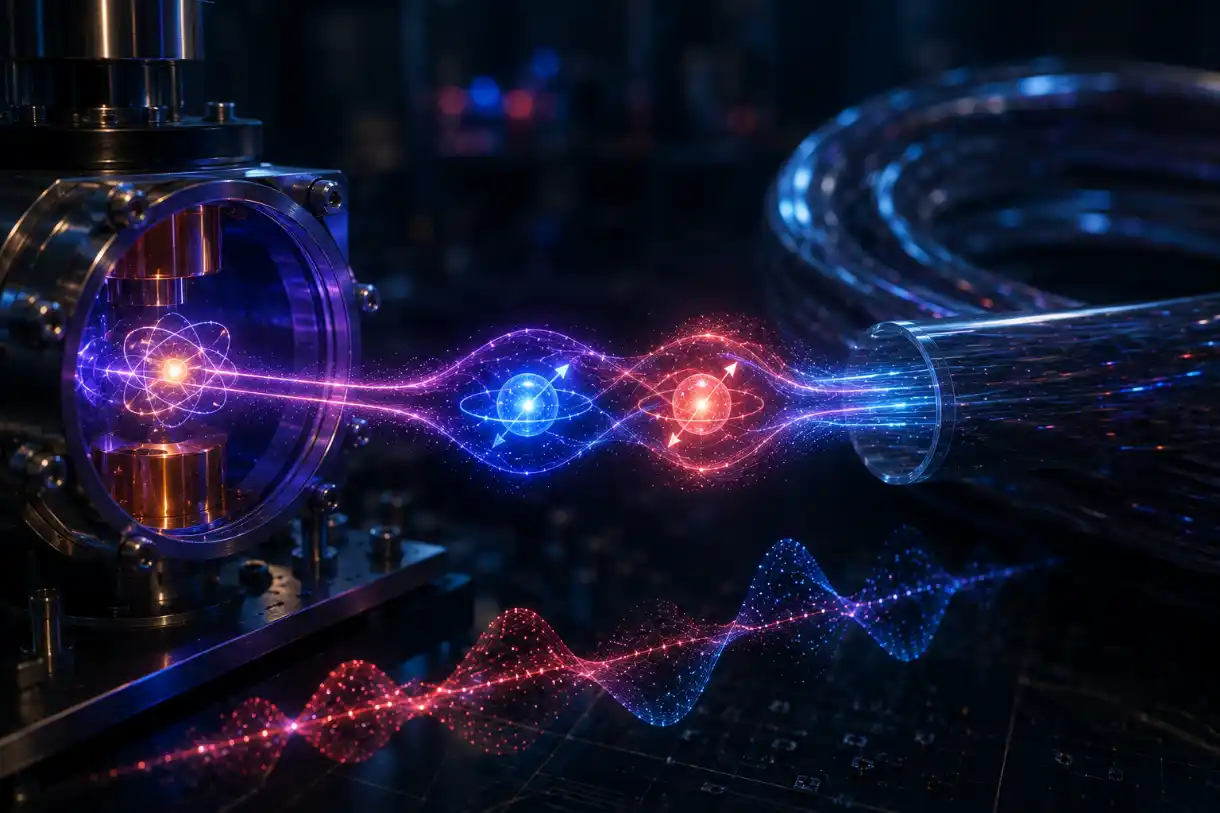
Sending entanglement down an optical fiber is normally a nightmare of babysitting. Fiber gets warm, gets bent, gets nudged, and every one of those disturbances scrambles the polarization of the light inside, quietly wrecking the delicate quantum correlations you were trying to send. Most quantum links handle this with constant active correction, sensors, and feedback loops fighting the noise in real time. Quantum Source, an Israeli company working with the country’s defense research directorate, just showed a way to skip that fight.
How Quantum Source sidesteps fiber noise
According to the July 16 press release, they did it with two clever moves. The first is how they make the entangled photons. The usual method, spontaneous parametric down-conversion, is a gamble: pairs pop out at random, most attempts fail, and if you crank up the odds you start getting messy double-pairs that ruin the fidelity. Quantum Source instead uses a single rubidium atom parked inside a tiny optical cavity. Poke it, and it emits two entangled photons on demand, within tens of nanoseconds, entangled from birth. No gambling. You ask, it delivers.
The second move is the elegant one. They generate the photons in a particular flavor of entanglement called the singlet state, and the singlet has a rare property. When both photons get their polarization rotated the same way, which is exactly what a noisy fiber does to them, its correlations don’t change at all. The noise happens, and the entanglement simply doesn’t notice.
Why is that so important?
Because you can then send entanglement through ordinary, jostled, uncorrected fiber and have it arrive intact. That’s what they tested: more than a kilometer of unstabilized fiber, no polarization control, no feedback, no calibration. Chief Scientist Barak Dayan said the entanglement came out “with essentially the same quality as when it entered.”
What the demonstration proves and what it doesn’t
That said, this is a lab demonstration over one kilometer, not a working network, and the results are the company’s own, announced and not yet independently vetted. The noise-immunity trick is also specific to the singlet state, not a cure for everything fiber does to light.
Still, it’s a genuinely nice piece of engineering. A source that stops gambling on when photons show up, paired with a quantum state that stops caring when the fiber misbehaves. Two of the field’s most annoying problems, sidestepped instead of fought.