
That Experiment to Prove Gravity Is Quantum? It Might Prove Nothing

Let’s say you’ve spent years designing a delicate experiment to catch gravity behaving like a quantum thing, the physics equivalent of setting a trap for a ghost you’re pretty sure lives in your house. You run it, and you get a signal. And then someone walks in and says the signal you just celebrated could come from completely ordinary, non-spooky physics, and there’s no way to tell the difference from the data alone. That’s basically the news out of a new paper, and it’s more of a warning label for an entire field than anything else.
Physics runs on two wildly successful theories that refuse to get along. Quantum mechanics governs the tiny stuff, atoms, particles, the works, and it says objects can be smeared across multiple places at once, a trick called superposition that’s been tested to death with atoms and even small chunks of metal. Gravity, per Einstein, isn’t a force sitting inside space. It’s space, and time, bendable and wave-carrying, which we confirmed when gravitational wave detectors actually caught spacetime ringing. The dream theory that fuses these two is called quantum gravity, and nobody has it yet.
The idea everyone was chasing
Most physicists expect that in a real theory of quantum gravity, gravity itself would have to follow quantum rules, which leads to a truly dizzying thought. If a quantum object can be in two places at once, and gravity is just spacetime responding to that object, then the spacetime around it should also be in two states at once. Two curvatures, two geometries. Both superimposed.
So people started designing experiments to catch exactly that. The whole cottage industry runs on a simple hope: see spacetime do its double-exposure thing through a sensitive enough setup that you’ve made, and you’ve got the first fingerprint of quantum gravity. Nobel speeches all around.
However, researchers from Kyushu University, the University of Waterloo, and Stockholm University just poured cold water on the interpretation, if not the experiments themselves. Writing in npj Quantum Information, they built a theoretical framework showing that a lot of scenarios people describe as a “quantum superposition of gravity” are mathematically identical to something far more boring. Namely, quantum particles doing their normal superposition thing and feeling completely ordinary, non-quantum gravity. Same math, but no quantum gravity signature required.
The two-map problem
Lead author Joshua Foo, an associate professor at Kyushu University’s Institute for Advanced Study, puts it as a matter of perspective. Some of these scenarios, he says, can be read two equally valid ways. One story: gravity is in a quantum superposition. The other story: quantum particles are just moving through a plain old gravitational field. Both descriptions fit the same experiment. Neither is more correct than the other.
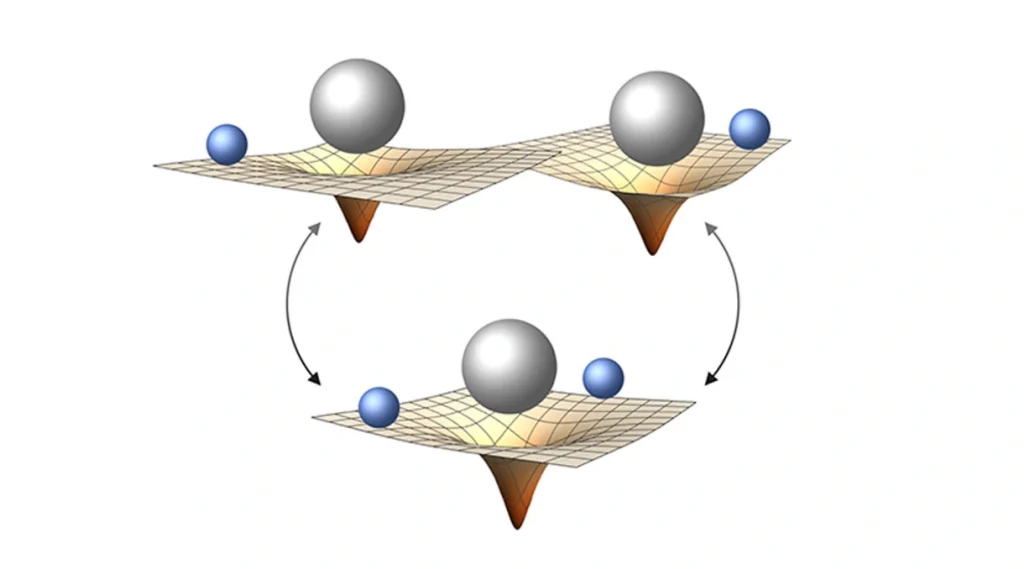
The team named this the “Relativity of Spacetime Superpositions,” and their own analogy is the cleanest way in, so I’ll steal it. It’s like having two maps of the same country. A Mercator projection and a globe show you the identical landscape, but they draw it with different rules, and Greenland looks like a continent on one and a modest island on the other. Neither map is lying, they’re just different projections of one reality.
What Foo’s group showed is that “quantum gravity” and “ordinary gravity plus quantum particles” can be two projections of the same physical situation. Call it the two-map problem, if you wish. If your experiment can be drawn on either map, it hasn’t told you which map is the real deal. So why does that sting?
It’s because a huge chunk of proposed tests assumed a signal would settle the question. This says many of them can’t, at least not on their own. You could get the result you wanted and still have no idea whether you saw quantum gravity or a clever impostor wearing its coat.
What this kills, and what it very much doesn’t
Now the part where I give the doomer reading its due and then take it back. It would be easy to read this as “quantum gravity experiments are pointless,” and that’s wrong. The paper doesn’t say gravity is classical, nor does it rule out quantum gravity. It doesn’t even say the experiments are bad.
What it does say is narrower and more useful. There’s an ambiguity baked into how these results get interpreted, and knowing the ambiguity exists is a useful tool in this case. Co-author Magdalena Zych of Stockholm University is direct about it. Their work doesn’t mean the experiments rule out quantum gravity, she says.
It helps sort which experimental signatures would truly demand a quantum description of gravity from which ones could come from more familiar physics. And that sorting, she notes, is the very thing you need to design experiments that actually work.
So the deliverable here is a filter, a way to look at a proposed experiment and ask, before you spend a decade building it, whether a positive result could be explained away by the boring map. If yes, redesign. If no, you might have something.
Why fundamental physics keeps quietly paying off
There’s a longer game too, the one physicists always invoke and, annoyingly, keep being right about. GPS, lasers, the electronics you’re reading this on, all of it grew out of poking at quantum theory and general relativity back when those looked like pure abstraction with zero practical payoff. Fundamental questions have a habit of cashing out decades later in ways nobody predicted. No promises, just a pattern worth respecting.
Foo’s closing framing is the honest one, and it’s not triumphant. Before you can test whether gravity is quantum, he says, you first have to know what evidence would prove it, and their work is about clarifying that question rather than answering the big one, which is a strange, humbling place to land. The headline result of a quantum gravity paper is that we’re still figuring out what winning would even look like. The ghost trap works fine, it’s just that we just learned we can’t yet tell a ghost from the wind.