
U.S. Labs Make Ultra-Pure Silicon and Germanium for Quantum Chips

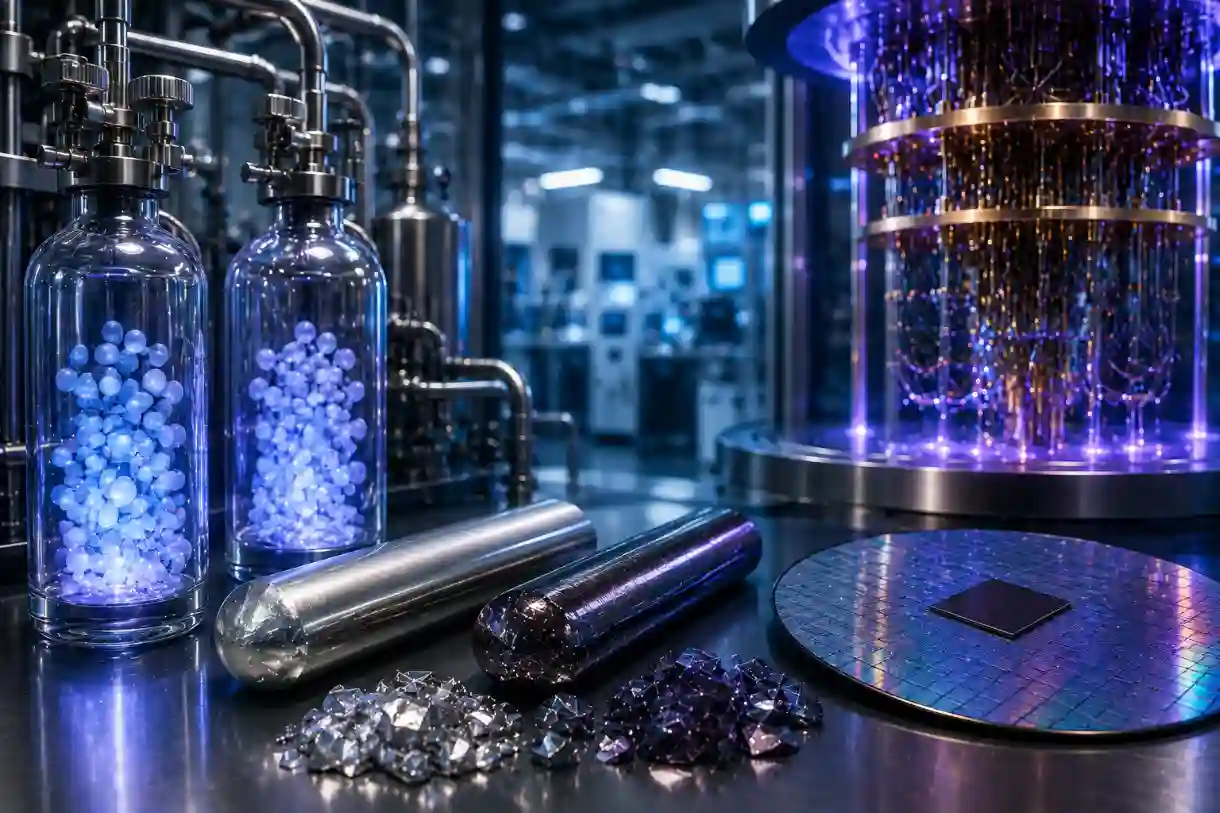
Two U.S. national laboratories say they can now produce silicon and germanium feedstock pure enough to build quieter qubits, and do it domestically. Oak Ridge and Pacific Northwest national labs stripped the troublesome isotopes Si-29 and Ge-73 from silane and germane gases to below one part per million, with silicon-28 reaching 99.9999% purity. The Department of Energy says the materials are at least 100 times more depleted of isotopic noise than anything commercially available.
Why isotopically pure silicon helps qubits
Specifically, qubits built in silicon or germanium are disturbed by their own surroundings. Certain isotopes of those elements carry nuclear spin, and that spin acts as background noise that nudges a qubit off its state and shortens how long it can hold information. Remove those isotopes from the starting material and you get a quieter substrate, which in principle means longer coherence times.
According to the July 16 press release by the U.S. DoE’s Office of Science, the work splits across two labs. Oak Ridge uses electromagnetic isotope separation, which can isolate several isotopes of an element in one production run, to strip the contaminants. Pacific Northwest converts the enriched material into silane and germane gases, the feedstocks chipmakers use to deposit thin silicon and germanium films, then purifies them further and applies thermal diffusion to enrich the gases directly.
Why a domestic supply matters
The physics is not new. The supply chain is. The U.S. has not had scaled domestic stable-isotope enrichment since retiring the wartime calutrons in 1998, so quantum hardware makers have had limited access to material at this purity. A domestic source is the point of the announcement.
The rhetoric around them DOE’s figures is heavy: officials called the work “our generation’s space race” and said they had “silenced that noise.” Isotopic purity addresses one source of decoherence among several, so it removes a known problem rather than solving qubit stability.