
The Quantum Internet, Explained: What It Is and What It Isn’t

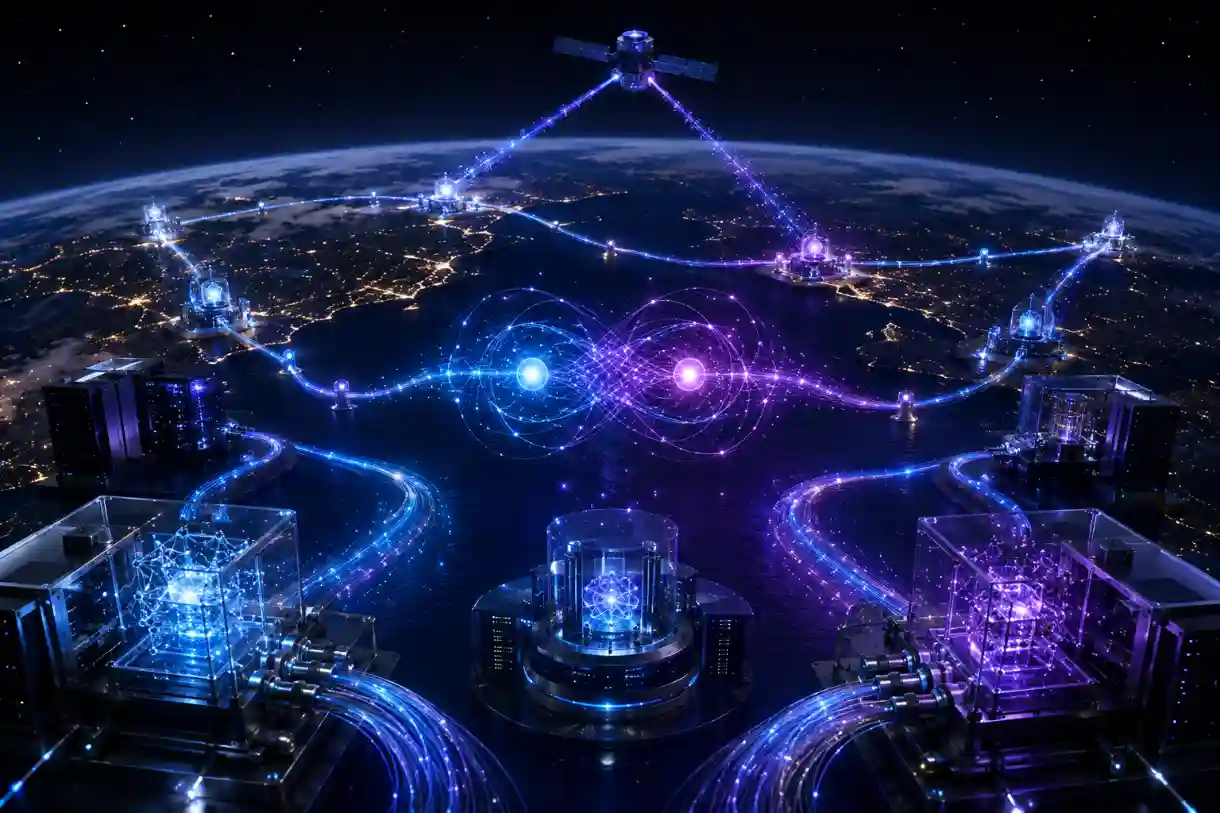
The quantum internet is a network that distributes entanglement and quantum information among distant devices. Today’s deployed quantum links mostly use quantum signals to produce classical encryption keys. A quantum internet would go further, sharing entanglement and usable quantum states between networked machines.
It’s the thing every QKD headline keeps gesturing at, and it’s wrapped in more hype than any phrase in this field. Sold as an unhackable everything-network, what’s coming is something narrower and stranger: a way to pass quantum states between computers so they can do things a classical network can’t.
One point belongs up front, because it’s the question a crypto holder asks first. Even a finished quantum internet wouldn’t sign your transactions. Let’s lay out what it is, what it would buy you, and where it stands.
What the quantum internet means
Most operational quantum networks today are QKD networks, and their practical output is shared classical key material. A quantum internet aims higher. It distributes entanglement, the strange link that ties two particles together so their outcomes stay correlated in ways no classical local model can reproduce.
It carries no instantaneous message between them. Spread high-quality entanglement across a network and distant processors can run coordinated quantum operations that would otherwise need them to share one machine. The principle is that simple, except the engineering to make it routed and fault-tolerant isn’t.
Why it’s hard: entanglement doesn’t travel well
Entanglement is fragile. Send an entangled photon down a fiber and loss makes a successful link rapidly less likely as the distance grows, and noise degrades the states that do arrive. You can’t copy it to boost the signal the way you amplify a classical one, one of the principles QKD security leans on. So a quantum internet needs two pieces that don’t yet exist at scale. Most leading designs need a quantum memory, a device that holds a quantum state without destroying it, though some proposals go all-photonic instead.
They also need a quantum repeater, which joins short entangled links into long ones through a step called entanglement swapping. Entanglement swapping alone doesn’t clean up errors. Purification or quantum error correction has to do that, or noise piles up across the chain. Unlike a trusted QKD relay, a repeater is meant to build end-to-end entanglement without requiring intermediate stations to recover the payload as readable classical data. Labs have shown the parts. A scalable long-haul repeater network doesn’t exist yet, and there’s no reliable date for one.
What it would buy you
This is where the hype and the substance part ways. A quantum internet would unlock a small set of capabilities a purely classical network can’t provide on its own.
One is device-independent QKD, a stronger form of key exchange that stays secure without trusting the internal workings of the quantum measurement devices, as long as some surrounding assumptions still hold. In 2026 Chinese researchers linked single-atom nodes through 100 km of fiber and reported positive asymptotic key rates at that distance. Their finite-size analysis ran at 11 km, where they gathered 1.2 million heralded Bell pairs over 624 hours and estimated an extractable secure-key rate of 0.112 bits per event.
Another is blind quantum computing, where you hand a computation to a remote quantum computer and it runs the job without seeing your input or your algorithm, under the protocol’s assumptions.
A third use links separate quantum processors into a modular machine. Two networked 100-qubit chips wouldn’t simply add up to one tightly connected 200-qubit processor, since the links between them carry heavy error and communication costs, but together they could handle computations neither could manage alone.
Timing is a fourth. Networked clocks and sensors could use entanglement to sharpen some measurements and clock comparisons beyond what classical methods reach, with possible later uses in navigation and fundamental physics.
What it won’t do
Here’s where to point the skepticism. “Quantum internet” gets sold as an unbreakable global network that ends cyber-crime. It won’t. The security on offer is specific and small. It protects the sharing of keys and the delivery of entanglement between equipped endpoints. It does nothing about malware on a laptop, stolen credentials, software bugs, or misconfigured systems, all of which stay common ways into a network.
Then the part your readers care about. A quantum internet still wouldn’t sign a blockchain transaction. It moves quantum states between machines. The blockchain’s signature rules stay a separate problem, untouched. When a cryptographically relevant quantum computer threatens those signatures, the fix is post-quantum cryptography, the same answer running through every article in this section. A quantum internet changes how computers talk to each other. It doesn’t change what secures your coins.
Where it stands in 2026
Up close, the quantum internet is a set of small experimental networks and short entangled links. Researchers can wire a few nodes together and run limited network software on them. What’s missing is a scalable, fault-tolerant network that ordinary organizations could plug into.
In 2026, a Chinese team used a metropolitan-scale repeater setup to distribute heralded entanglement between two solid-state quantum memories 14.5 km apart, reaching a Bell-state fidelity of 78.6%. Its multiplexed design raised the entanglement-generation rate over earlier metropolitan memory links.
Separate experiments ran device-independent QKD across fiber paths up to 100 km, though the practical secure key performance stayed far more limited. The Quantum Internet Alliance, an EU-funded research effort, is working toward an entanglement-based network, separate from the QKD-focused EuroQCI. The United States and the Netherlands run experimental networks of their own. The components are starting to connect, but nothing yet resembles a dependable, interoperable internet service.
Bottom line
The quantum internet is a serious research goal with a few uses you couldn’t get any other way, led by cryptographic protocols that lean less on trusting quantum devices and by modular processors that coordinate work across entangled links. It’s also mostly a lab result today, dressed in marketing that promises far more than entanglement can deliver.
Watch it, because the science keeps moving. Don’t wait on it to guard anything you own. For that, the answer is conventional endpoint security and a timely move to post-quantum signatures. A quantum network isn’t part of it.