
Quantum Source’s Plan: Photons Carry the Information, Atoms Do the Linking

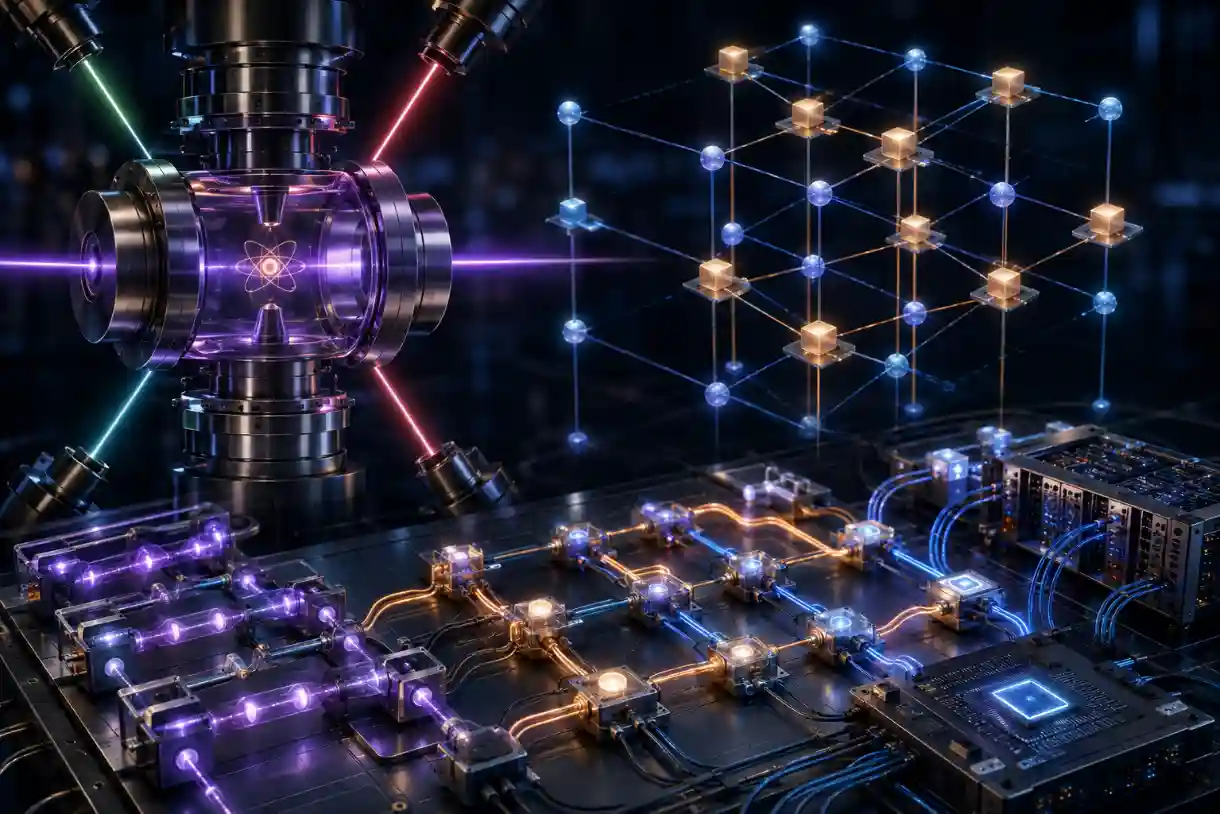
Every approach to a useful quantum computer is trying to clear the same bar: error correction good enough to run long calculations without the answer dissolving into noise. Clearing it takes two things at once. You need scale, enough physical qubits that redundant encoding can catch and fix errors, and you need connectivity, the ability to entangle qubits sitting far apart on the machine. No hardware platform today has both. Meanwhile, the Israeli company Quantum Source has posted a blueprint, worked out on paper and in simulation, for a design that goes after them together by handing each job to the particle best suited for it.
Two particles, two talents
Photons are superb messengers. They barely decohere as they travel, single-qubit operations on them are easy with standard optics, and once two photons are entangled you can route one anywhere in the machine to link distant parts, the kind of long-distance photonic connection that matter qubits struggle to match.
Their weakness shows up at the very start. Photons ignore each other. They pass straight through one another without interacting, so entangling two of them in the first place is a game of chance, and photonic designs pay for that with staggering redundancy, on the order of a million attempts to net the operations a real machine needs.
Atoms have the opposite profile. A trapped atom interacts strongly and controllably, and it can hold a quantum state as short-term memory, but atoms don’t travel. A machine built only from them fights the connectivity problem that hampers trapped-ion and neutral-atom systems as they grow.
A single reusable building block
Quantum Source’s answer is one module it reuses everywhere: a single rubidium-87 atom trapped inside a tiny, high-quality optical cavity. The cavity is a pair of facing mirrors that trap light long enough for a lone atom to leave a mark on it. A photon is sent to bounce off the cavity, and the phase it comes back with depends on the atom’s state inside.
If the atom sits in one state, the photon slips in, rattles around, and leaves carrying one phase. If it sits in the other, the photon is turned away almost at once, carrying a different phase. That single-atom-controlled difference is an entangling gate, and because a real atom does the work, it fires near-deterministically instead of by luck, in tens of nanoseconds.
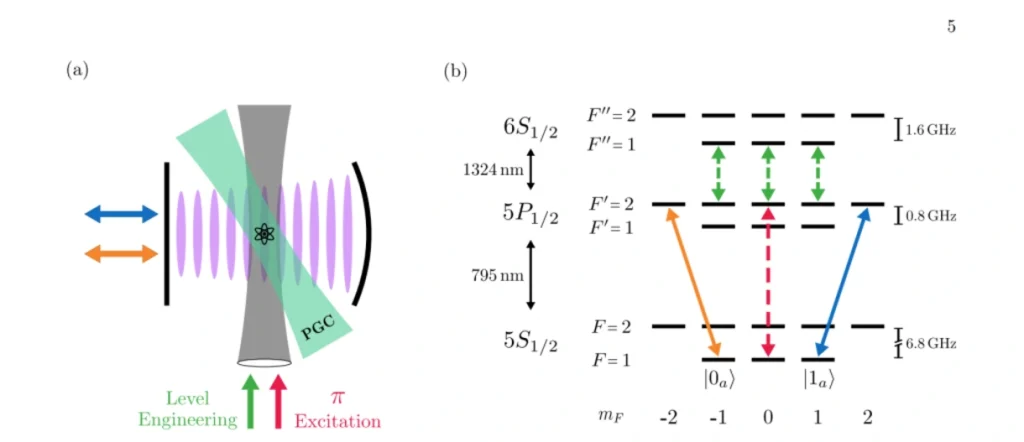
The same cell does more than entangle. It prepares and reads out the atomic qubit, and it emits single photons on demand, so one piece of hardware covers jobs that other designs split across separate specialized parts. Barak Dayan, the Weizmann physicist behind the photon-atom gate and one of the company’s founders, has put the ambition in simple terms:
“We aim for a smaller machine, something you can have in your facility, not a factory-sized building in another country.”
Weaving the lattice, and the numbers behind it
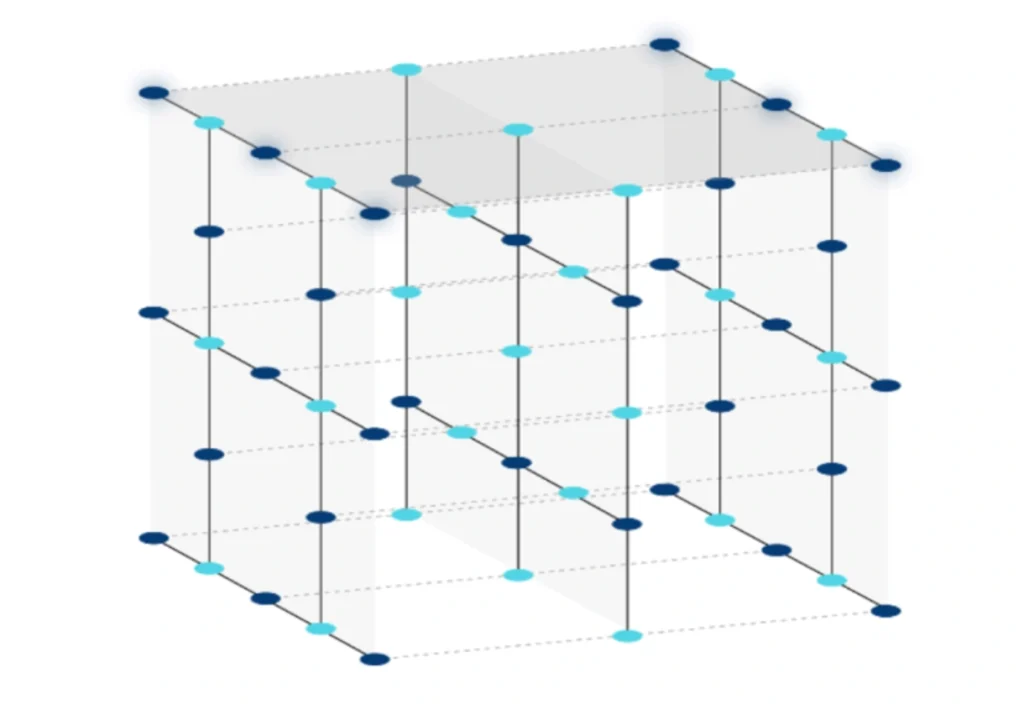
The machine computes by building a giant entangled web called a cluster state and then measuring it piece by piece, a model that front-loads the entangling and turns the computation itself into readout. The target structure is the RHG lattice, a three-dimensional relative of the surface code that underpins a lot of error-correction work.
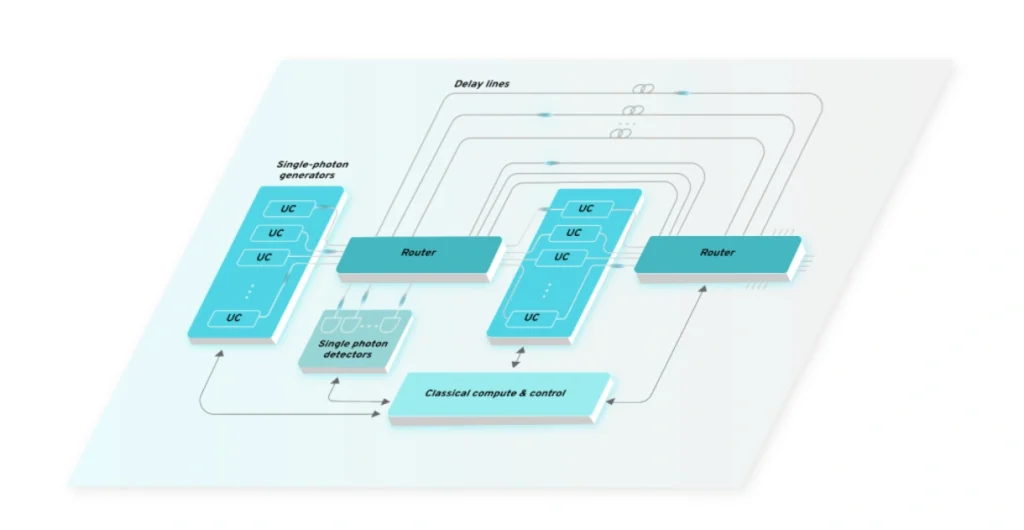
One sublattice consists of photons, the other of atoms. Picture the atoms as reusable stitching points: a photon is generated, threads through a few atom-cavity gates, gets measured, and the atom is reset for the next round. Recycling atoms this way cuts the number of cavities more than tenfold, though it buys that saving with extra lossy delay lines to park photons between steps.
Then the numbers. Under a deliberately simplified noise model, one that treats lost photons as the main error and sets other imperfections aside, the design tolerates a photon-loss rate of about 2.6% per gate, or close to 15% across a photon’s whole path through the machine. That threshold covers the Clifford operations.
Universal computation needs one more ingredient, a non-Clifford gate, and here the blueprint sketches two possible routes without pinning either down, leaving the details for later work. It is also a preprint posted to arXiv in late June and not yet peer-reviewed, and the simplified noise model is a limit: atomic errors, atom loss, and system-level noise are named as future work as opposed to being folded into the headline figure. To the company’s credit, it says as much directly.
Still a blueprint
What the paper offers is a route with attached numbers, well short of a working device. It shows that photon-atom cavity gates could remove photonics’ probability tax, that unrestricted photonic connectivity could ease the code-design constraints that box in more hardware-efficient codes, and that a rubidium-cavity system sidesteps both the dilution-refrigerator cold of superconducting chips and the extreme coherence demands of neutral-atom arrays. Each atom only has to stay coherent through a short burst of fast operations rather than an entire computation.
The engineering bill is long. Thousands of cavities have to trap single atoms reliably and identically. Optical switches, detectors, delay lines, and real-time decoders all have to run together as one system. This design solves none of that. What Quantum Source has done is separate the physics question from the engineering one, and argue, with explicit numbers and a clear ledger of what it hasn’t yet modeled, that the physics holds together. Whether the engineering follows is the overhead question the whole field is still working out, one qubit at a time.