
Researchers Send Twin Photons 7 km Across Guanabara Bay

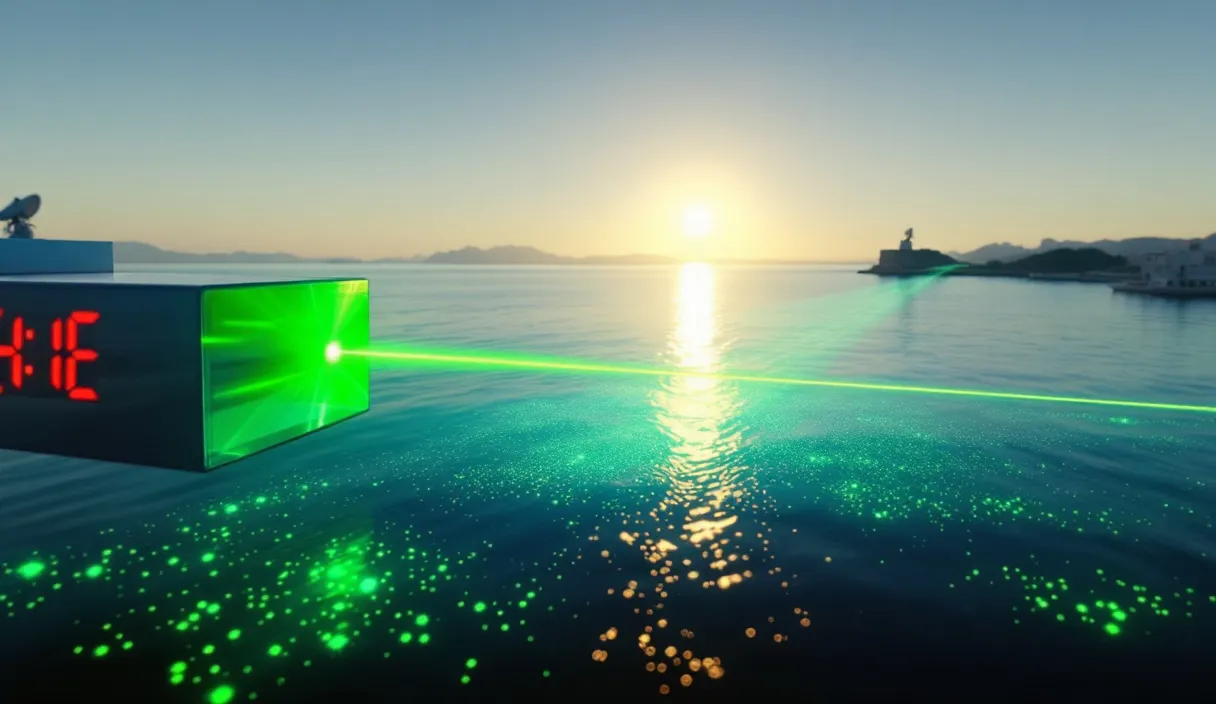
Say there were two light particles, created simultaneously within a crystal in Niterói. One remains at its origin, while the other launches across 7 kilometers of open air, traversing a busy urban bay. It encounters turbulence, water vapor, and various atmospheric interferences over Rio. Despite this journey, both photons arrive carrying a shared timing signal, a signature that random light cannot replicate.
A team at Fluminense Federal University (UFF) reported this achievement, as detailed in a press release from Agência FAPESP associated with the FAPESP-funded Rio Quantum Network project. This is a reported experimental result, not yet a formal peer-reviewed paper or a preprint. The team also acknowledges that the underlying entanglement claim is not yet confirmed.
Understanding the Crossing
A photon is the fundamental unit of light. Twin photons are two photons generated in the same physical event, inheriting related properties from their inception.
The photon source operates as follows: A 405-nanometer (blue-violet) laser strikes a nonlinear optical crystal. Within the crystal, a process known as spontaneous parametric down-conversion splits one pump photon into two lower-energy photons. Energy conservation dictates that the pair divides the original photon’s energy between them. The crystal’s geometry also establishes specific relationships between their directions and polarizations.
Entanglement represents a deeper form of this relationship. Two entangled photons exist as a single quantum state, meaning their properties are interdependent, even when separated by significant distances. The UFF source is for polarization entanglement, where polarization refers to the orientation of the light wave’s oscillation (e.g., horizontal or vertical).
Crucially, being “twins” does not automatically guarantee persistent entanglement. These are distinct concepts, and the team is precise about what they have verified.
The Challenge of 7 km of Open Air
A free-space link involves photons traveling through the open atmosphere rather than a fiber optic cable. Horizontal free-space links are particularly challenging. The atmosphere near the ground is dense with gas molecules, dust, and water vapor, which scatter and absorb light. Turbulence further distorts and shifts the beam, making it difficult for the receiving telescope to capture.
Vertical links face fewer obstacles because atmospheric density decreases rapidly with altitude. This is why satellite-based quantum experiments often have higher success rates than horizontal links across a bay.
The UFF team measured coincidences, or detections at both ends that occur within a sufficiently narrow time window to confirm they belong to the same photon pair. One photon is detected immediately near the source, whereas its twin arrives approximately 20 microseconds later, consistent with its travel time across the bay. A clear peak in coincidences appears precisely at this interval.
Measured Results
The team reported 7,000 coincident detections over a 5-second period, a significant signal for a horizontal open-air path. The link spanned approximately 7 kilometers, connecting UFF in Niterói to a receiver across Guanabara Bay, using a 405-nanometer pump wavelength.
In separate, earlier channel tests using conventional laser light, the team successfully transmitted polarization states across the bay and recovered them with over 99 percent fidelity, according to coordinator Antonio Zelaquett Khoury. This led them to choose polarization for carrying the quantum information.
Notably absent from the report are details such as a Bell parameter, visibility figures for entangled pairs after the crossing, a quantum bit error rate, or a secure key rate (as no key distribution protocol ran). Khoury clarified that while polarization entanglement has been demonstrated locally at UFF, the next step is to confirm its survival during the 7 km journey. The coincidence peak confirms that the twin photons reached both detectors but does not yet prove that entanglement persisted throughout the trip.
Thus, the measured results confirm two things: the local production of highly entangled pairs and the remote detection of coincidences across 7 km. Verifying entanglement over the full distance is the objective of future experiments.
Scope, Limitations, and Future Directions
This demonstration serves as a proof-of-principle for urban free-space quantum communication. A production-ready secure network does not yet exist. Discussions of ultra-secure internet or ground-to-satellite links represent the researchers’ aspirations for the future applications of this work.
The engineering involved is substantial and commendable. The team developed active stabilization systems to maintain telescope alignment over 7 km, counteracting thermal and vibrational disturbances using a reference light source, a tracking camera, and motors. Each station has a GPS-synchronized clock. To provide rapid transmission of detection timestamps, MLS Wireless installed a dedicated radio link between the two sites, as the standard internet would not suffice.
The next crucial step involves performing polarization measurements at both distant locations to test whether entanglement was maintained. Until these results are available, the claim of entanglement over 7 km remains a hypothesis that the team is actively pursuing.
For broader context, other research groups are advancing long-distance quantum links through various methods, including fiber-based work from Chinese researchers, which presents different challenges compared to horizontal free-space communication in an urban environment. This research is part of a wider effort by governments to translate quantum research into deployable systems, exemplified by Europe’s proposed Quantum Act.
Achieving routine city-scale quantum communication would require a confirmed entanglement measurement across the link, a functional key distribution protocol with a practical key rate, and robust hardware capable of operating reliably beyond ideal conditions. The Guanabara Bay crossing represents a significant step towards this goal, but it is just one stage in a longer journey