
Mitsubishi Electric Wins NEDO Support for Quantum Hardware R&D

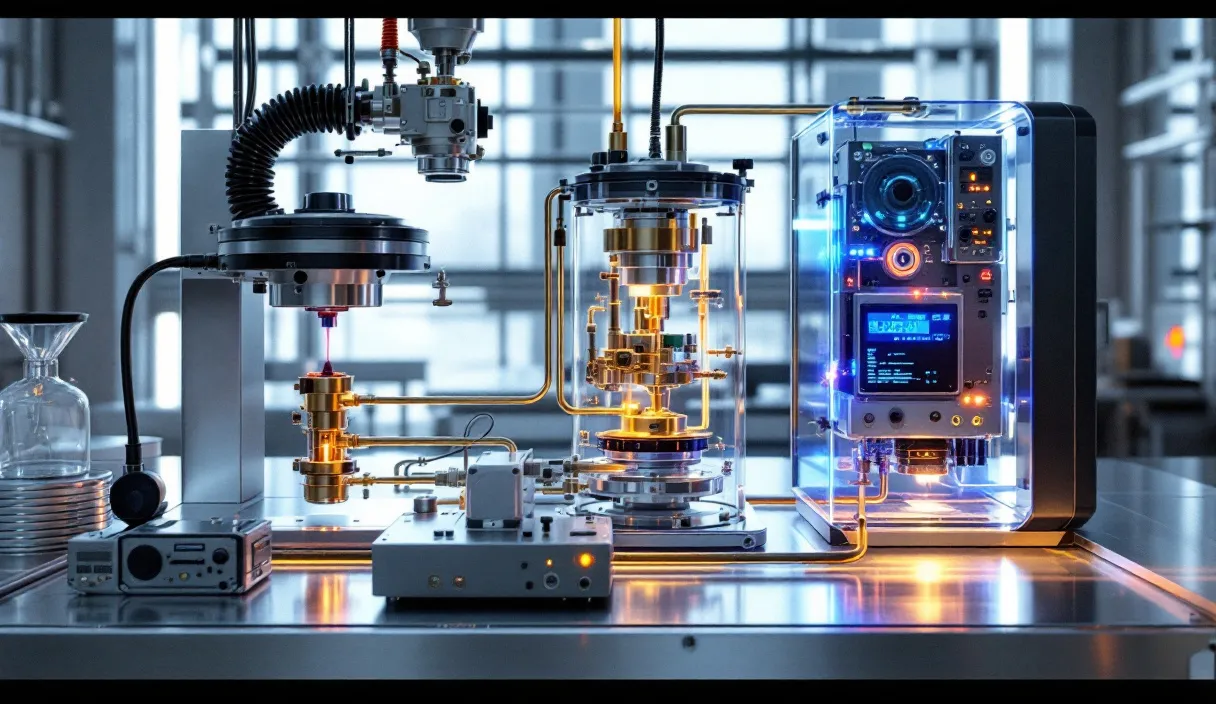
Mitsubishi Electric announced on September 17 that Japan’s New Energy and Industrial Technology Development Organization (NEDO) has selected two of its research projects for support under a post-5G quantum computing program. The company plans to develop laser control systems for neutral-atom and trapped-ion quantum computers, as well as amplifier modules for superconducting processors.
This work will take place in collaboration with institutions such as Japan’s National Institute of Advanced Industrial Science and Technology. This initiative is in its early stages; the announcement does not detail a functional machine, qubit count, or performance metrics.
Details of the Mitsubishi Electric and NEDO Announcement
These two projects are part of NEDO’s Research and Development Project to Strengthen Post-5G Information and Communication System Infrastructure. One project focuses on multi-qubit-control laser systems for neutral-atom and trapped-ion computers, both of which utilize lasers to trap and manipulate atoms or ions. The other project involves ultra-compact, multi-channel, low-noise amplifier modules for superconducting machines, which control qubits using microwaves within cryogenic environments.
Mitsubishi Electric intends to leverage its expertise in laser technology for machine tools and microwave integrated circuits to develop these components. The company also highlights its use of field-programmable gate arrays for low-latency control.
The stated objective is to control a larger number of qubits across various hardware types, with a long-term goal of scaling to one million qubits. This target is an internal company objective, not an immediate result. NEDO’s involvement is to provide public funding through a competitive solicitation; the company release does not specify the grant amount or a completion date.
What the Announcement Does Not Indicate
The provided materials do not include any information on prototypes, benchmarks, logical-qubit results, physical-qubit counts, or error rates. There is no mention of a deployment site or a production timeline. These projects are centered on supporting hardware for qubits, such as control electronics and cryogenic amplification, rather than a complete quantum computer that Mitsubishi Electric currently operates.
Research into scaling quantum systems does not equate to achieving quantum advantage. No system globally has demonstrated a measurable advantage for a commercially useful problem, nor does a cryptographically relevant quantum computer exist. Selection for public funding signifies status and intent, indicating that work is commencing, not that it has been successfully completed.
Real-time control and error correction are crucial to addressing the scaling problem, and other companies are pursuing similar research. For instance, Altera and Riverlane announced a partnership on FPGA-based quantum error correction, with any latency or validation claims attributed to those specific firms. This is distinct from Mitsubishi Electric’s projects and does not offer insights into their progress.