
QNu Labs Demonstrates 5.56 Km Free-Space QKD Link

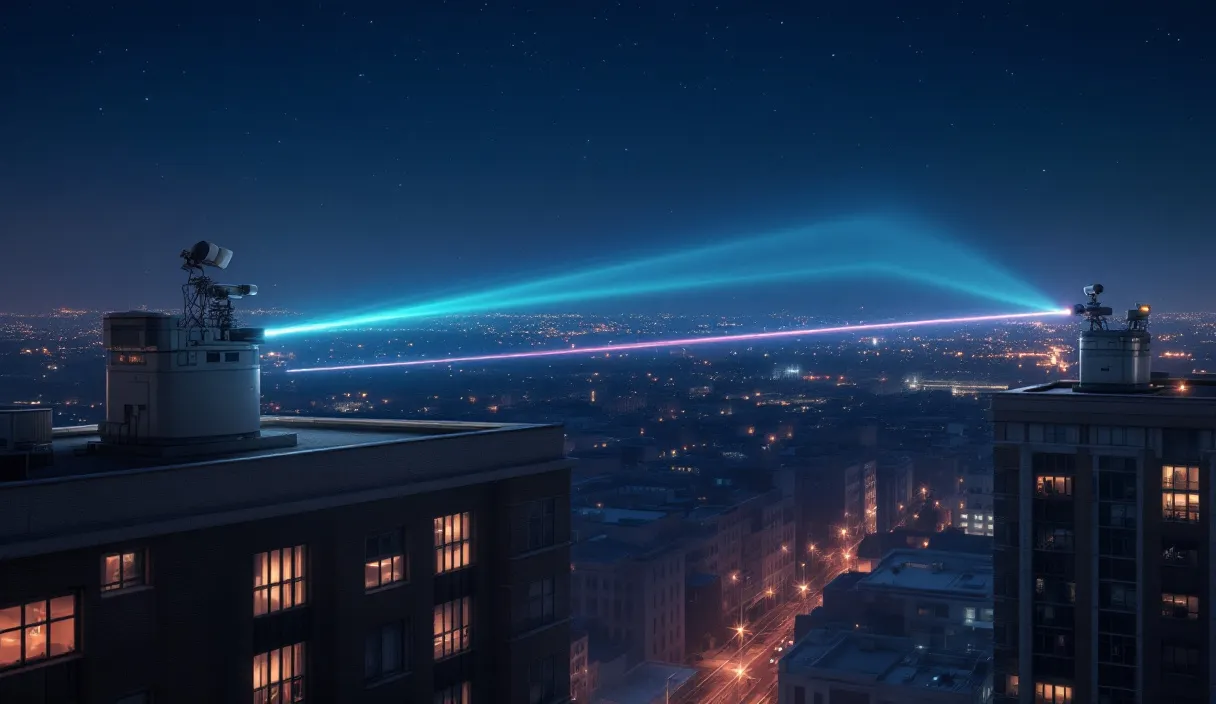
The seemingly counterintuitive aspect of this feat is worth examining: QNu Labs intentionally transmitted a secret key through the open atmosphere between two buildings in Gujarat. This channel, where anyone with a telescope and ill intent could attempt to intercept the photons, was precisely where they wanted it. The security of this method doesn’t rely on signal concealment. Instead, it stems from the inherent physics that cause any interception to manifest as measurable errors.
This is the fundamental principle of quantum key distribution (QKD). Since it’s impossible to copy a quantum state without disturbing it, an eavesdropper inevitably leaves detectable traces. QNu Labs, in collaboration with BISAG-N and IIT Gandhinagar, extended this concept across 5.56 kilometers of night sky. The resulting data proved usable. Let’s delve into the specifics of their work.
System Design and Range Achieved
From the night of September 27 to 28, 2026, the team established a free-space QKD link spanning 5.56 km between BISAG-N and IIT Gandhinagar, as announced by QNu Labs. The team accomplished this without fiber optic cables, relying solely on two terminals aimed at each other through the open air.
It’s important to note that this is a company-announced field trial, not a peer-reviewed publication. QNu Labs asserts this as India’s first free-space QKD link at the 5 km scale, a claim originating from QNu Labs itself, not a third party. Prior free-space work in India by other groups could potentially challenge the “first” claim; I am attributing the statement without endorsing it.
The Open-Air Challenge: Fiber Link vs. Weather Noise
Consider a standard fiber QKD system as a sealed conduit, where glass protects photons within a controlled environment, shielded from external factors like wind, sunlight, and scattering agents. Free-space QKD, however, removes this conduit, transmitting single photons directly through the atmosphere. Here, turbulence distorts the beam, background light overwhelms the signal, and the two terminals constantly risk misalignment.
Therefore, the primary difficulty isn’t the quantum mechanics, but rather maintaining a 1550 nm beam locked onto a receiver several kilometers away despite atmospheric interference. QNu Labs addressed this with a Pointing, Acquisition, and Tracking (PAT) system. Coarse aiming was managed by a gimbal, while fine steering operated at a 100 Hz tracking bandwidth to maintain the lock. The reported pointing accuracy reached 5 microradians for coarse adjustment and up to 0.1 microradians for fine adjustment, sufficient to keep the channel aligned against atmospheric movement.
Key Performance Metrics
The following data represents measured values from the field trial unless otherwise indicated.
- Distance: 5.56 km, free-space, terminal to terminal
- Wavelength: 1550 nm quantum channel
- Protocol: DPS-Decoy QKD
- Secure key rate: 230 to 260 bits per second
- Quantum bit error rate (QBER): below 5%
- Conditions: Night of September 27 to 28, 2026
- Key delivery: 256-bit keys via the ETSI GS QKD 014 interface
- Pointing accuracy: 5 microradians coarse, up to 0.1 microradians fine
At this key rate, the link generated approximately one new 256-bit key every second. The duration of the run and specific detector hardware were not detailed in the available reports, so these aspects remain unaddressed.
Significance of 5 km Open-Air Transmission
The reported QBER of below 5% across an open atmosphere is particularly noteworthy. This figure represents the effective operation of the eavesdropper-detection threshold. Maintaining this low error rate over 5.56 km of turbulent air indicates that the pointing system successfully kept the channel clear enough to extract a usable key. Background light and beam wander are typically major impediments to free-space QKD, and the night operation combined with precise steering mitigated both.
The wider importance of this scale lies in its implications for future applications. Terrestrial free-space QKD serves as a crucial proving ground for satellite QKD, where uplink or downlink transmissions similarly traverse open atmosphere before reaching a spacecraft. Indian Defence News explicitly framed it this way, positioning it as a step towards space-based secure links. Successfully managing pointing and error budgets over kilometers of air builds the necessary capability for the more challenging space-based implementation.
QKD and Post-Quantum Cryptography: Distinct Roles
The trial also integrated its generated keys into BISAG-N’s Vedic Kavach, a browser and web server utilizing post-quantum cryptography and quantum random number generation. A test message was encrypted, transmitted, and then decrypted. The architecture was designed to ensure application protection even if the physical quantum channel becomes unavailable.
It’s crucial not to conflate these two layers. QKD distributes a symmetric key over a physical channel and leverages physics to detect tampering. Post-quantum cryptography, conversely, secures classical systems using mathematical algorithms presumed resistant to quantum computer attacks, as standardized by NIST (FIPS 203, 204, and 205). QRNG simply provides high-quality randomness. These technologies address different problems, and the demonstration does not merge their functions.
This distinction is vital for accurate assessment elsewhere. QKD operations in Gujarat have no bearing on, for instance, Bitcoin’s quantum vulnerability, which resides entirely within classical signatures. QNews has reported on developers reducing the cost of quantum-safe Bitcoin transactions to below $70, which is a software solution independent of free-space QKD. Enterprise tools like BitGo’s quantum-risk capabilities for Bitcoin wallets address the same classical vulnerability. QKD is not involved in that particular challenge.
The quantum technology landscape continues to diversify into specialized hardware, from cryogenic systems for utility-scale machines to key-distribution terminals aimed across vast distances. This result represents one component of that evolution, measured during a single clear night.
The primary challenge was the atmospheric transmission, and for 5.56 km, it proved successful. For further updates on QKD progress and Q-Day timelines, follow QNews.