
Reading a Qubit Without Killing It, Using Its Own Current

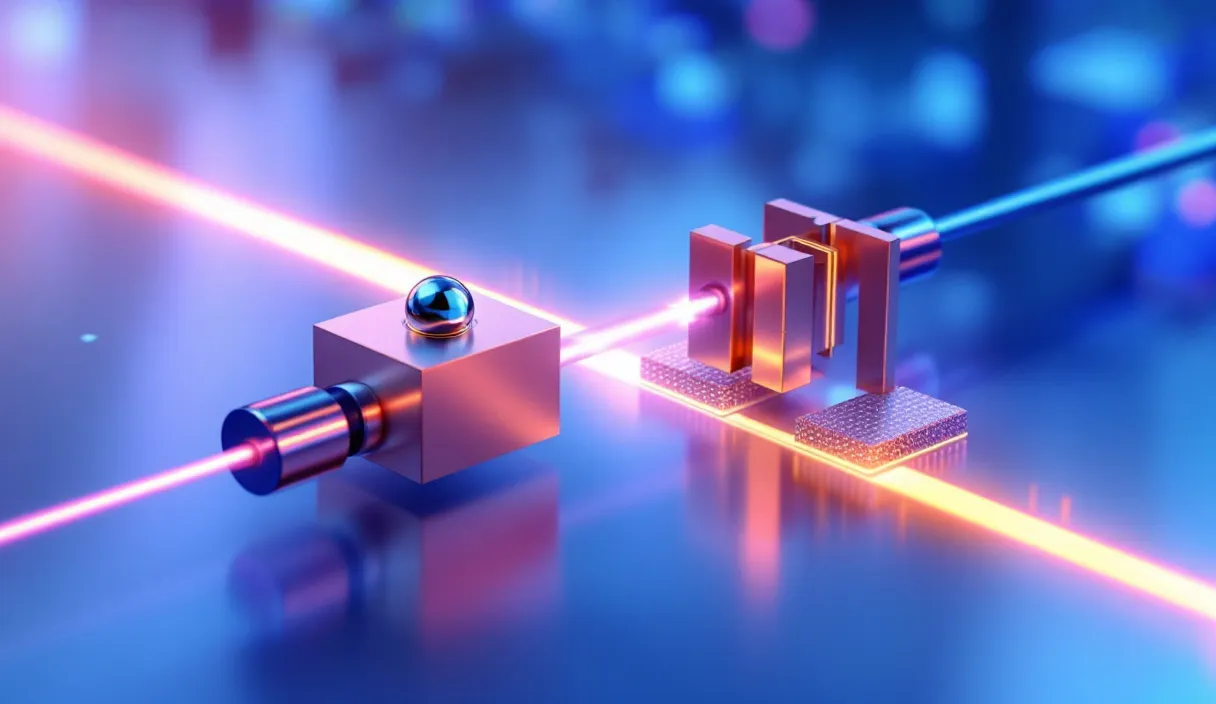
A measurement that tends to destroy the very thing you want to read is the central annoyance in quantum computing. You prepare a qubit in a careful blend of 0 and 1, you look at it, and the blend collapses into a plain answer. The information you wanted is gone the instant you check for it. A group proposes dodging that by never pointing a detector at the qubit at all. Instead, they listen to an electric current the qubit produces on its own, and reconstruct its state from how that current wobbles over time.
What the Proposal Actually Covers
The qubit in question is an Andreev qubit. It lives in a quantum dot formed inside an indium arsenide nanowire wedged between two superconductors, as reported by FAPESP. The states encoding 0 and 1 sit in the nanoscale gap where normal and superconducting materials meet, the Andreev states described by Alexander Andreev back in 1964.
The work is theoretical. That label belongs inline and stays there. The team ran simulations, not a lab build, and the specific device geometry they describe hasn’t been fabricated. The study appeared in Physical Review B Letters, led by José Carlos Egues at IFSC-USP in Brazil and Yugui Yao at the Beijing Institute of Technology, with support from FAPESP. So this is peer-reviewed physics describing a setup that doesn’t exist yet. Those two facts coexist without contradiction.
The scope is one qubit and one readout scheme. No multi-qubit array, no error-corrected processor, no runtime on real hardware. The claim is narrow and clean.
The Current Carries the Answer
Here’s the part that makes the entire thing tick. When the Andreev qubit sits in a superposition, a supercurrent circulating through it doesn’t stay flat. It picks up an oscillating component, driven by quantum interference between the 0 and 1 parts of the superposition. That oscillation is a readable fingerprint of the state.
Think of any qubit state as a point on the Bloch sphere, a globe where every spot on the surface is a different mix of 0 and 1. Two angles pin down the point. One tells you the proportion of 0 versus 1, the other tells you the phase relationship between them. Know both, know the state. Egues and Yao show both live in the current.
- The constant part of the supercurrent and the amplitude of its oscillation together reveal the proportion of 0 and 1 in the mix.
- The moment the oscillation starts reveals the phase relationship between the two states.
- Measuring how the current changes over time reconstructs the full initial state.
Normally, you’d need an applied voltage to make a supercurrent oscillate, the AC Josephson effect. Not here. The oscillation comes from the qubit’s own coherent evolution, voltage-free. That’s the fundamental-physics half of the result, a current that behaves like AC without anyone plugging it in.
A SQUID in the Room Next Door
To read that current, you don’t touch the circuit. The Andreev qubit sits in a closed superconducting loop, and the circulating supercurrent throws off a tiny magnetic field.
Nearby, a SQUID, a superconducting quantum interference device, picks up those magnetic variations. It infers how the current behaves, which tells you the qubit’s state. Egues frames it as two compasses, one being the qubit, one being the SQUID, with the coupling between them kept deliberately weak so the detector barely nudges the thing it’s watching.
That weak coupling is the entire game. The measuring instrument still disturbs the system, because in quantum mechanics it always does. The proposal doesn’t pretend to escape that law. It just shrinks the disturbance until, in the simulations, it stops counting. SQUIDs sensitive enough to catch currents and fields this small already exist, which is part of why the authors call their parameters realistic rather than aspirational.
Two more conveniences fall out. No ancillas, the auxiliary qubits other quantum-nondemolition protocols lean on to carry information off the main qubit before measuring it. And no reset after each read. You can take measurements in sequence as the state evolves and watch the dynamics unfold.
The Numbers, and What They Mean
The team added noise and detector feedback to their simulations to see whether the idea survives contact with imperfection. Depending on how many measurements they allowed, reconstruction accuracy landed at:
- 99.52%
- 99.81%
- 99.85%
These are simulated figures, attributed to the Egues and Yao study. They sit inside the thresholds quantum error correction schemes typically demand, which is the bar that makes a readout method worth building hardware around.
Why does this fit the current moment? Readout overhead is one of the quiet drags on scaling. Every ancilla you prepare, couple, and reset is time and infrastructure, and that cost grows with qubit count. A scheme that reads a qubit through a signal it generates itself cuts that overhead at the root. The same pressure to trim cost and complexity shows up across the field, from control electronics to the economics of quantum-safe cryptographic operations.
The concerns stay small because the paper is upfront about them. The geometry is proposed, not fabricated. The components are standard, but nobody has wired them together this way. If an experiment confirms the prediction, Andreev qubits get a simpler readout path and a macroscopic current becomes a window into microscopic quantum information. That confirmation hasn’t happened yet. The idea is clean, the simulations are encouraging, and a nanowire sitting next to a SQUID remains a drawing until someone builds it.