
Quantum Key Distribution Field Guide
The No-Cloning Theorem, Explained: Why Quantum States Can’t Be Copied

- THE RULE
- No perfect copy
- of an unknown quantum state
- WHY
- Linearity
- of quantum mechanics (1982)
- SECURES
- QKD
- eavesdropping leaves a trace
- FOR YOUR WALLET
- Nothing
- your keys are classical data
The no-cloning theorem says you cannot perfectly copy an arbitrary unknown quantum state. That single rule, proved in 1982, is why an eavesdropper can’t quietly duplicate the quantum signals a key is built from: combined with the disturbance that measurement causes, it lets the two sides detect or bound anyone listening in. It also sets the hard limit on how far quantum keys travel without a repeater, since you can’t amplify a quantum signal either. The theorem is narrower than its reputation, though. Known states copy fine, approximate copies are allowed, and teleportation moves a state by destroying the original. And it does nothing for your wallet, whose keys are ordinary classical data.
Part of the Quantum Key Distribution guide seriesWhat the No-Cloning Theorem Actually Says
Start with what is permitted, because the theorem is narrower than its reputation.
You can copy information you already know. A 0 stays a 0 when you write it down twice, and you can reproduce any quantum state whose full recipe you have in hand. You can also reliably identify and copy a state drawn from a known set of mutually orthogonal — and therefore perfectly distinguishable — options. That is exactly what a CNOT gate does to the computational basis, and it is why classical data copies without limit.
What you cannot do is copy an arbitrary unknown quantum state. Hand a machine a qubit sitting in some superposition you do not know, and there is no physical operation that deterministically produces two perfect copies of it. That much the theorem rules out, and no more.
| Operation | Classical analogue | Quantum verdict | Why |
|---|---|---|---|
| Copy a known basis state (0 or 1) | Ctrl+C on a file | Allowed | Orthogonal states are perfectly distinguishable |
| Copy an unknown superposition | Ctrl+C on a file | Forbidden | Would require a nonlinear, state-dependent operation |
| Make an approximate copy | Lossy compression | Allowed, with a fidelity ceiling | Imperfect clones exist as long as they are never exact |
| Move a state (teleportation) | Cut and paste | Allowed | The original is destroyed; one copy in, one copy out |
| Delete one of two copies | Delete key | Forbidden | No-deleting theorem (Pati and Braunstein, 2000) |
| Broadcast a set of mixed states | Broadcasting | Forbidden for non-commuting sets | No-broadcasting theorem (Barnum et al., 1996) |
| Encode one logical qubit into many physical ones | RAID mirroring | Allowed | Error-correction encoding is an isometry, not a clone |
That last row matters more than it looks. Quantum error correction and quantum repeaters are not loopholes in the theorem; they never claim to duplicate an unknown state, only to spread a known code across many qubits. Confusing the two is the single most common mistake in popular explanations of quantum networking.
Why It’s True, Without the Algebra
Quantum mechanics is linear. Specifically, the rules that move quantum states around have to treat a blend of two states as the same blend of whatever they would do to each state on its own. Feed a superposition into a would-be copier and linearity forces its hand: the output cannot be two clean copies, because two clean copies is not what a linear rule produces.
Work it through for two different states and you reach a contradiction, unless the states were perfectly distinguishable to start with. A machine can deterministically copy states drawn from a known perfectly distinguishable set. It cannot do the same for an arbitrary collection of overlapping ones. The obstruction is not engineering, noise, or budget. It is the geometry of Hilbert space.
A two-minute history: 1970, 1982, and a failed shortcut
The theorem has an unusually clean origin story, and it is worth knowing because it explains why physicists suddenly cared.
In 1970, James Park published an argument in Foundations of Physics that amounted to no-cloning, and the result sat largely unnoticed for a decade. Then in 1982, William Wootters and Wojciech Zurek — and, independently, Dennis Dieks — published the proof as it is cited today: Wootters and Zurek in Nature, Dieks in Physics Letters A. The trigger was a paper by Nick Herbert proposing “FLASH,” a scheme that would have used a hypothetical cloning device plus entangled pairs to send signals faster than light. No-cloning killed the shortcut, and the no-communication theorem locked the door behind it.
No-cloning was not discovered out of curiosity about copying. It was discovered because someone tried to build a superluminal telegraph and the math refused.
Putting the theorem to a test you can run
The cheapest way to feel the theorem is to build the naive copier and watch it fail. A CNOT with the unknown qubit as control and a blank |0> as target copies |0> and |1> exactly. On |+>, it produces a Bell pair, not two copies of |+> — and the reduced state of either output is maximally mixed, giving a fidelity of exactly 0.5.
# A CNOT-based "copier": works on |0> and |1>, fails on everything else.
# Requires qiskit (see https://docs.quantum.ibm.com/)
from qiskit import QuantumCircuit
from qiskit.quantum_info import Statevector, partial_trace, state_fidelity
import numpy as np
def cnot_cloner(psi):
    qc = QuantumCircuit(2)
    qc.initialize(psi, 0)      # unknown input on qubit 0
    qc.cx(0, 1)                # qubit 1 starts in |0>
    return Statevector.from_instruction(qc)
basis0 = cnot_cloner([1, 0])                        # -> |00>
basis1 = cnot_cloner([0, 1])                        # -> |11>
plus   = cnot_cloner([1/np.sqrt(2), 1/np.sqrt(2)])  # -> (|00> + |11>)/sqrt(2)
print("|0> copies to |00>:", np.allclose(basis0.data, [1, 0, 0, 0]))
print("|1> copies to |11>:", np.allclose(basis1.data, [0, 0, 0, 1]))
print("|+> becomes a Bell pair, not |++>:",
      np.allclose(plus.data, [1/np.sqrt(2), 0, 0, 1/np.sqrt(2)]))
# Fidelity of the would-be copy (qubit 1) with the input state |+>
rho_copy = partial_trace(plus, [0])
print("copy fidelity for |+>:",
      state_fidelity(rho_copy, Statevector([1/np.sqrt(2), 1/np.sqrt(2)])))
      # -> 0.5
The output is unambiguous: exact copies for the basis states, 0.5 for the superposition. No cleverness in the circuit design fixes this — the failure is structural.
What It Does Not Say
A theorem this famous collects a lot of misreadings. Four deserve to be retired.
First, it does not say you can never copy anything. Known, distinguishable states copy fine, which is the whole reason classical data copies without limit. The theorem constrains unknown states, not copies in general.
Second, imperfect copies are allowed. A machine can make blurry, approximate duplicates of an unknown state as long as they are never exact. That is not a technicality — it is a quantified discipline, and cryptographic security proofs have to account for it.
Third, moving a state is not copying it. Quantum teleportation can carry a state from one place to another, but it destroys the original in the process, so you end up with one copy and never two. This is not a philosophical claim but a measurable one: when IBM moved an unknown state between two 120-qubit chips at 99% fidelity, the headline finding was that the transfer preserved the state while consuming it.
Fourth, measurement does not erase information. The no-hiding theorem (Braunstein and Pati, 2007) shows that information apparently lost in a measurement is not destroyed; it migrates into correlations with the environment. That is a statement about where information goes, not about whether it can be copied.
Fidelity ceilings, in one table
The approximate-copying loophole is small and precisely bounded. These are the numbers that matter for security analysis.
| Approach (1 → 2 copies of one qubit) | Copy fidelity | Status |
|---|---|---|
| Exact cloning of an arbitrary unknown qubit | 1.000 | Forbidden by the theorem |
| Optimal universal cloning machine (Bužek and Hillery, 1996) | 0.8333 (5/6) | Allowed; state-independent ceiling |
| Optimal phase-covariant cloning (Bruß et al., 2000) | 0.8536 | Allowed; the relevant bound for BB84 |
| Naive CNOT copier on |+> (the code above) | 0.5000 | Fails; output is a Bell pair |
| Honest copy of a known basis state | 1.000 | Allowed; this is classical copying |
How QKD Turns the Theorem Into a Security Guarantee
This is where the theorem shows its true value. Consider Eve, an eavesdropper, sitting on the fiber between Alice and Bob. In the classical world she would tap the line and copy every bit, and no one would know. No-cloning takes that option off the table: she cannot quietly duplicate each unknown signal and pass the original along untouched.
Intercept-resend, and the 25% that gives Eve away
In the simplest attack, called intercept-resend, Eve measures each signal and sends a fresh one on. Because she does not know Alice’s basis, she guesses. When she guesses the wrong basis, she introduces errors that Alice and Bob can catch statistically. In BB84, that attack drives the quantum bit error rate to about 25% — ten times the few-percent threshold a real system tolerates before it aborts the key. Eve’s information gain and the disturbance she creates are locked together, and no-cloning is the reason the lock holds.
Why one theorem is not the whole proof
More sophisticated attacks let Eve interact with the signals coherently, or hold them in quantum memory and measure later, or split off a photon from a multi-photon pulse. That is why QKD security rests on a complete protocol and a full security proof, with no-cloning as one ingredient among several. Under the protocol’s security assumptions, any information Eve gains ties to a disturbance, or to other statistics Alice and Bob use to bound how much she could know. The theorem makes eavesdropping detectable; the proof makes it quantifiable.
Practical weak-laser systems need a patch for one specific gap. Real sources sometimes emit two or more photons with identical polarization, letting Eve keep one and let the other pass — the photon-number-splitting attack. Decoy states — pulses sent with randomly varied intensities — close that hole by letting Alice and Bob measure the statistics of single-photon versus multi-photon emissions. No-cloning forbids copying the photon; decoys catch it when a system accidentally hands one over.
The Side Effect: Distance
The same physics that guards a quantum key also shapes how far it can travel, and here the theorem stops being comforting and starts being expensive.
A classical optical network fights loss with amplifiers — boxes every so many kilometers that regenerate a fading signal and push a strong one onward. An arbitrary quantum signal cannot be regenerated the same way. A phase-insensitive linear amplifier adds at least 3 dB of excess noise, which is exactly the amount needed to preserve the uncertainty relations; run a chain of them and the signal is buried in the noise long before it arrives. Amplification and cloning fail for the same underlying reason.
More generally, a lossy quantum channel imposes a hard limit on the key rate you can get over distance without a repeater. The benchmark here is the PLOB bound, derived by Pirandola and colleagues in 2017: repeaterless secret-key capacity scales as −log₂(1 − η) bits per channel use, where η is the channel transmittance. Over 100 km of standard fiber at 0.2 dB/km, η = 10⁻², giving a ceiling of about 0.0145 bits per channel use — and that is an upper bound, not a design target. In practice, conventional point-to-point fiber QKD works over far shorter spans than the headline lab records.
| System | Distance | Reported rate | What it proves |
|---|---|---|---|
| Gobby–Yuan–Shields decoy-state BB84 (2004) | 122 km | ≈1 kbps | Decoy states made weak-laser QKD practical |
| Commercial point-to-point fiber QKD | ~50–100 km typical | kbps to low Mbps | Deployable, but short-haul |
| Micius satellite (Yin et al., 2017) | 1,200 km satellite-to-ground | Decoy-state BB84 | Free-space beats fiber for reach |
| Twin-field QKD record (Liu et al., 2023) | 1,002 km ultralow-loss fiber | ≈0.0034 bps | Beats the PLOB bound in a lab, at a whisper |
| Trusted-node chain | Arbitrary, node by node | High, but trust-dependent | Engineering workaround, not a physics fix |
Twin-field QKD, proposed by Lucamarini and colleagues in 2018, is the cleverest loophole so far: instead of sending the key signal the whole way, Alice and Bob interfere single photons at a middle station, which cancels most of the loss. It pushed keys past 1,000 kilometers of ultralow-loss fiber — an extraordinary result at roughly 0.0034 bits per second, which is a few bits per hour. That is a physics demonstration, not a network service.
To stretch QKD into a usable network, you still need trusted nodes that re-key at each hop, satellites, twin-field links, or eventually quantum repeaters that distribute entanglement and teleport states instead of copying them. The theorem is not an obstacle to repeaters; it is the design constraint that tells engineers what a repeater must do. And these constraints shape network planning before any hardware is bought: SK Telecom and KISTI’s QKD digital twin models distance, optical loss, and equipment performance in software first.
What No-Cloning Means for Your Wallet
Nothing. And that distinction is worth more than it sounds.
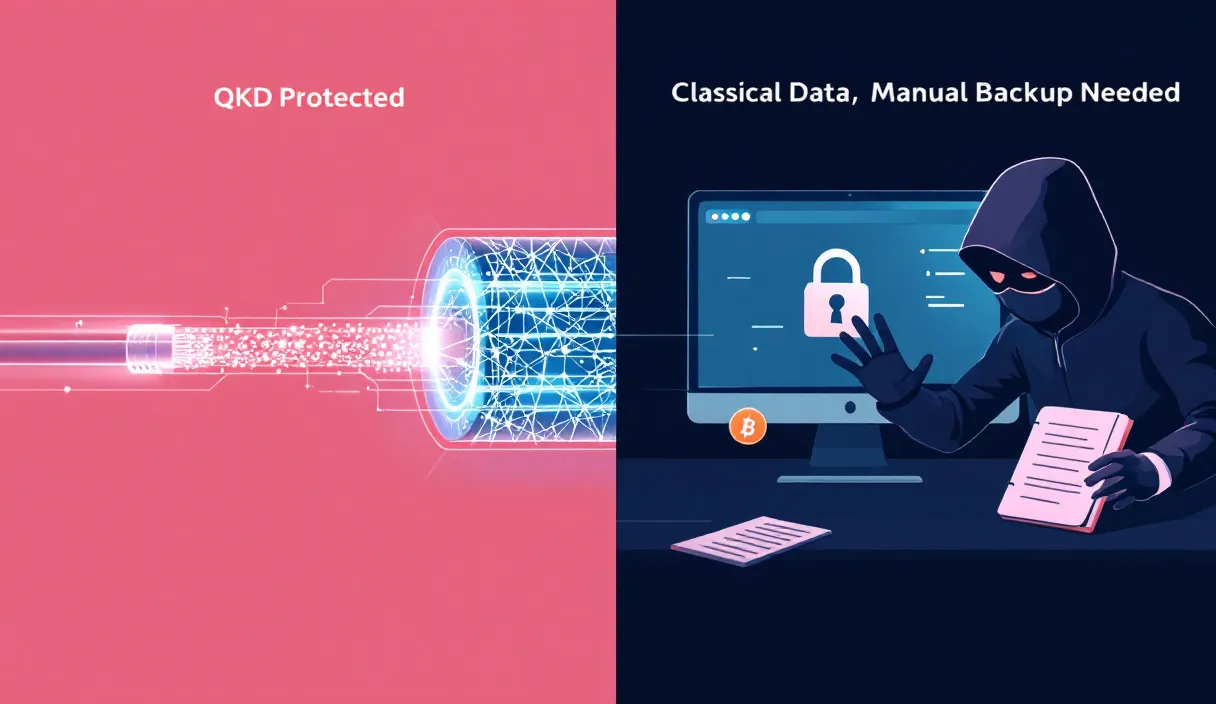
No-cloning protects a quantum state moving through a channel. Your wallet’s keys are not quantum states. They are classical data, copyable like any file — which is the whole reason you back up a seed phrase and the whole reason a leaked private key must be treated as permanently compromised. No physics rule stands guard over them. If someone reads your seed phrase, they have your coins, and there is no uncertainty principle that steps in to help.
A recent Cisco and KETS demonstration illustrates the communications role clearly: QKD supplied keys to routers using MACsec to encrypt Ethernet traffic. That is the theorem earning its keep — protecting a key in transit between two physical sites, not protecting a key at rest on your hardware.
The quantum danger to your coins is a different problem entirely: a sufficiently capable quantum computer using Shor’s algorithm to recover a private key from its exposed elliptic-curve public key. The answer to that threat is migration to post-quantum cryptography, including signature schemes built on mathematical problems with no known efficient quantum solution. No-cloning helps secure quantum communication, and it is not what will protect the coins in your wallet.
The takeaway: no-cloning is a statement about unknown quantum states in transit. It makes quantum eavesdropping detectable, it caps how far fiber QKD can reach without repeaters, and it has no bearing whatsoever on a private key sitting on your disk.
Frequently Asked Questions
Was the no-cloning theorem really proved in 1982?
Yes, twice independently. Wootters and Zurek published the proof in Nature in 1982, and Dieks reached the same result in Physics Letters A the same year. James Park published an equivalent argument in 1970 that went largely unnoticed until the 1982 papers made the point canonical.
Can quantum computers be used to break the no-cloning theorem?
No. The theorem follows from the linearity of quantum mechanics, which quantum computers obey by construction. A quantum computer is a linear machine, and no linear machine can deterministically clone an arbitrary unknown state. More qubits buy more capability, not a nonlinearity.
If cloning is impossible, how does quantum error correction work?
Error correction does not copy the state. It encodes one logical qubit into an entangled state spread across many physical qubits — an isometry, which is a perfectly legal linear operation. The encoded information is protected by redundancy in a code, not by duplicates of an unknown state.
Does the theorem mean quantum states are always destroyed when read?
Not always, but reading an unknown state in the wrong basis destroys the information it carried. Orthogonal basis states can be measured cleanly and re-prepared. The no-hiding theorem adds an important nuance: information disturbed by measurement is not erased, it leaks into correlations with the environment — which is precisely why eavesdroppers leave traces.
Is no-cloning the only reason QKD is secure?
No, and treating it as the whole story is a common error. No-cloning explains why copying is unavailable, but security rests on a complete protocol plus a proof that bounds Eve’s information against the disturbance it causes. Implementation flaws, detector behaviour, source imperfections, and side channels have all broken real QKD systems — which is why decoy states, finite-key analysis, and device-level engineering matter as much as the physics.
Does no-cloning make quantum money possible?
It helps. The idea predates the theorem itself: Stephen Wiesner proposed unforgeable quantum money in 1970, circulated informally and published in 1983. No-cloning is why a banknote carrying unknown quantum states cannot simply be duplicated — though real quantum money schemes still have to defend against the holder’s own tampering and against storage errors.
The Bottom Line
The no-cloning theorem is a one-page observation with four decades of consequences. It says that linear quantum mechanics cannot copy an unknown state exactly, and it says nothing more. From that single constraint follows the detectability of an eavesdropper in QKD, the hard rate–distance barrier that makes repeaters necessary, the fidelity ceilings that security proofs must respect, and a durable set of misreadings that keep the theorem famous.
The cleanest way to remember it: quantum information can be moved, distorted, or lost to correlations, but never duplicated on demand. Anything claiming otherwise — including a scheme that promises to copy a qbit for you, or a product that claims to extend quantum links with ordinary amplifiers — is not defeating the theorem. It is misrepresenting it.
This article is educational and does not constitute security or investment advice.
// Sources
- Wootters and Zurek, A single quantum cannot be cloned (Nature, 1982) https://www.nature.com/articles/299802a0
- Dieks, Communication by EPR devices (Physics Letters A, 1982) https://doi.org/10.1016/0375-9601(82)90084-6
- Pirandola et al., Fundamental limits of repeaterless quantum communications (the PLOB bound, 2017) https://www.nature.com/articles/ncomms15043
- QNews, Decoy States, Explained https://qnews.io/guides/quantum-key-distribution/decoy-states-explained-the-fix-that-made-weak-laser-qkd-practical/
- QNews, Post-Quantum Cryptography: The Quantum Computing Threat, in Plain English https://qnews.io/guides/post-quantum-cryptography/post-quantum-cryptography-a-plain-english-guide-for-crypto-holders/