
New Post-Quantum Wallet Pitches AI Firmware Verification

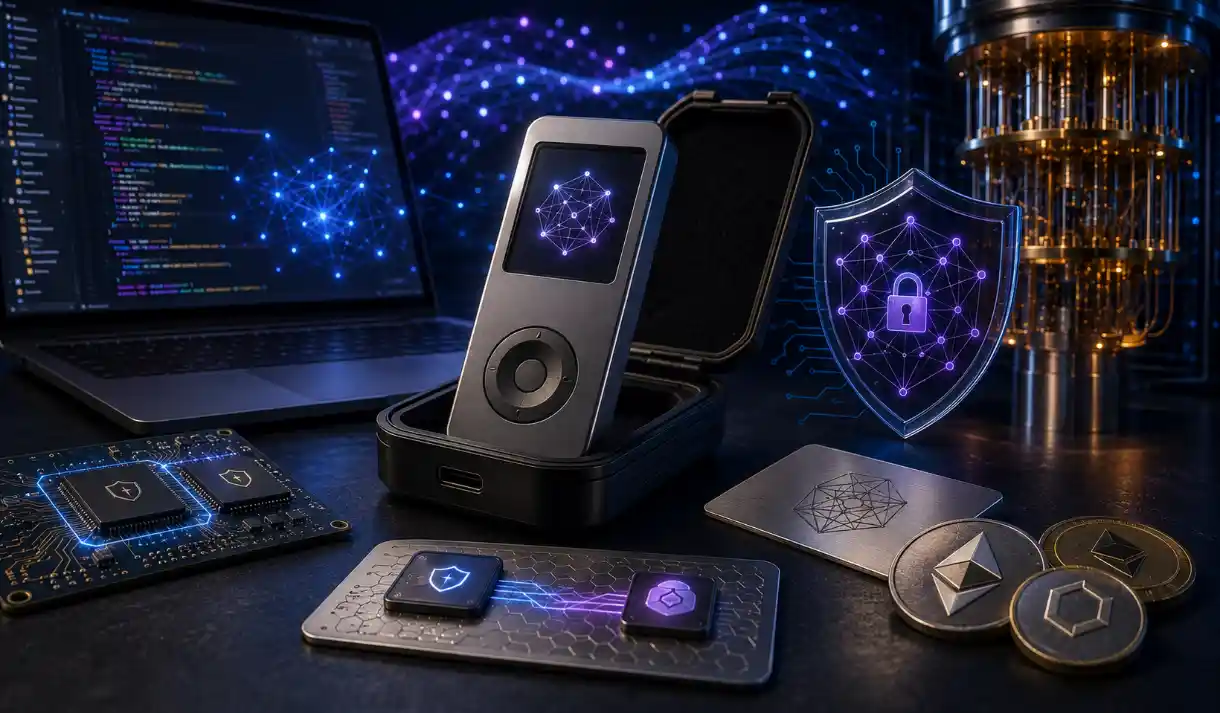
Freedom Factory has announced a hardware wallet it calls the world’s first quantum-resistant one, and its most unusual selling point has little to do with quantum. The PQ1 is fully open-source, and the company wants you to verify its firmware by pasting the code into ChatGPT or Claude. That pitch is the part worth examining most closely.
What the PQ1 is
According to the July 28 announcement, the device targets Ethereum and EVM-compatible chains, costs $179, and is up for pre-order with shipping expected in Q4 2026. Its security rests on SPHINCS+, the hash-based signature scheme NIST standardized as SLH-DSA, and the PQ1 runs it with no ECDSA fallback, committing fully to post-quantum signatures instead of hedging with today’s elliptic-curve crypto. That’s a design choice, because most wallets rely on the ECDSA that a future quantum computer could break.
The hardware claims sit on the high end. Freedom Factory says the PQ1 uses dual secure elements rated EAL6+, a notch above the EAL5+ common in the category, and splits the recovery seed across both chips so compromising one wouldn’t expose the whole key. It supports ERC-4337 account abstraction, which allows smart-contract accounts with features like social recovery and gas sponsorship. The wallet skips Bitcoin, which the company attributes to Bitcoin not adopting post-quantum signatures. Vitalik Buterin and Balaji Srinivasan have endorsed it, though endorsements aren’t audits, and “world’s first” is the company’s own claim.
The AI-audit question
Now the pitch that leads the announcement. Freedom Factory promotes using AI models like Claude or ChatGPT to check the wallet’s firmware, framing it as a way for non-engineers to confirm their device hasn’t been compromised. Treat that carefully. An open-source wallet with a reproducible verification process is genuinely good, and letting a curious owner read the code with an AI’s help beats a sealed black box. But an LLM isn’t a reliable security auditor. It can miss vulnerabilities and describe flawed code as safe with total confidence, and selling “ask an AI” as verification risks handing users false assurance. To put it plainly, a chatbot’s read is a starting point that can’t replace reproducible builds and independent expert review.
The quantum part rests on firmer ground. Wallets do face a real long-term threat, since a powerful enough quantum computer could pull private keys from exposed public keys, which is why harvest now decrypt later already worries anyone holding long-lived keys and why Q-Day preparation is under way. Committing to SPHINCS+ addresses that, with one tradeoff worth knowing. Hash-based signatures are far larger than the ECDSA ones they replace, which affects storage and fees. The move fits a wider push to build post-quantum protection into wallets and shipping products, even as most of the field, and most of Bitcoin, hasn’t gotten there yet.