
Top Quantum Computing Investors in 2026: Who Is Funding the Sector


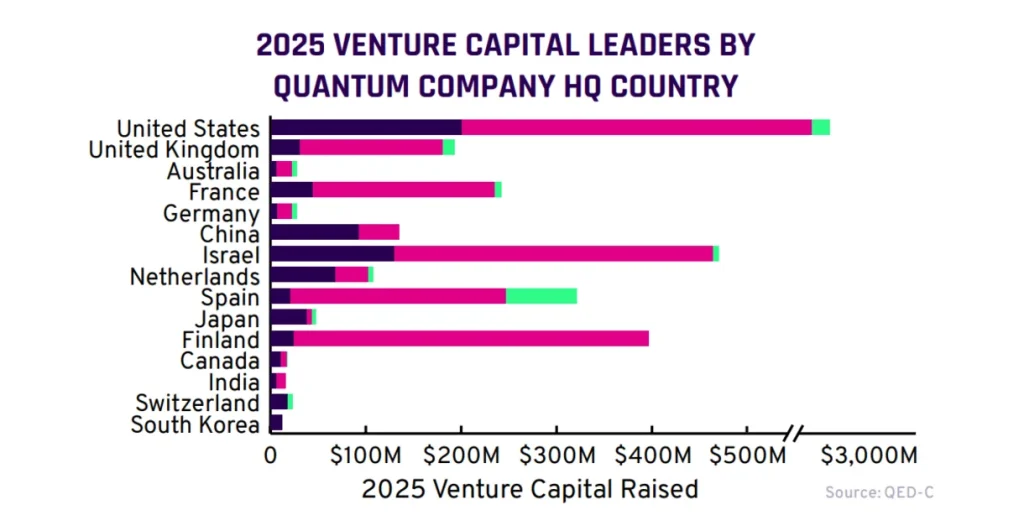
Quantum computing investment reached a new high in 2025, and the investors writing those checks have become easier to name. Private venture capital in quantum hit $4.9 billion in 2025, more than double the previous record, according to Quantum Economic Development Consortium (QED-C)’s State of the Global Quantum Industry 2026 report. US-headquartered companies alone raised more than $2.7 billion of that total. This guide profiles the leading quantum computing investors in 2026, grouped by type, with the companies they have backed and the funding stages they target.
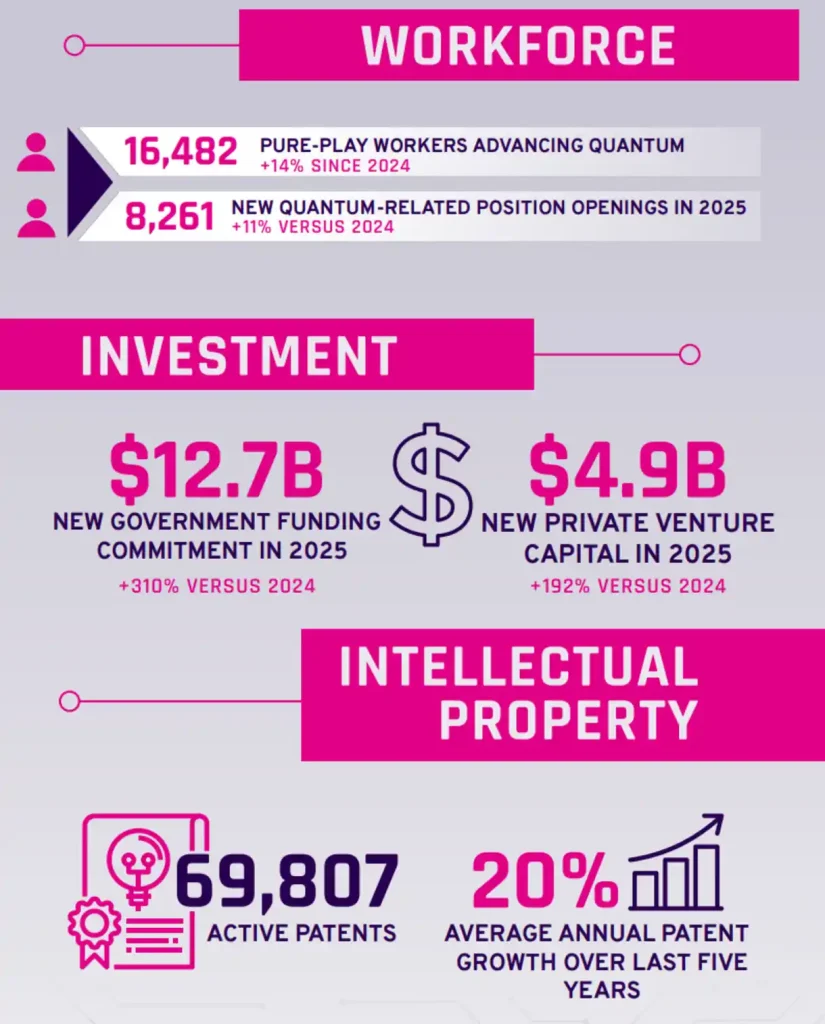
Quantum computing funding in 2026: where the money is going
Quantum funding has changed character several times. Money chased almost anything with “quantum” in the pitch during 2018 to 2020. Investors got stricter between 2022 and 2024 and asked for proof of technical progress. Then 2025 pushed the numbers to a level the sector had not seen before.
Hardware now takes the largest share of quantum funding, a reversal of the software-heavy pattern from 2023 and 2024. Companies with a credible path to fault tolerance are winning capital over those pitching near-term software use cases.
Three events from 2025 show the shift. PsiQuantum raised $1 billion in September in a Series E led by BlackRock at a $7 billion valuation, the largest single private round in quantum computing history. In that same month, NVIDIA’s venture arm NVentures backed Quantinuum, PsiQuantum, and QuEra inside one week, covering all three major hardware approaches.
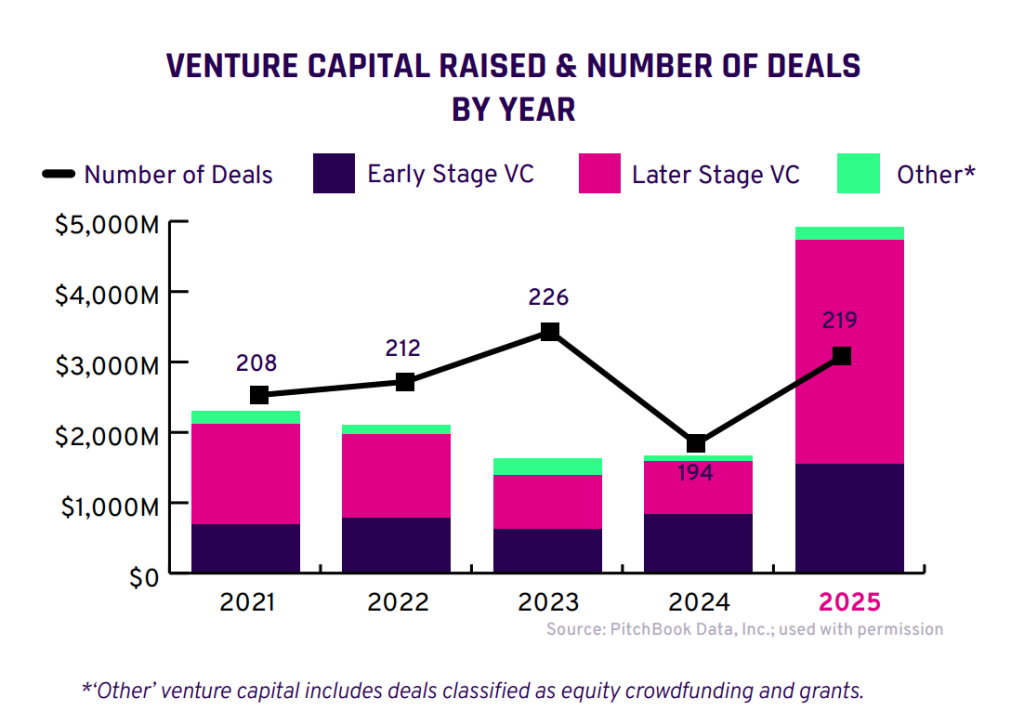
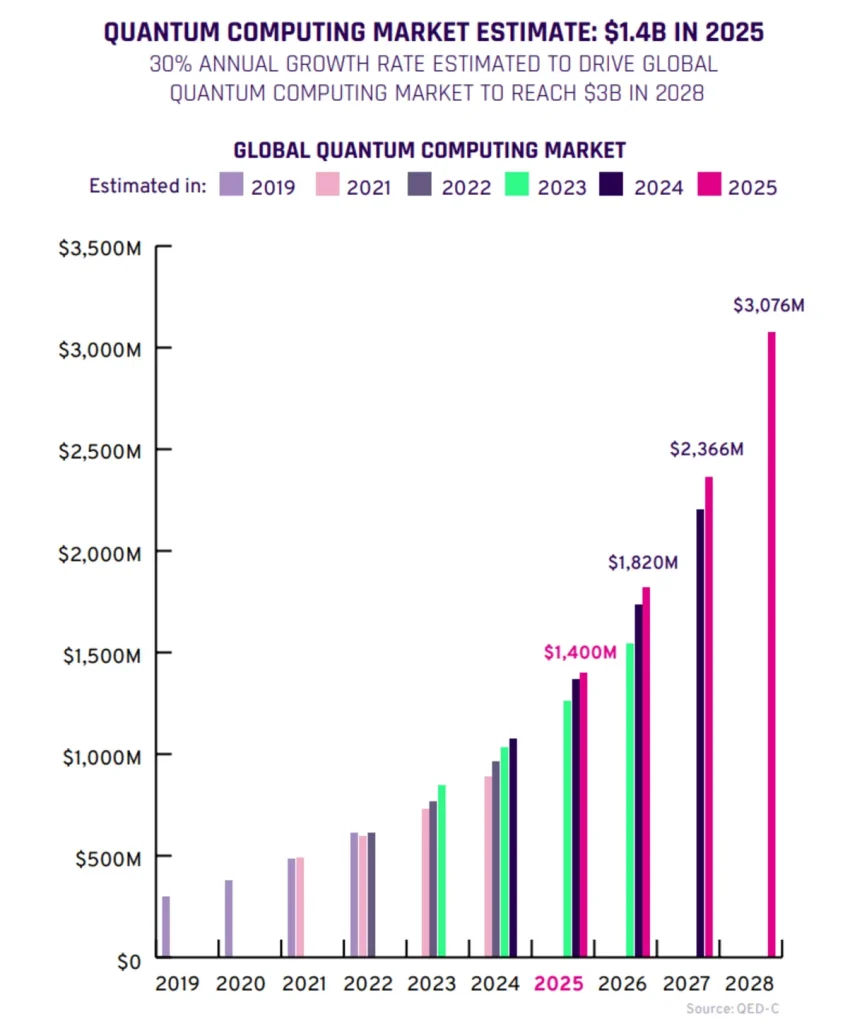
The picture keeps moving in 2026. The QED-C report projects the global quantum market will double by 2028 and reach $3 billion in revenue. The billion-dollar mega-rounds of 2025 are giving way to a higher number of mid-size raises, with more strategic money from hyperscalers, defense primes, and industrial groups. China’s quantum investment in the first quarter of 2026 nearly matched its full-year 2025 total, so capital is no longer concentrated only in the US and Europe.
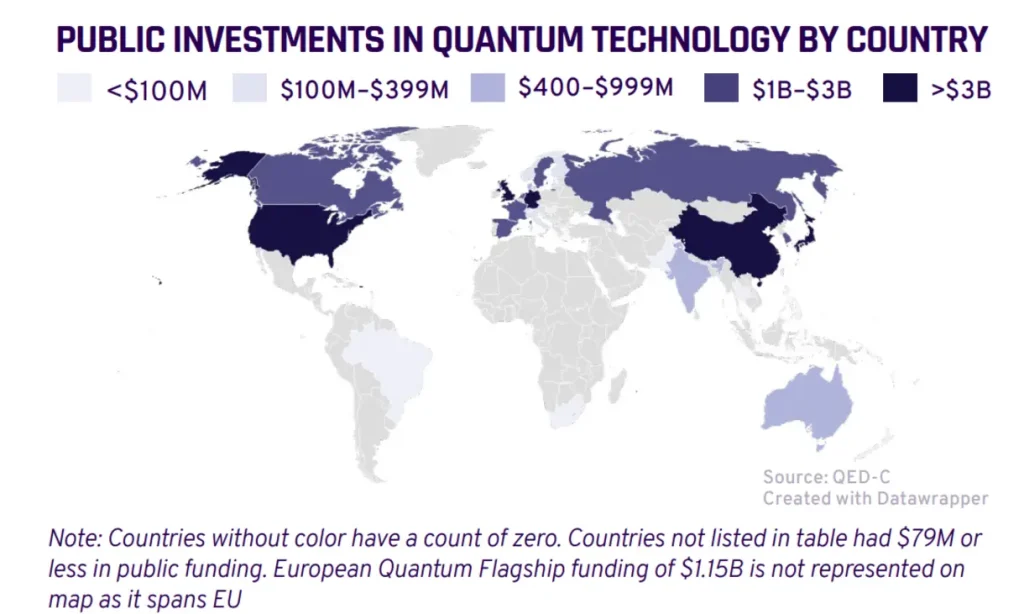
Government moves from backstop to direct quantum investor
Government has moved from safety net to direct player. On June 22, 2026, President Trump signed an executive order directing a national quantum strategy, a federally backed quantum computer for scientific research, and agency-level post-quantum cryptography migration deadlines. It was the widest federal quantum action since the National Quantum Initiative Act of 2018.
The Department of Energy followed a day later with Quantum Genesis, aiming for fault-tolerant quantum computing capability by 2028. In May, the US government reported plans to award about $2 billion in grants and equity stakes to nine quantum companies, with IBM expected to receive around $1 billion.
The list below is a selection, not a ranking. Only confirmed quantum portfolio companies are named for each investor.
Dedicated quantum venture funds
These firms invest in quantum technology as their core mandate, usually at the earliest stages.
Quantonation
Quantonation closed its second fund above target at €220 million ($252 million) in February 2026, more than doubling its first €91 million ($104 million) fund and becoming the largest dedicated quantum investment firm by assets under management. The Paris firm has backed 27 companies since 2018 through Fund I and has already put money into 12 companies through Fund II, aiming for roughly 25. Confirmed portfolio companies include PASQAL, Nord Quantique, Multiverse Computing, Diraq, and Pioniq. Limited partners include Vertex Holdings (Temasek), Bpifrance, the European Investment Fund, Novo Holdings, and Toshiba. It invests from pre-seed to Series A across computing, sensing, communications, error correction, and enabling technologies.
55 North
55 North, based in Copenhagen, announced a €134 million first close of its €300 million debut quantum technology fund in October 2025. Managing Partner Owen Lozman leads it with General Partners Helmut Katzgraber and Kai Hudek. About 75% of the capital goes to European companies, and a quarter is set aside specifically for Nordic firms. Anchor investors include EIFO and Novo Holdings.
Firgun Ventures
Firgun Ventures launched from London in late 2025 and completed a $70 million first close backed by the Qatar Investment Authority. It is targeting $250 million for what it calls the first VC fund focused on early growth-stage quantum companies. Firgun invests worldwide across quantum computing, sensing, and communications, plus applications in healthcare, climate, finance, and cybersecurity. Early investments include Photonic Inc. in Canada and Quantum Elements in the US.
Quantum Coast Capital
Quantum Coast Capital (QCC) sits in Palm Beach and was founded in 2024. It is one of the few US venture firms dedicated entirely to quantum. QCC targets early-stage startups across the US and NATO countries, spanning quantum computing, quantum-enabled technologies, AI, advanced sensors, networking, and post-quantum cybersecurity. In October 2025 it signed an MOU with the Florida Opportunity Fund to co-invest in quantum companies.
Quantum Exponential
Quantum Exponential Group (QEG) is the UK’s first specialist quantum technology investment company. In November 2025 it opened fundraising for a £100 million venture fund for UK quantum technologies, with about two-thirds aimed at UK companies. QEG already manages a quantum portfolio of eight companies, all revenue generating, and holds an MOU with the Harwell Quantum Cluster, home to the National Quantum Computing Centre.
Ground State Ventures
Ground State Ventures, formerly QDNL Participations, rebranded in April 2026 after raising $88 million for its early-stage quantum fund, past its $70 million target. Ton van ‘t Noordende founded it in 2022 with a Dutch focus, and it now works out of Amsterdam, London, and San Francisco at pre-seed and seed stage. Partners include Chad Rigetti, founder of Rigetti Computing, and Kris Kaczmarek, a former Oxford researcher who co-founded ORCA Computing. Confirmed portfolio companies include QuantWare, Qblox, QphoX, Q*Bird, Diffraqtion, and Quantum Elements.
Generalist and deep-tech VCs backing quantum
These firms invest across deep tech and hold meaningful quantum positions.
Lux Capital
Lux Capital invests in quantum through a physics-first thesis and favors companies with long commercialization timelines. Its confirmed quantum position is Rigetti Computing, held from seed through IPO. Lux’s patient capital supports development horizons past ten years.
Playground Global
Playground Global, in Palo Alto, backs early-stage deep-tech companies that connect computation with the physical world. Its quantum portfolio centers on PsiQuantum, which began in Playground’s warehouse with three employees before becoming one of the best-funded quantum companies anywhere. Playground closed its $475 million Fund IV in May 2026, bringing assets under management to about $1.6 billion, with next-generation computing including quantum and superconducting hardware as one of four investment pillars.
Andreessen Horowitz (a16z)
Andreessen Horowitz backed quantum through Rigetti Computing, joining the superconducting hardware company’s Series A alongside Lux Capital and holding through the public listing.
Felicis Ventures
Felicis Ventures was an early Rigetti Computing backer, taking part in an early round alongside Y Combinator. Its quantum exposure is small next to dedicated funds, though the early Rigetti stake shows a willingness to fund frontier hardware at the start.
Prelude Ventures
Prelude Ventures is a San Francisco climate and deep-tech fund with a confirmed position in Atom Computing. Atom delivered the first neutral-atom system past 1,000 qubits and is working with Microsoft on Magne, an error-corrected system aimed at commercial availability by the end of 2026. Prelude’s focus on foundational technology suits the long cycles common in quantum hardware.
Amadeus Capital Partners
Amadeus Capital Partners, founded in 1997 in Cambridge and London, holds one of the most consistent UK quantum portfolios among generalist deep-tech VCs. Confirmed investments include Riverlane, planqc, Quantum Motion Technologies, and Nu Quantum. It also runs the Amadeus-Apex Technology Fund with Austria’s Apex Ventures for early-stage European deep tech.
Parkwalk Advisors
Parkwalk Advisors is a UK fund manager focused on university spinouts, with £500 million under management, and calls itself the UK’s most active investor in that space. It has been part of IP Group since 2017 and keeps close ties to Oxford, Cambridge, and Bristol. Confirmed quantum portfolio companies include Oxford Quantum Circuits (OQC), Quantum Motion Technologies, Phasecraft, and Riverlane.
High-Tech Gründerfonds
High-Tech Gründerfonds (HTGF) is a Bonn seed investor backed by the German Federal Ministry for Economic Affairs, KfW Capital, and Fraunhofer-Gesellschaft, with about €1.4 billion under management across four funds since 2005. Confirmed quantum portfolio companies include Aegiq, Delft Circuits, HQS Quantum Simulations, Kiutra, and Pixel Photonics. Its German industrial and public-sector LPs place it inside the country’s domestic quantum supply chain.
Corporate and strategic quantum investors
Corporate venture arms invest for fit with a parent company’s quantum program, cloud platform, or industrial applications.
Samsung Catalyst Fund
The Samsung Catalyst Fund (SCF), Samsung Electronics’ evergreen venture arm, commits to quantum with a thesis built on Samsung’s semiconductor and device-physics work. SCF co-led IonQ’s $55 million round with Mubadala Capital in 2019. Samsung Next also joined Classiq’s $110 million Series C in 2025.
Robert Bosch Venture Capital
Robert Bosch Venture Capital invests in quantum with an eye on automotive, manufacturing, and IoT. Bosch’s industrial base helps it judge quantum uses in sensing, optimization, and materials simulation.
Airbus Ventures
Airbus Ventures runs from Silicon Valley with offices in Toulouse and Tokyo and funds quantum with aerospace and defense uses. Confirmed quantum investments include IonQ and Q-CTRL. Airbus also co-ran the 2024 Quantum Computing Challenge with BMW Group, which drew more than 420 teams to work on problems such as fuel cell catalyst simulation and logistics optimization.
BMW i Ventures
BMW i Ventures, BMW Group’s independent fund in Silicon Valley, invests around mobility, energy, and AI. BMW’s quantum work runs mostly at the corporate level. It expanded a multi-year quantum partnership with Quantinuum in May 2026 focused on materials science for advanced mobility, and it co-ran the 2024 Quantum Computing Challenge with Airbus.
Google Ventures (GV)
Google Ventures holds confirmed quantum positions in IonQ and QuEra Computing. It operates apart from Google Quantum AI’s internal research, which gives Alphabet commercial equity across trapped-ion and neutral-atom hardware while its own team works on superconducting systems.
IBM Ventures
IBM Ventures backs quantum startups that fit IBM Quantum’s platform and customers. Confirmed portfolio companies include QEDMA in error mitigation, QunaSys in quantum chemistry algorithms, and Strangeworks in quantum software. IBM Ventures usually invests at Series A and later in companies that integrate with IBM Quantum services and Qiskit.
Microsoft M12
Microsoft M12 invests in companies aligned with Azure Quantum. Confirmed investments include PsiQuantum, which uses GlobalFoundries silicon photonic manufacturing to pursue million-qubit fault-tolerant systems. Microsoft also gives strategic support to companies building on Azure Quantum, including 1QBit and Quantinuum.
Amazon (AWS)
Amazon invested in IonQ as an early strategic backer, from early rounds through the public listing. Its quantum strategy ties to AWS Braket, which offers access to IonQ, Rigetti, D-Wave, and Oxford Quantum Circuits hardware. Companies in Amazon’s quantum orbit connect to classical cloud services such as SageMaker and Lambda for hybrid workflows.
Sovereign and government-backed quantum investors
These investors carry long horizons and, in several cases, a national mandate.
In-Q-Tel
In-Q-Tel is the US intelligence community’s main quantum venture vehicle. It invests without the exit pressure or fixed timelines of a standard VC and stays focused on cryptography, quantum sensing, and national security. Confirmed portfolio companies include Quantum Brilliance, which builds diamond-based room-temperature systems, Infleqtion, and Lightsynq, which IonQ acquired in June 2025.
Mubadala Investment Company
Mubadala, Abu Dhabi’s sovereign fund, has held a confirmed quantum position since co-leading IonQ’s $55 million round with Samsung Catalyst Fund in 2019, one of the earliest major sovereign entries into quantum hardware. Its long horizon and cross-sector portfolio fit companies with extended commercialization timelines.
Temasek
Temasek, Singapore’s sovereign wealth fund, has quantum exposure through direct deals and fund commitments. It co-led PsiQuantum’s $1 billion Series E in September 2025 with BlackRock and Baillie Gifford, and it committed as a limited partner to Quantonation II through its Vertex Holdings subsidiary.
SGInnovate
SGInnovate is Singapore’s government-backed deep-tech venture builder and invests as part of the national quantum strategy. Singapore’s Quantum Engineering Programme has committed S$23.5 million to national platforms for computing, quantum-safe communications, and device manufacturing. Confirmed investments include SpeQtral, which develops satellite-based quantum key distribution. SGInnovate works to turn Singapore’s quantum research into companies with Asia-Pacific reach.
SBI Investment
SBI Investment, the venture arm of Japan’s SBI Group, invests in quantum as part of Japan’s technology strategy. Japan has allocated ¥1.05 trillion, about $7 billion, for next-generation semiconductor and quantum research combined, and METI called 2025 the “first year of quantum industrialization.” SBI has backed QunaSys, the Tokyo quantum chemistry and algorithm company.
Quantum investor overview table
| Investor | Type | Geography | Stage focus |
|---|---|---|---|
| Quantonation | Dedicated Quantum VC | France | Pre-seed to Series A |
| 55 North | Dedicated Quantum VC | Denmark | Seed to growth |
| Firgun Ventures | Dedicated Quantum VC | UK/Global | Early growth (Series A-B) |
| Quantum Coast Capital | Dedicated Quantum VC | USA | Early stage |
| Quantum Exponential | Dedicated Quantum VC | UK | Early stage |
| Ground State Ventures | Dedicated Quantum VC | Netherlands/Global | Pre-seed to Seed |
| In-Q-Tel | Government VC | USA | All stages |
| Lux Capital | VC | USA | Seed to growth |
| Playground Global | VC | USA | Seed to Series A |
| Andreessen Horowitz | VC | USA | Seed to growth |
| Felicis Ventures | VC | USA | Seed |
| Prelude Ventures | VC | USA | Seed to growth |
| Samsung Catalyst Fund | Corporate VC | USA | Series A+ |
| Google Ventures (GV) | Corporate VC | USA | Series B+ |
| IBM Ventures | Corporate VC | USA | Series A+ |
| Microsoft M12 | Corporate VC | USA | Series A+ |
| Amazon | Corporate/Strategic | USA | Early to growth |
| Airbus Ventures | Corporate VC | USA/Europe | Early to growth |
| Robert Bosch VC | Corporate VC | Germany | Seed to Series A |
| BMW i Ventures | Corporate VC | USA | Strategic partnerships |
| Amadeus Capital Partners | VC | UK | Seed to Series C |
| Parkwalk Advisors | VC | UK | Seed to Series B |
| High-Tech Gründerfonds | VC | Germany | Seed |
| Temasek | Sovereign Fund | Singapore | Growth stage |
| Mubadala | Sovereign Fund | UAE | Growth stage |
| SGInnovate | Government VC | Singapore | Seed to Series A |
| SBI Investment | VC | Japan | Series A+ |
How to pitch to quantum investors
A strong quantum pitch answers three questions clearly: what makes the technology different, when it earns revenue, and why this team can build it.
On technical differentiation, investors want numbers, not general talk of quantum advantage. Show gate fidelities, coherence times, qubit counts against your roadmap, and error rates next to competing platforms. Vague claims read as inexperience.
On commercialization, a credible path to revenue within three to seven years is now the baseline, whether through hardware sales, software licensing, or quantum services partnerships. The 2025 surge did not drop commercial standards. It rewarded fault-tolerance roadmaps paired with a near-term revenue plan.
On the team, founders with deep quantum research backgrounds or a record of building hardware or software companies carry the most weight. Corporate VCs value prior exits and experience scaling deep-tech companies. Government investors weigh scientific credibility and peer-recognized expertise.
Match the investor to your stage. A seed-focused VC works differently from a corporate arm chasing strategic fit, and government funds care about national security and economic competitiveness. Approaching Google Ventures or IBM Ventures before Series B, without technical validation, rarely goes anywhere. Early-stage founders get further with dedicated quantum funds such as Quantonation, 55 North, and Prelude Ventures, plus government sources like NSF SBIR grants, DARPA, and national quantum initiatives.
Quantum funding trends for the next few years
Early-stage quantum money increasingly comes through government grants and academic spinout programs. Series A and B rounds are getting bigger as companies scale manufacturing and software platforms. Late-stage rounds now regularly pair corporate strategic investors with traditional growth equity. Consolidation looks likely over the next two to three years, as stronger companies buy teams and IP from earlier-stage rivals.
The best-capitalized quantum companies in 2026 combine three funding sources: government research grants for patient, long-horizon work, venture capital for scaling and commercialization, and corporate partnerships for market access and technical integration. Companies leaning on only one source carry more timeline risk than those that built across all three.