
German QKD System Passes an Independent Hardware Security Test

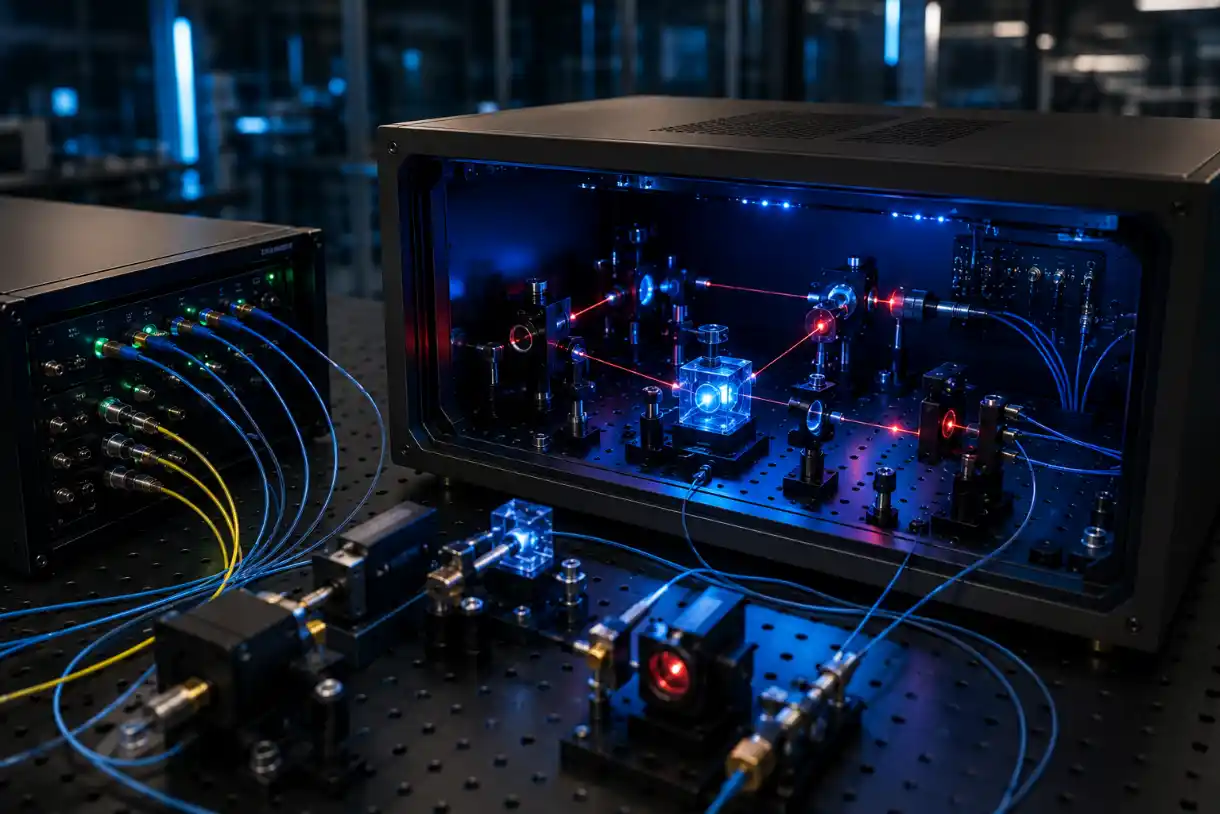
Quantum Optics Jena says its ELVIS quantum-encryption system has passed an independent security evaluation aimed at the hardware attacks that actually break quantum key distribution (QKD). Indeed, over three months, the German assessor TÜV Informationstechnik ran six tests under the ISO/IEC 23837 standard and reported no major weaknesses. The result goes after the distance between QKD’s theory and the equipment it runs on.
The physics was never the weak point
Specifically, quantum key distribution draws its security from physics. According to the August 6 report, Quantum Optics Jena’s system sends keys on entangled photons, and any eavesdropper who tries to intercept them disturbs the signal and gets noticed.
The catch is that attackers don’t bother fighting the physics. They go after the box, exploiting lasers, detectors, and optical parts to leak key information without tripping the alarm, a class of side-channel attacks that is QKD’s real-world weak spot. Kevin Füchsel, CEO of Quantum Optics Jena, put the problem squarely:
“Quantum encryption sounds bulletproof, but it’s only as strong as the solution design and the hardware it runs on.”
The three-month evaluation aimed at exactly those hardware channels, probing the lasers, detectors, and optics an attacker would target. Quantum Optics Jena says none of the six tests found a weakness to exploit, and calls ELVIS the first commercial QKD system to clear scrutiny at this level, a “world’s first” claim that rests on its own account.
What the test settles, and what it doesn’t
The credibility here is in who ran it. TÜV Informationstechnik is an accredited evaluator. ISO/IEC 23837 is the international standard written for testing QKD security, and the methodology came out of QuNET+BlueCert, a Fraunhofer-backed effort to build certification for quantum communication. Sven Bettendorf, who leads quantum technologies at the assessor, kept the framing measured:
“Independent testing is the foundation of trust in any new security technology. With this evaluation, QKD takes a first concrete step toward the certification standards the industry will ultimately need.”
A “first concrete step” is the right size for it. Passing one evaluator’s suite is a strong signal, though short of a certificate of unbreakability, and it doesn’t resolve QKD’s older headaches, the trusted-node problem that limits its range or the running debate over whether QKD or post-quantum cryptography works better for most networks.
Those questions stay open even as QKD turns up in real deployments on power grids and financial links, and in trials pairing it with PQC on live traffic. What Quantum Optics Jena has added is a data point that had been missing: a QKD system that stood up to an independent team paid to break its hardware.