
Physicists Built a Controllable Quantum Fluid Inside a Chip

A Bose-Einstein condensate is sometimes called the fifth state of matter: cool a cloud of particles enough and they stop behaving as individuals, and they merge into a single quantum object that acts as one. Physicists usually make them from atomic gases chilled to a billionth of a degree above absolute zero, floating in a vacuum.
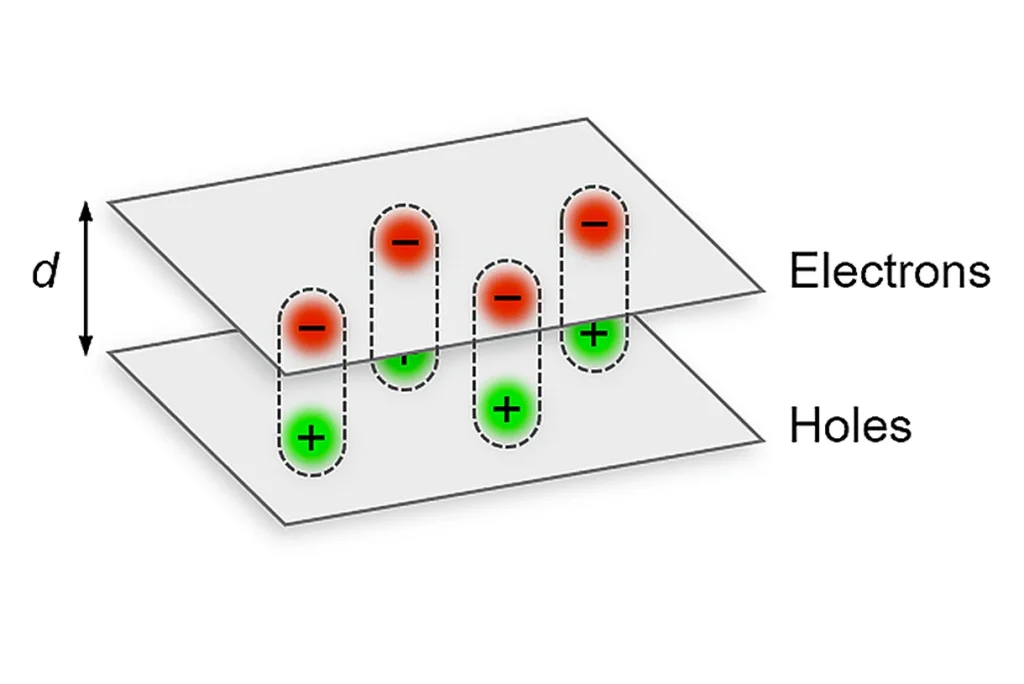
For sixty years they’ve wanted a version built from excitons, the paired electron and hole left behind when light knocks an electron loose in a semiconductor, because that would put macroscopic quantum coherence inside an ordinary solid-state chip. The problem is that excitons made by light vanish in about a billionth of a second, far too fast to settle into a condensate. A Berkeley Lab team has now made one that lasts.
Getting excitons to hold still
According to the August 4 press release, the fix was to stop relying on light. An exciton is a bound pair, an electron and the hole it leaves, that travels through a crystal like a single particle, and a condensate needs those particles to live long enough to relax into a shared ground state.
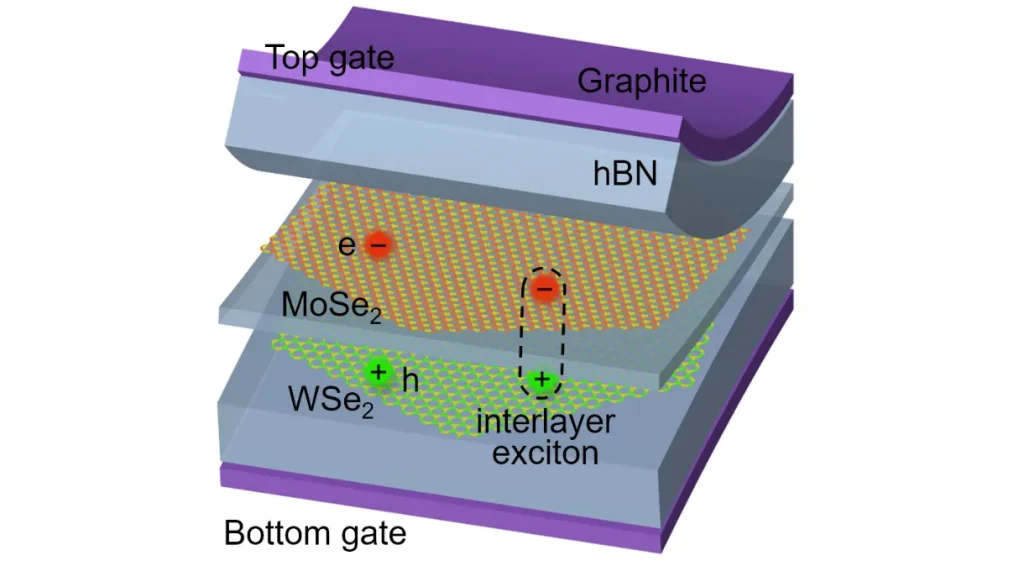
Led by Feng Wang, the team engineered an atomically thin semiconductor device in which the excitons sit in the ground state to begin with rather than a fleeting excited one. That lets them reach equilibrium and stay, a resting quantum fluid instead of a flash. Electrical gates above and below the device let the researchers dial the exciton density up and down, the kind of control that comes from engineering the material itself.
Warm, for a condensate
The researchers cooled the device near absolute zero and probed it with magneto-optical spectroscopy, and watched the excitons behave collectively, exactly as a condensate should. The surprise was how far up the effect held: signatures of the condensate survived to about 2 kelvin.
That’s still bitterly cold, liquid-helium territory, but it’s millions of times warmer than the nanokelvin atomic gases where condensates usually appear, and warm enough to be useful for a device you might actually build. Ruishi Qi, a co-first author, put the distinction in plain terms:
“What is unusual here is that the excitons are not just short-lived particles created by light. They form an equilibrium quantum fluid in a device that we can tune electrically and magnetically.”
The hidden structure
The strangest finding is what’s inside the fluid. In these atomically thin crystals, electrons and holes carry the usual charge and spin, and also a property called “valley” that reflects how they move through the material.
Together. these give an exciton several possible flavors, different spin-and-valley patterns. The condensate the team found has more than one character. It splits into two components with different flavors, which produces several distinct condensate states, and a small magnetic field flips between them. As Qi explained:
“By simply applying a small magnetic field, we can switch the same exciton fluid between different quantum states.”
That switchable interior is the “hidden structure” of the headline, and until now there was no clean way to see it, let alone control it. The team’s method reads it out directly, the sort of access to quantum matter in a solid that experimentalists rarely get.
Where this actually stands
It’s worth being clear about what this is. The result, published in Nature, is fundamental physics: a new, controllable platform for studying quantum fluids inside solid materials. It’s not a quantum computer, and the uses the team points to, quantum simulation and superfluid-based devices among them, are hopes for future work rather than anything demonstrated here.
The 2-kelvin operation still needs cryogenics, and turning a tunable condensate into a device is a long road. Those hopes sit in the same many-body territory where quantum machines are starting to out-reach classical simulation.
What it does give physicists is rare: a quantum fluid they can hold inside a chip and steer with a voltage or a magnet, a controllable solid-state condensate that could one day earn its place on a chip. The devices are a someday. The physics is done, and it’s beautiful.