
Sound Could Carry Quantum Signals Across a Whole Chip – On Paper


Here’s a small, stubborn problem at the heart of building a big quantum computer. The qubits can usually only talk to the ones right next to them. That’s fine for a huddle of a few dozen, but the machines people dream about need millions of qubits spread across a whole chip, all able to coordinate, and a qubit whispering only to its neighbors can’t run that kind of conversation. Researchers at the University of Warwick and NRC Canada have proposed an unusual messenger to bridge the gap: sound.
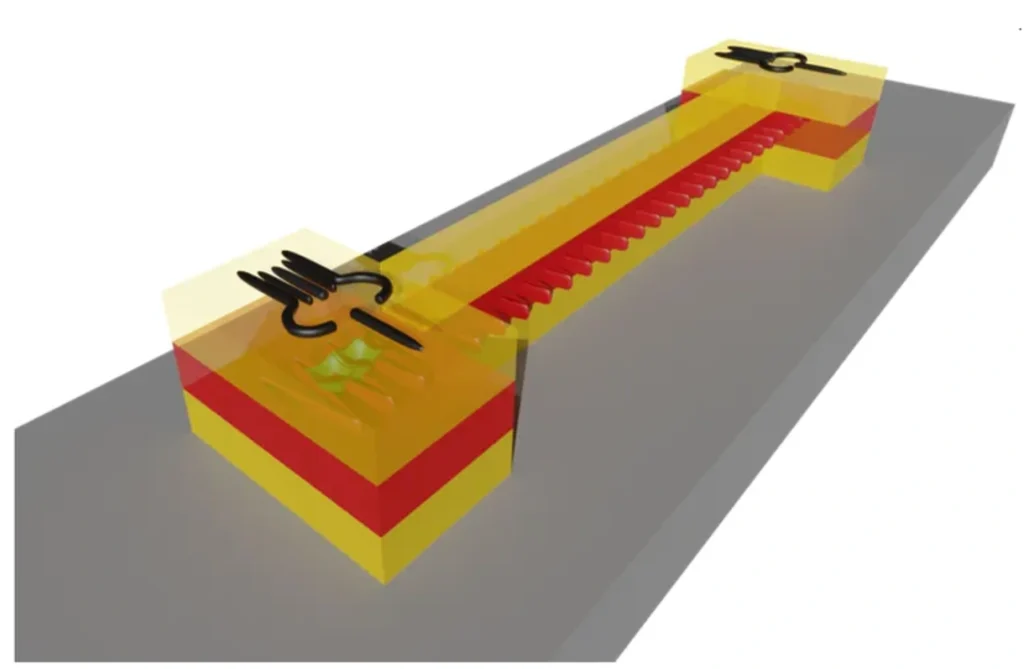
Their idea, published in APL Quantum, is called a Quantum Phononic Link, and it leans on a particle you rarely hear about. Light comes in packets called photons. Sound, it turns out, comes in packets too, called phonons, tiny quantized vibrations rippling through a crystal. The Warwick team wants to use those vibrations as a kind of shuttle, carrying quantum information from one qubit to a distant one on the same chip. Physicists call a shared channel like that a quantum bus, and the pitch here is that a well-behaved stream of phonons could serve as one across surprisingly long distances.
How a Quantum Phononic Link would work
What makes it plausible is a specific material the Warwick group has spent years perfecting, compressively strained germanium grown on silicon. According to the July 28 report, in that thin, squeezed germanium layer, the qubits turn out to be unusually sensitive to the tiny vibrations passing through the crystal. Sensitivity is exactly what you want if vibrations are going to be your messenger, because a qubit that barely notices a phonon can’t receive a message carried by one. Engineer those vibrations carefully, the researchers argue, and quantum information could in principle hop between qubits whether they sit shoulder to shoulder or on opposite sides of a wafer as wide as 300 millimeters.
As Maksym Myronov of the University of Warwick explained:
“Our work introduces a new concept in which phonons act as a quantum bus, enabling distant qubits to exchange quantum information while remaining fully compatible with semiconductor technology.”
That last part is the quiet selling point. Other schemes for long-range qubit links tend to bolt extra machinery onto the chip, microwave resonators or externally generated surface acoustic waves, each adding hardware and complication. A Quantum Phononic Link is meant to live inside the semiconductor itself, grown into the same material that hosts the qubits. If it works, the team argues, it could ride the manufacturing processes the chip industry already uses, which is the difference between a lab curiosity and something you could someday mass-produce.
Why the idea remains theoretical
Now, this is a concept, not a chip. The paper describes what could happen in principle, backed by the physics of a real material, but nobody has yet sent a quantum message from one qubit to another on a phonon and shown it survived the trip. There’s no working device, no measured fidelity across a wafer, and the leap from an elegant proposal to a manufactured processor is its own long climb. What the paper has going for it is peer review, which is more than a lot of splashy quantum claims can say, and a material the group genuinely knows how to grow. What it doesn’t have yet is a demonstration.
The 300-millimeter, million-qubit framing is the horizon the idea points toward, not a result it delivers. Read it as a direction of travel. Connectivity really is one of the central walls between today’s small machines and the useful ones, the same scaling bottleneck a whole field keeps circling, and using vibrations to fight quantum problems isn’t as exotic as it sounds, given that another group is already using tiny vibrations to suppress quantum errors.
The manufacturing-compatibility angle lands in the same ambition driving Hitachi, Intel, and AIST’s silicon quantum project and IBM’s move to buy HRL Labs for silicon spin-qubit know-how, all of it aimed at the million-qubit scale nobody has reached. Today this joins a familiar category, a promising design that lives on paper, the way a recently engineered qubit did before anyone built it. The physics is sound. Whether the chip ever hums the way the math says it should is the experiment still to come.