
The Lab That Bent Light Backwards Is Going Quantum

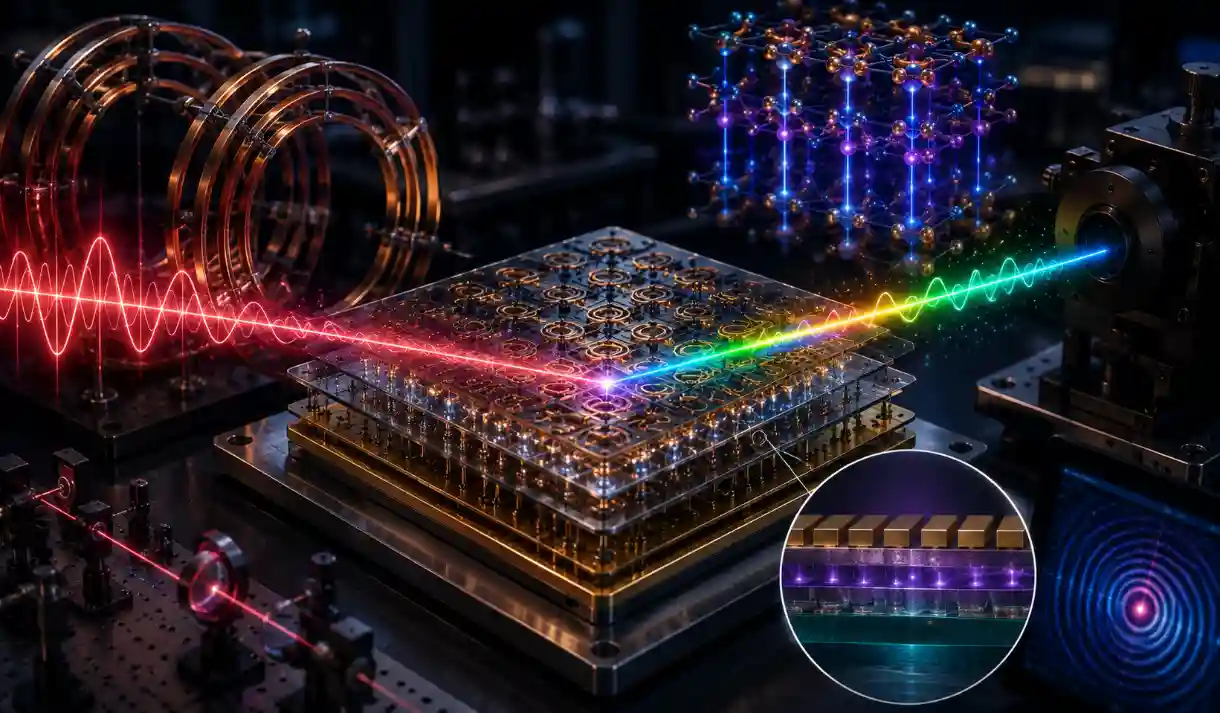
Natural materials bend light in predictable ways. Glass slows it and tilts it toward you, and water does much the same. A quarter-century ago, a team at UC San Diego built something that broke the pattern: a structure of copper rings and wires that bent microwaves the opposite way, which is a trick no natural material pulls off. They called the class of engineered materials metamaterials, and the property negative refraction. The same lab is now trying to do that kind of light-bending with quantum ingredients, and one early result is worth a look.
What a metamaterial does
The idea behind a metamaterial is that structure can beat substance. Rather than relying on what a material is made of, you build tiny patterns, smaller than the wavelength of the light you want to control, and those patterns dictate how the light behaves. Arrange them right and you can steer light around corners or bend it backward in ways no bulk material allows.
According to the July 30 report, UC San Diego’s 2000 and 2001 experiments, led by David Smith with physicist Sheldon Schultz, were the first to show negative refraction in the lab, and they kicked off a field that now reaches into things like MRI, where metamaterials are being developed to shape the radio fields and sharpen images.
Those early structures worked on microwaves, which have long wavelengths and are relatively forgiving. Pushing the same control up to visible light, with its far shorter wavelengths, is much harder, because the patterns have to shrink to the nanoscale.
The quantum ingredient
Here’s where “quantum” enters. The word here has nothing to do with qubits or quantum computing. The team is using nanoscale quantum materials, specifically quantum wells, thin layers where electrons are confined so tightly that their energy levels turn tunable and quantum-mechanical, as the active building blocks of the metamaterial. Richard Averitt, who co-leads the effort, describes the shift as using those quantum elements to build much smaller structures with optical properties that respond faster and more precisely controllable than conventional metamaterials manage.
The payoff they’re most excited about is a conversion trick. Zhaowei Liu, the effort’s other co-lead, put the finding plainly:
“We recently found that a metamaterial comprised of multiple metallic quantum wells can convert an ultrafast pulse of infrared light into visible light with an efficiency more than a thousand times greater than conventional metal structures.”
Turning infrared into visible light is useful because infrared is invisible and awkward to work with directly, and doing it efficiently inside a tiny structure is the hard part. Take the thousandfold number with care, though, as it’s a comparison against conventional metal structures for this one ultrafast conversion, and it says nothing about absolute efficiency or about beating every other method. It’s a big relative jump in a single process.
What it might become
Liu’s group thinks it’s possible to pack these quantum-engineered structures into very small devices, which is why the words “optical computing” come up. Computing with light instead of electrons is an old dream with real appeal, since photons move fast and shed less heat, and ultracompact light-shaping components would help get there. Keep the framing objective, though. This is laboratory research, with funding through UC San Diego’s NSF materials center, and the applications stated as possibilities. Nobody has built an optical computer out of these metamaterials. What exists is a promising conversion result and a plausible path toward using it.
But that still counts a lot. It sits in the same materials-first push behind a lot of quantum-adjacent progress, the materials engineering under every qubit and the exotic films stamped onto photonic chips. The optical-computing angle rhymes with other bets on moving past conventional electronics, like photonic quantum machines built for data centers and chip designs that trade exact arithmetic for efficiency. Like a lot of frontier materials work, the honest label is promising-and-early, the same caveat hanging over designs that so far only exist in simulation. The lab that bent light backward has a long record of turning odd physics into working demonstrations. This is the next one to watch.