
ZuriQ Raises $25.5M for 2D Trapped-Ion Chips

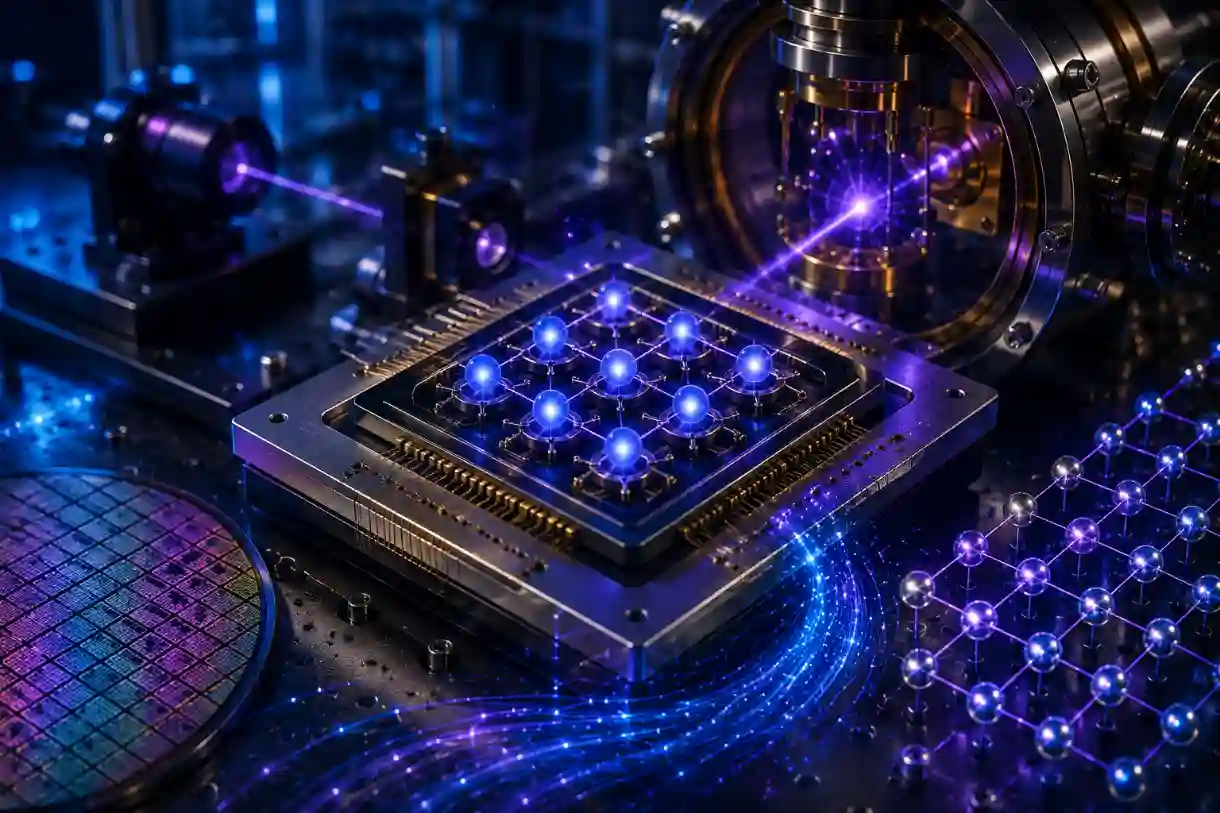
ZuriQ, an ETH Zürich spinout, has raised $25.5 million in seed funding to scale a trapped-ion quantum processor built differently from most. Instead of lining ions up in one-dimensional chains, the company holds them in a native two-dimensional grid where they can move and connect more freely. The round, led by Quantonation, follows a $4.2 million pre-seed last year.
Why ZuriQ’s two-dimensional chip design is different
Most trapped-ion quantum computers rest on a blueprint proposed more than two decades ago, in which ions sit in essentially one-dimensional chains that get stitched into larger grids using complex junction structures. According to the July 28 press release, ZuriQ’s design starts in two dimensions. Using Penning micro-traps, it swaps the rapidly oscillating fields of conventional traps for a static magnetic field, which lets ions move in any direction without the junctions that limit how a chain can be reconfigured. The appeal, in the company’s telling, comes down to how the ion count grows. Jonathan Home, an ETH professor and a scientific adviser to ZuriQ, put the case for it:
“What makes this approach powerful is geometry. (…) Hold ions in a line and the count grows one at a time; hold them in two dimensions, and it grows with the area of the chip.”
That’s an interested source rather than a neutral one, so weigh it accordingly, but the underlying point about area-versus-line scaling is sound. ZuriQ backs it with a working demonstrator, a 3×3 array of nine individually controlled ions that it calls the largest two-dimensional array of its kind shown to date, built with ETH researchers. The chips came from its manufacturing partner Infineon, which is the more grounded detail here, since it shows it’s possible to make the design on established industry processes and not only in a lab.
What the funding means for ZuriQ’s roadmap
Keep the demonstrator in proportion. Nine ions is small, and the leap to the “many thousands” the pitch invokes is a goal, not a measured result. The company frames the raise as the money that turns its architecture into scale, and it has grown from four people to eighteen since the last round, with hires from IonQ, Xanadu, and other quantum and photonics firms, by its own account. The capital goes toward more hiring, a wider research program, additional chip-fabrication capacity, and the groundwork for putting hundreds of qubits on a chip.
The investor and founder quotes are positioning, from Quantonation’s Christophe Jurczak arguing the quantum race is far from decided to CEO Pavel Hrmo casting one-dimensional rivals as stuck on a legacy blueprint. Read those as sales, but the technical bet sits on a real problem. Trapped ions are a serious modality, one that recently caught up with superconductors on error correction and aims at commercial benchmarks, and scale plus connectivity is the exact bottleneck the neutral-atom field has rallied around. ZuriQ joins a run of early hardware bets, alongside seed-stage efforts like Photon Queue’s warm quantum memory, and it draws on the same ETH trapped-ion expertise behind work like an ion state that holds still long enough to read cleanly.