
An Atom That Refuses to Settle Down, and Why That Helps

Atoms aren’t famous for their patience. Nudge an electron up to a high energy level and it usually tumbles back down almost instantly, in millionths of a second or faster. So when physicists find an atomic state that hangs around for a full second, and then ten, with hints of one lasting past thirty, that’s worth stopping for. A team from the Universities of Amsterdam and New South Wales found exactly that in ytterbium, and published it in Physical Review A.
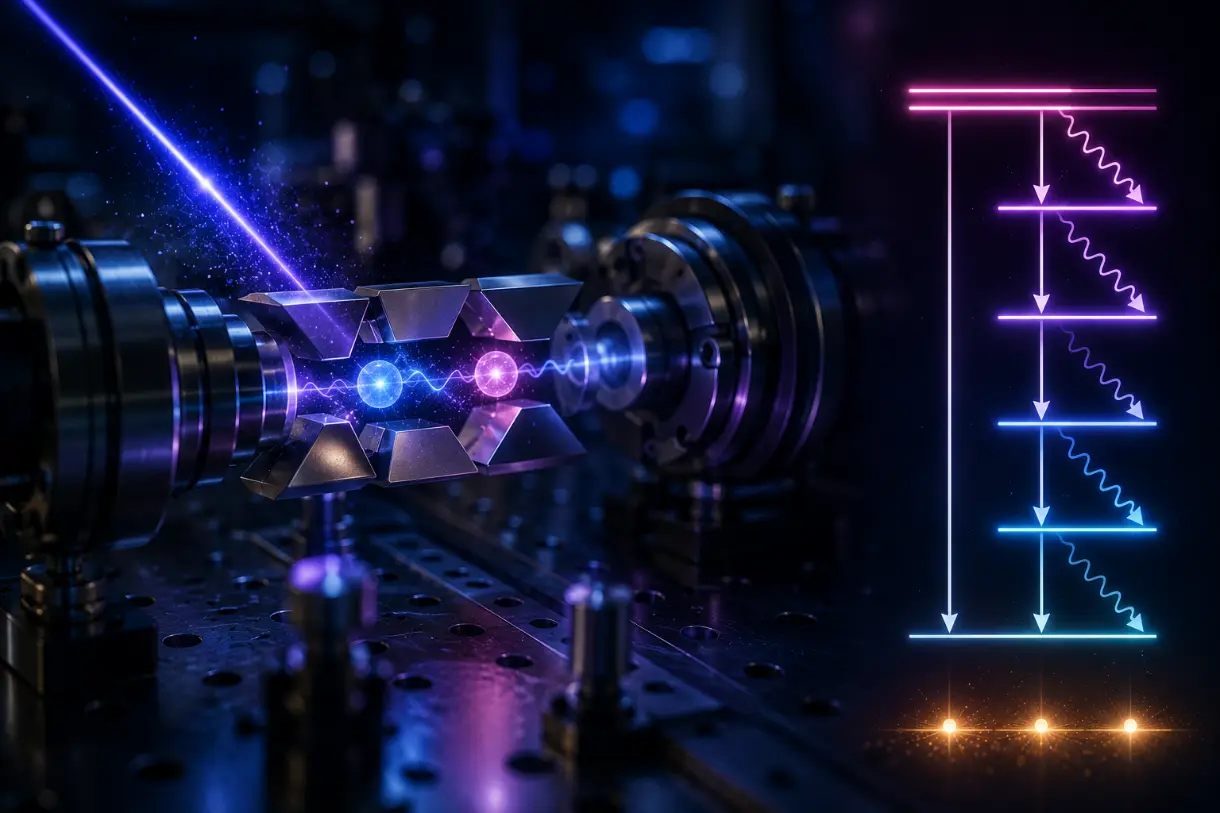
The states they measured are called metastable, a sciency way of saying “nearly stable, but not quite.” An ytterbium ion, a charged ytterbium atom, is one of the workhorses of both trapped-ion quantum computers and atomic clocks. The team pumped a single one up to a high energy level with a laser, then watched where it fell. Some of the lower states it dropped into turned out to be metastable themselves, holding on for a shockingly long time before sliding back to the ground state.
How researchers measured the long-lived ytterbium states
Here’s the clever bit. A state that lasts tens of seconds is hard to measure, because the usual tricks for keeping an ion cool and steady tend to disturb the very state you’re trying to watch. According to the July 24 report, the team used two ions instead of one. As PhD student Zeger Ackerman, the paper’s first author, explained:
“To make the measurements possible, we did not just trap one single ion, but in fact we trapped two ions together. One of these was for spectroscopy measurements, and the other to continuously cool and stabilize the system without disturbing the metastable state being studied.”
One ion does the work, the other quietly keeps the whole system calm. With that setup they clocked lifetimes of about a second and about ten seconds, plus evidence of a state lasting more than thirty. Detailed atomic calculations then backed up what they saw.
Why metastable states matter for quantum technology
Long-lived states are useful precisely because they hold still long enough to read. The team is most excited about the one-second state, since it’s reachable straight from the ground state with a single laser pulse. In practice, that could make reading out the state of ytterbium qubits, and their multi-level cousins called qudits, cleaner. Better readout helps trapped-ion quantum computers and atomic clocks alike, both of which live or die on knowing exactly which state an ion is in. The same stray disturbances this kind of control helps tame are the ones a single trapped ion can now map just above a chip.
There’s also a lovely footnote. Back in 1990, two theorists named Fawcett and Wilson predicted this long-lived state and asked someone to go confirm it. Thirty-five years later, someone did.
Keep the excitement in proportion. This is a measurement, and a nice one, as opposed to a new computer or clock. The applications are potential, and turning a well-behaved atomic state into better qubit readout is its own engineering project. An entire active field rests on designing qubits around specific long-lived states, as a separate team’s engineered defect qubit shows, and trapped-ion machines are already in plans for use in tasks like portfolio optimization.
And that 35-year-old prediction? Fawcett and Wilson guessed 5.2 seconds. The team measured around one. The right neighborhood, off by a factor of five, which given how tangled ytterbium’s energy levels are counts as a solid hit for 1990-era theory. The thirty-second state, worth noting, is still “evidence for” and not firmly pinned down.