
SEALSQ Takes Miraex’s Quantum Interconnect Tech Commercial

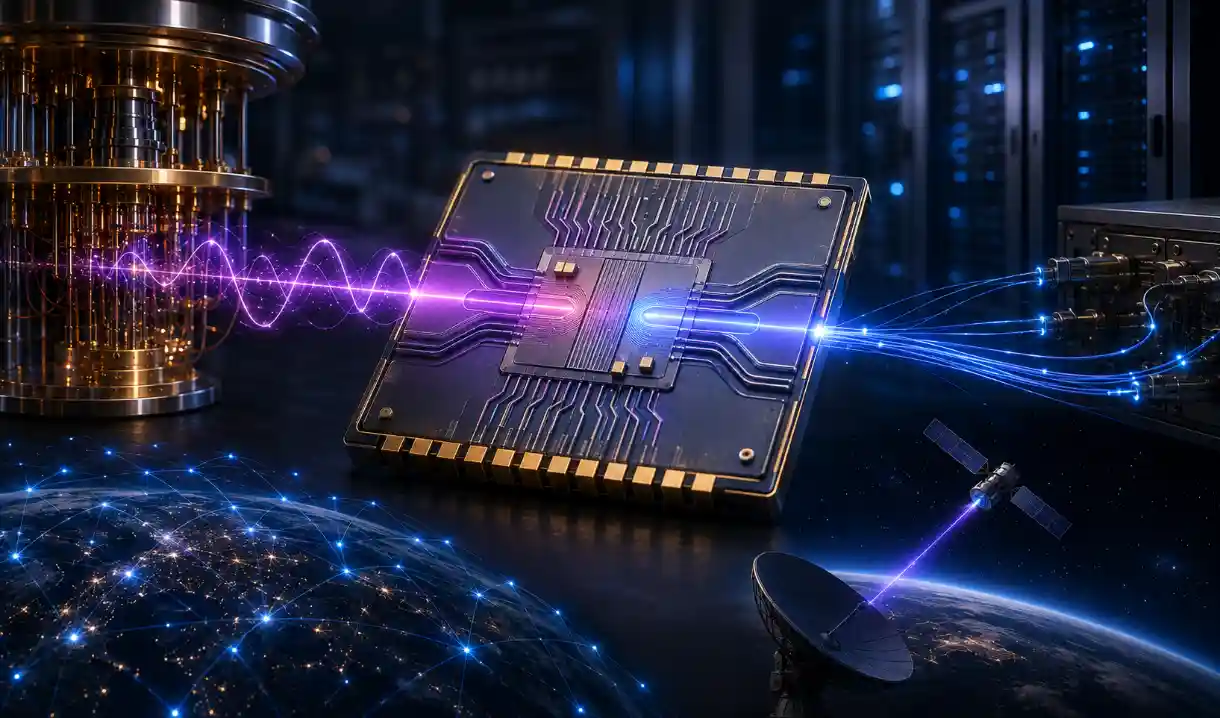
SEALSQ says it’s begun commercial activities for the quantum photonics technology of Miraex, the Swiss startup it acquired outright in June. The draw is a chip that translates quantum signals between the microwave frequencies superconducting processors use and the optical frequencies that travel down fiber. That said, the announcement hasn’t listed any customer, revenue, shipped product, or delivery date.
The technology under the announcement
According to the July 31 press release, Miraex, an EPFL spinout that SEALSQ bought on June 2 through its $200 million Quantum Fund, builds a thin-film lithium tantalate photonic integrated circuit. Its job is conversion. Specifically, superconducting quantum computers speak in microwaves, long-distance quantum links speak in light, and something has to translate cleanly between the two without wrecking the fragile quantum information. That translation, microwave-to-optical transduction, is one of the harder open problems in quantum engineering, and it’s central to connecting superconducting machines to optical networks and to each other. SEALSQ CEO Carlos Moreira framed the deal as filling that gap. As Moreira said:
“Miraex closes the quantum interconnect layer of our Quantum Sovereign Vertical Stack, the one piece the industry cannot scale without, and we now own it outright, acquired and funded through our $200 million Quantum Fund.”
Indeed, the underlying work is legitimate. Miraex is a real EPFL spinout, and thin-film lithium tantalate is a genuine line of photonics research, a cousin of the thin-film lithium niobate that has reshaped optical chips.
Read the commercial claim
That said, “commercial phase” and “commercial deployment” are carrying a lot of weight for an announcement with nothing shipped behind them. Moreira’s list of targets, governments, defense, cloud providers, telecom operators, and critical-infrastructure operators, is a set of sales ambitions, and the four markets SEALSQ names, distributed quantum computing, networking, sensing, and space communications, are where it hopes to sell and not where the technology runs today. Transduction still has no commercial-scale solution anywhere, so calling this the piece the industry “cannot scale without” describes a problem SEALSQ is stepping into. It hasn’t solved it yet.
Furthermore, the marketing is the company’s own. “World’s first Quantum Sovereign Vertical Stack” and “an end-to-end offering no competitor can match” are SEALSQ’s phrases, and the $200 million fund and $65 million deployed are its figures. However, what’s solid is certainly worth noting. A Nasdaq company has bought a real transduction startup and put its technology up for sale. Moreover, it sits alongside SEALSQ’s other quantum moves, like its $5 million deal with Quobly, and a wider effort to solve quantum interconnects, extend QKD networks, pull the quantum stack into one integrated system, and advance the thin-film photonic materials this kind of chip relies on.