
IBM’s Trillion-Dollar Quantum Forecast Comes With Fine Print

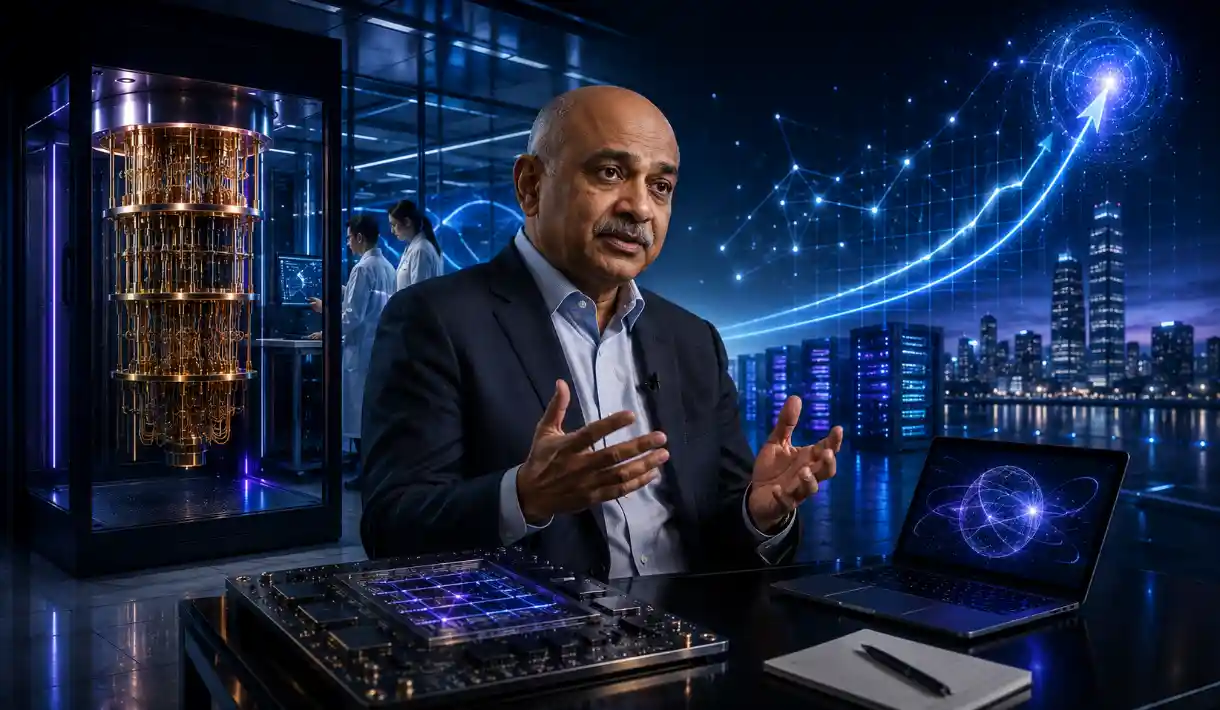
Arvind Krishna went on CNBC this week and gave quantum computing a price tag. IBM’s CEO said the technology will make a measurable dent in the company’s revenue and profit by 2028 or 2029, and be worth a trillion dollars by the end of the 2030s. It’s a striking number. But it’s also a decade-out forecast from the person with the most reason to sound confident, delivered days after IBM posted its largest single-day stock drop on record. Both things can be true at once, and reading this objectively means holding them together.
Why IBM believes quantum is nearing commercial impact
Here’s what Krishna said in CNBC’s “Mad Money” on July 30, which is worth quoting in full because the hedge and the confidence sit right next to each other:
“I think that in 2028 or 2029, you’ll see it have a measurable impact on our top line and bottom line. By the end of the 2030s, we are now pretty convinced this is a trillion dollars of value.”
Take the near-term half seriously and the far half with a grain salt. A measurable revenue contribution by 2028 is a checkable claim IBM can be held to. A trillion dollars of value by the end of the 2030s is a projection ten-plus years out, unfalsifiable today, made by a CEO whose stock could use the story. IBM has earned some credit here, since it’s one of the few companies with paying quantum customers and a long hardware roadmap. Credit isn’t proof of a trillion dollars.
The result behind the number
Meanwhile, Krishna’s timing wasn’t random. That same week, IBM and the startup Algorithmiq said they’d demonstrated quantum advantage.
Running 56-qubit circuits on IBM’s Heron processor, they simulated a property of a disordered quantum material called an operator Loschmidt echo, pushing it into a regime where three independent classical teams produced conflicting answers. They checked the quantum result with error mitigation that carries a quantified uncertainty, and reproduced parts of the circuit on Quantinuum’s trapped-ion hardware as an outside cross-check. Algorithmiq is open-sourcing its best classical method so others can try to beat the claim. That verification effort is more rigorous than most quantum-advantage announcements, and the open benchmark cuts against pure salesmanship.
As for the limits, this covers error-mitigated computing on 56 qubits, a far cry from a fault-tolerant machine. The task is one narrow physics problem, and the belief that classical can’t do this rests on classical methods disagreeing, which hints at advantage without proving no classical method will catch up. Quantum advantage claims have a long habit of narrowing later. The definition of a quantum win keeps getting redrawn, and the argument over what advantage even means is still live.
Why IBM’s trillion-dollar prediction deserves scrutiny
The forecast arrived in a specific context. IBM’s recent earnings triggered its worst single-day share decline on record after several enterprise deals slipped and investors worried that AI could pressure parts of its software business. A CNBC hit putting bullish long-range numbers on quantum is partly reassuring.
Krishna addressed the deferred deals directly, saying about 40% had already closed within three to four weeks and calling the pattern “a deferral, not a destruction.” It’s a claim about IBM’s overall enterprise and software business. Quantum revenue is a separate question, and the two shouldn’t blur together just because they shared a segment on Mad Money.
What IBM is building
That said, none of the skepticism means IBM is bluffing. In May it committed to a standalone quantum chip foundry, backed by a $1 billion CHIPS award and a matching billion of its own, aimed at domestic manufacturing of quantum processors. It keeps pushing on the unglamorous core problem, error correction, the same wall every serious hardware effort is trying to climb, and it has bought its way toward better packaging with moves like the HRL Labs acquisition. The company is also chasing the exact thing its CEO is now pricing, a way to show quantum delivers measurable business value instead of lab demos.
So weigh it in two parts. IBM has a real quantum program, a carefully-verified advantage result, a foundry with government money behind it, and customers paying today. It also has a CEO putting a trillion-dollar number on a decade from now in the same week he needed investors to feel better. The first part is why the forecast isn’t empty, the second is why you don’t bank on the figure.