
An AI Learned to Write Quantum Circuits, Then Outdid Its Teacher

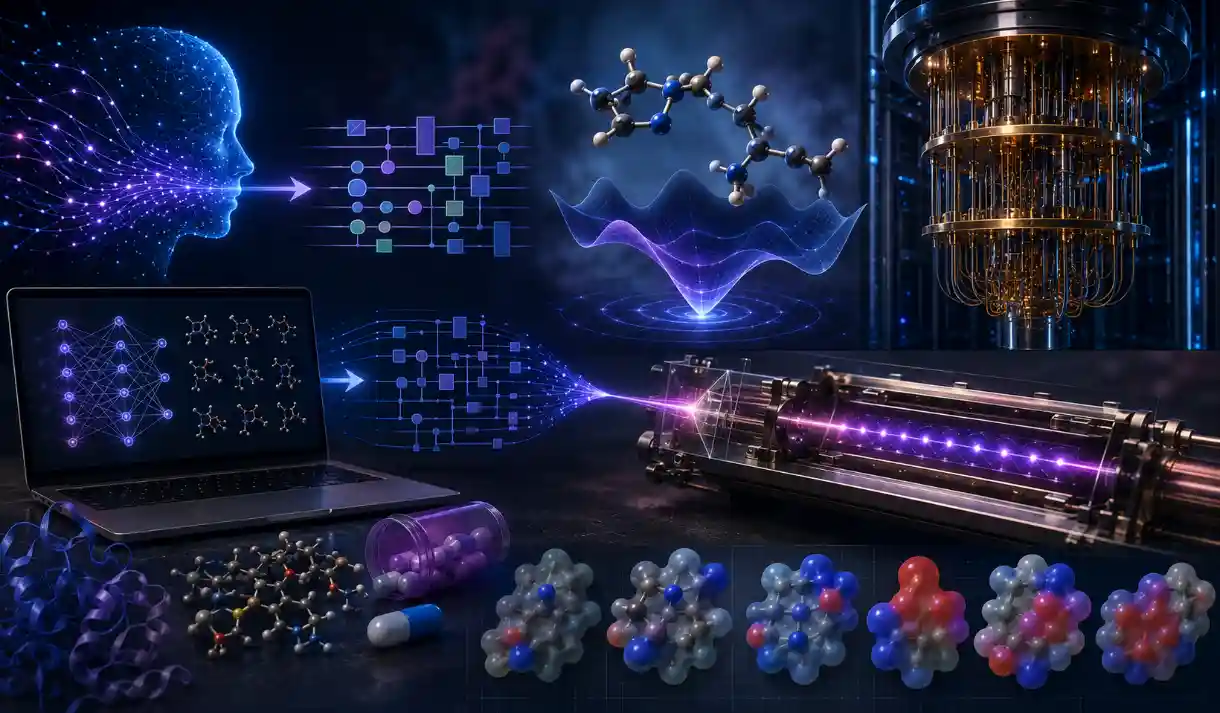
Before a quantum computer can tell you anything useful about a molecule, it has to be coaxed into a state that mimics the molecule’s lowest-energy configuration. Getting there is slow, finicky work. The standard tool, an algorithm called ADAPT-VQE, builds the right circuit by trial and adjustment, over and over, and the cost balloons as molecules get bigger. A team from Quantinuum, NVIDIA, and Pfizer had a different idea, posted as an arXiv preprint: let an AI write the circuit instead.
How AI learned to write quantum circuits
The point is to treat a quantum circuit the way a chatbot treats a sentence. A transformer, the model architecture behind generative AI, predicts the next word by learning patterns from mountains of text. This team pointed the same machinery at quantum operations, training transformers to output the sequence of gates that prepares a molecule’s ground state.
They fed the models thousands of good circuits that ADAPT-VQE had already produced, and the AI learned the patterns. Once trained, it writes a full circuit in a single shot, where ADAPT-VQE grinds through many rounds of optimization. The reported speedup on generation time is three to four orders of magnitude, with accuracy that matches or beats the slower method on their benchmarks. They call the framework ADAPT-GQE.
That said, the AI didn’t just copy its teacher. As the authors write:
“Once trained, the model can efficiently propose and score circuits, enabling reinforcement learning (RL) to drive circuit generation accuracy beyond the accuracy of the ADAPT-VQE training data.”
The coolest result came next. After the smaller of their two models learned from ADAPT-VQE’s examples, a round of reinforcement learning, rewarding circuits that reached lower energies, pushed it past the quality of the data it trained on. It found better answers than the algorithm that taught it. Reinforcement learning also loosened the usual penalty where longer, harder circuits came out sloppier, so the model held its accuracy on the tough cases.
A real molecule on a real machine
The team tested this on imipramine, a tricyclic antidepressant that stands in for a genuinely hard pharmaceutical target because it folds into many shapes and has several reactive spots. Predicting the electronic behavior of those shapes matters for questions like how a drug degrades. To build training data, the researchers generated thousands of molecular geometries, then had ADAPT-VQE produce optimized circuits for each across small active spaces topping out at 16 qubits.
Then they did something most work in this corner skips: they ran representative AI-generated circuits on Quantinuum’s Helios-1 trapped-ion processor. The circuits executed on real hardware, which the paper frames as a milestone for pairing AI circuit synthesis with a commercial quantum machine on a chemically relevant molecule. Plenty of prior work stopped at simulation or toy benchmarks.
What the results prove, and what they don’t
Now, this is a preprint that hasn’t cleared peer review yet, and the source says so plainly. The speedup is specific too. It’s about generating the circuit faster, one inference instead of endless optimization, and it says nothing about the quantum computation itself running faster or about beating a classical chemistry calculation.
The scope is narrow. The models worked on small active spaces, the tests centered on one molecule, and each model was trained separately for a given qubit count, so it can’t yet generalize across different sizes. Extending it will need more general ways to represent molecular Hamiltonians and quantum operators. Quantum chemistry at a scale that changes drug discovery is still a long-horizon, fault-tolerant problem, and this work sits at the front end of it, the plumbing that prepares a state, and not a molecule anyone has cracked. No drug was discovered here, but a slow step just got a lot faster.
That’s a strong contribution, and it fits a run of work bending machine learning toward quantum problems, from teaching quantum models without them forgetting to utility-scale quantum machine learning tested on real hardware and NVIDIA’s AI decoder for error correction. Running it on Quantinuum’s trapped-ion hardware puts it alongside other real-machine tests like a trapped-ion portfolio-optimization run, whereas the preprint limitation is the same one that hangs over promising designs that only exist in simulation until someone builds them.