
Pittsburgh Supercomputing Center to Build Hybrid Quantum Testbed

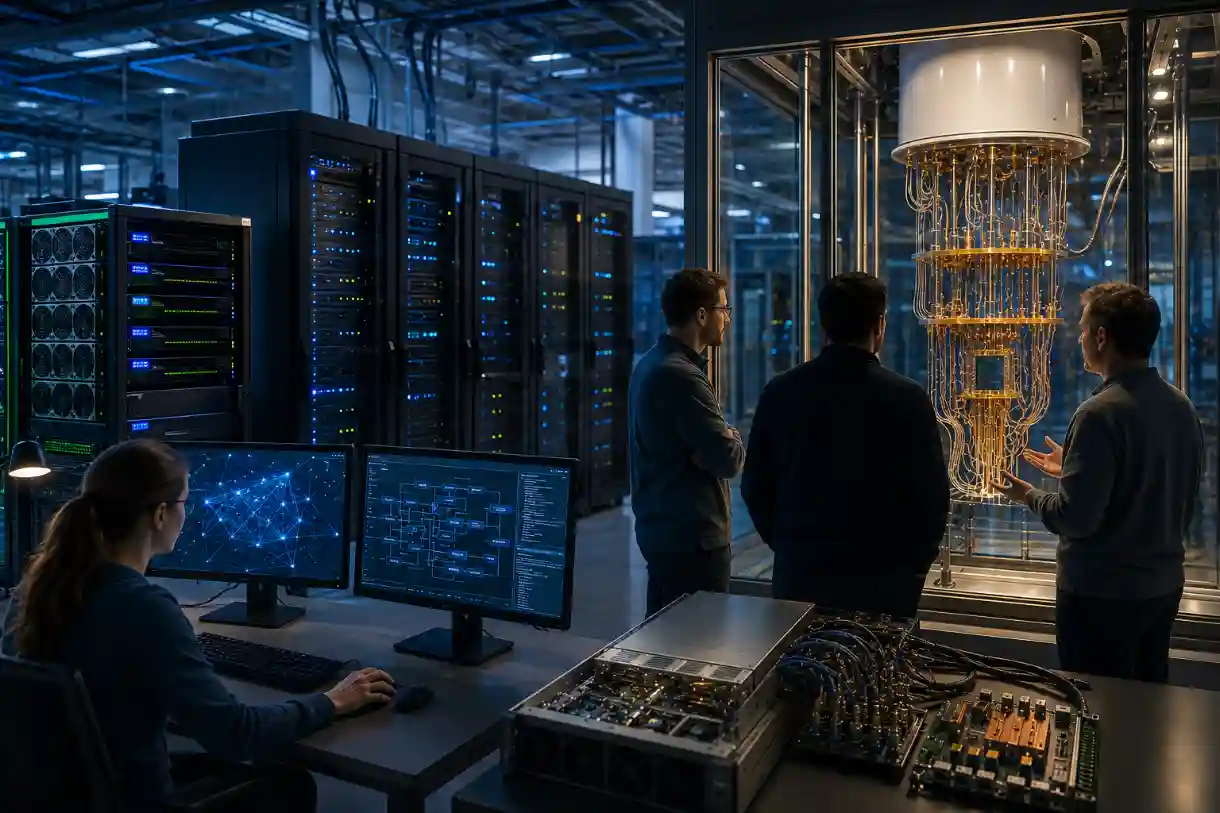
The Pittsburgh Supercomputing Center has won a $5 million NSF grant to build TangleLab, a hybrid quantum-classical testbed that pairs a Rigetti quantum processor with HPE supercomputing hardware. Construction starts September 1 at PSC’s new data center, and full operations are expected in 2027. Its leaders are unusually blunt about what the system is for, and about how modest it is.
What TangleLab is designed to do
According to the PSC report on July 27, the award, NSF grant #2537076 under the Advanced Computing Systems and Services program, funds a three-way build by PSC, HPE, and Rigetti Computing. The hardware plan connects a Rigetti Novera QPU, a small nine-qubit superconducting processor, to HPE ProLiant compute nodes, Cray storage, and networking, alongside GPUs for AI and simulation work. The point isn’t raw quantum horsepower. It’s to give researchers a place to benchmark how quantum and classical parts actually work together, from compilation and pre-processing to workload management, and to train students and educators with real access to an integrated machine.
That integration problem is where the field’s attention has shifted, as Masoud Mohseni, who directs HPE’s quantum work, made clear in describing the goal. PSC also brings a long record of heterogeneous supercomputing, the practice of routing different parts of a problem to whichever processor suits them, which it dates to 1991. Access will run through a competitive proposal process, with dedicated time for researchers and real-time slots for teaching.
Why this is a testbed rather than a quantum breakthrough
The most useful line in the release is a disclaimer. Bruno Abreu, PSC’s deputy scientific director and a co-PI, drew the boundary himself. As Abreu said:
“We are not deploying a standalone quantum computer. Our goal is to make TangleLab the prototype open platform for a future where quantum information processing and distribution are core elements of advanced cyberinfrastructure.”
Hold the rest to that standard. A nine-qubit Novera is a development-scale QPU, not a machine anyone expects to outrun classical hardware, so this is infrastructure for learning how the pieces fit rather than a bid at quantum advantage. The workforce and “quantum utility” benefits are goals for 2027 and later, not results. And the release’s own primer, the bit about superposition letting these devices “calculate between the lines” and prove superior at chemistry, cryptography, and optimization, is a statement of expectations, not settled fact.
What’s solid is the money, the partners, and the dates. A federally funded center is committing to a real hybrid testbed, which fits a wider push to wire quantum processors into supercomputers, seen in Finland bolting an IQM machine onto the LUMI supercomputer and in Quantinuum’s HPC turbine-design work with Rolls-Royce and Edinburgh. It also speaks to the missing connective tissue the industry keeps flagging, and to the shift toward judging these systems by practical business value rather than qubit counts, a national priority the government now backs with hard deadlines.